

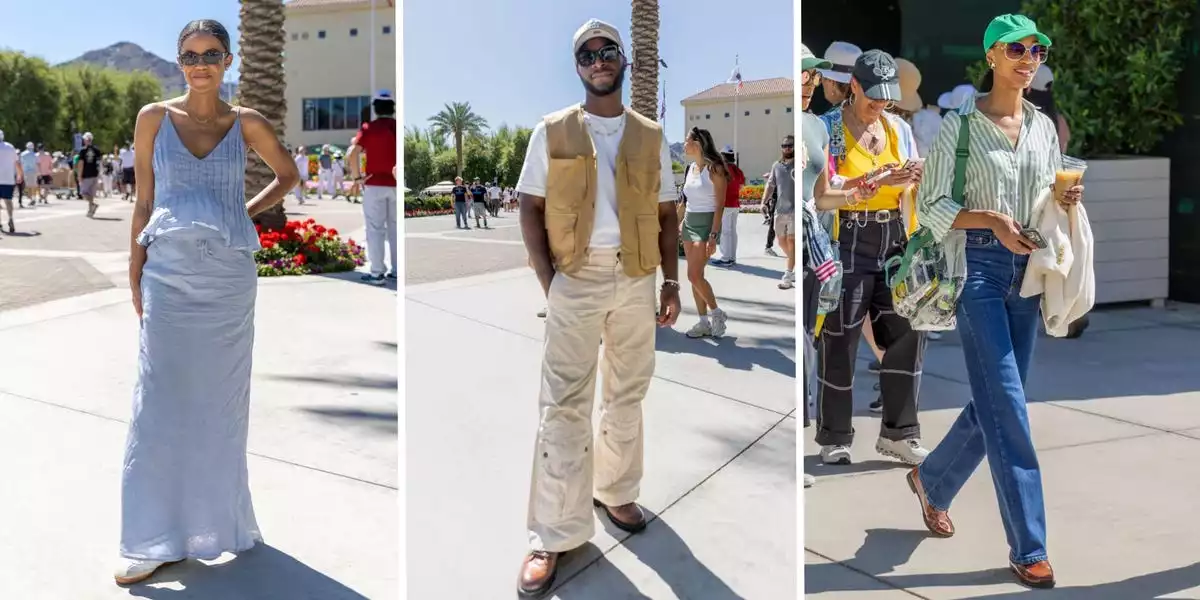

Indian Wells as a live laboratory for “quiet luxury” athleisure—and a new kind of status signaling
The BNP Paribas Open at Indian Wells has long been positioned as a premier tennis tournament, but its gravitational pull now extends well beyond sport. The grounds have become a high-signal environment for quiet-luxury fashion and performance-led athleisure, where attendees curate looks that read as effortless yet highly intentional. The aesthetic is less about overt branding and more about discreet markers of taste—a visual language built on fit, fabric, and provenance.
What stands out is the strategic blend of high-end accessories with understated silhouettes: designer sunglasses, Rolex timepieces, diamond jewelry, and recognizable-but-subtle motifs paired with clean tennis whites, technical knits, and tailored outerwear. This is not merely “dressing up for the event”; it is a form of social positioning that aligns with post-pandemic consumer psychology—where comfort is non-negotiable, and status is communicated through restraint.
For brands, Indian Wells functions as a concentrated marketplace of affluent, mobile consumers who are primed to spend on experiences and the products that authenticate those experiences. For observers of business and technology, it is also a real-time case study in how luxury, sport, and digital media now co-produce demand.
Social-first amplification and AI trend intelligence reshape fashion marketing in real time
Indian Wells illustrates how modern fashion narratives are increasingly written by the crowd—then refined by algorithms. Attendees and influencers livestream, post, and tag outfits in real time, creating an always-on stream of user-generated content that extends the tournament’s reach far beyond the venue. The result is a feedback loop: the event becomes content, content becomes commerce, and commerce becomes the next wave of content.
Several technology dynamics are converging here:
- Social-first amplification at scale: Real-time posting turns the tournament into a distributed runway. Brands benefit from ambient visibility even when they are not official sponsors, as long as their products appear in high-engagement feeds.
- Predictive trend modeling using AI: Luxury houses and sportswear labels increasingly mine social and creator data for early signals—silhouette shifts, color preferences, accessory pairings—then translate those signals into rapid capsule releases or targeted merchandising.
- Wearable tech and smart textile spillover: The prominence of lightweight, functional fabrics points to an R&D pipeline where performance innovations—UV-protective fibers, moisture-wicking coatings, breathable composites—move from athletic wear into premium categories. The “quiet” in quiet luxury increasingly refers not only to logos, but to invisible engineering embedded in garments.
This is a meaningful shift in how fashion value is constructed. Traditional luxury relied on heritage storytelling and controlled distribution; today’s hybrid luxury-athleisure moment is equally shaped by data velocity, content formats, and the ability to respond quickly without diluting brand equity.
Macro pressures meet experiential spending: why subtle luxury is winning now
The style codes on display at Indian Wells reflect broader economic and cultural recalibration. After years of volatility—pandemic disruption, inflationary pressure, and heightened sensitivity to conspicuous consumption—many luxury buyers are leaning into value-over-logo. The preference is for pieces that signal quality through materials, craftsmanship, and recognizable design language rather than loud branding.
Two spending patterns are particularly relevant:
- Experience-driven allocation: Consumers are prioritizing live events and premium outings, shifting budget share from goods-only consumption to experience-plus-product consumption. Indian Wells exemplifies how sporting venues can command higher ticket premiums by doubling as lifestyle destinations.
- Versatility as a purchasing filter: Buyers want items that work across contexts—court-side seating, travel, casual business settings—making performance-luxury hybrids especially attractive. Comfort is no longer casual; it is a baseline expectation even at high-end events.
On the supply side, the eclectic mix of brands—from fast fashion to streetwear to heritage luxury—highlights how companies are adapting operations to capture microtrends without sacrificing margins:
- Agile sourcing and just-in-time production help brands respond to fast-moving aesthetic cues while managing inventory risk.
- Regional diversification reduces exposure to currency swings and localized cost inflation, enabling a broader range of price points to coexist in the same venue ecosystem.
The economic subtext is clear: in an era of tighter scrutiny and higher uncertainty, consumers still seek aspiration—but they increasingly demand that aspiration be functional, durable, and socially legible without being ostentatious.
The next frontier: performance luxury, omnichannel activations, and sustainability as proof of credibility
Indian Wells is fertile ground for event-driven collaborations and omnichannel experimentation, particularly where luxury and sportswear overlap. Limited-edition drops and co-branded capsules thrive in environments where scarcity, social visibility, and immediate purchase intent converge. The tournament setting also encourages brands to treat physical presence as a gateway to digital conversion—turning on-site engagement into measurable e-commerce outcomes.
Emerging strategic plays include:
- Co-branded capsules and limited releases designed for urgency and shareability, leveraging the tournament’s concentrated cultural attention.
- Data-driven influencer ecosystems where brands optimize on-site ambassador selection and dynamically reallocate ad spend based on live engagement metrics.
- Experiential retail layers such as pop-up boutiques, QR-linked product storytelling, and AR try-on that compress discovery-to-purchase cycles.
- Loyalty mechanics with digital collectibles—including NFTs or venue-specific badges—used less as speculation vehicles and more as programmable membership tools tied to perks and purchase incentives.
Forward-looking, the most durable winners are likely to be those that treat “quiet luxury” as more than an aesthetic. As longevity and craftsmanship become central to the narrative, sustainability and supply-chain transparency shift from optional messaging to competitive necessity. Traceable sourcing, certified recycled materials, and credible lifecycle claims will matter more to this demographic precisely because the branding is understated; the proof must live in the product and its documentation.
Indian Wells now operates as a high-resolution snapshot of where premium consumer markets are headed: luxury that performs, performance that feels luxurious, and experiences engineered as both entertainment and commerce—all accelerated by data, content, and the quiet power of restraint.

 By
By
 By
By
 By
By

 By
By

 By
By
 By
By







