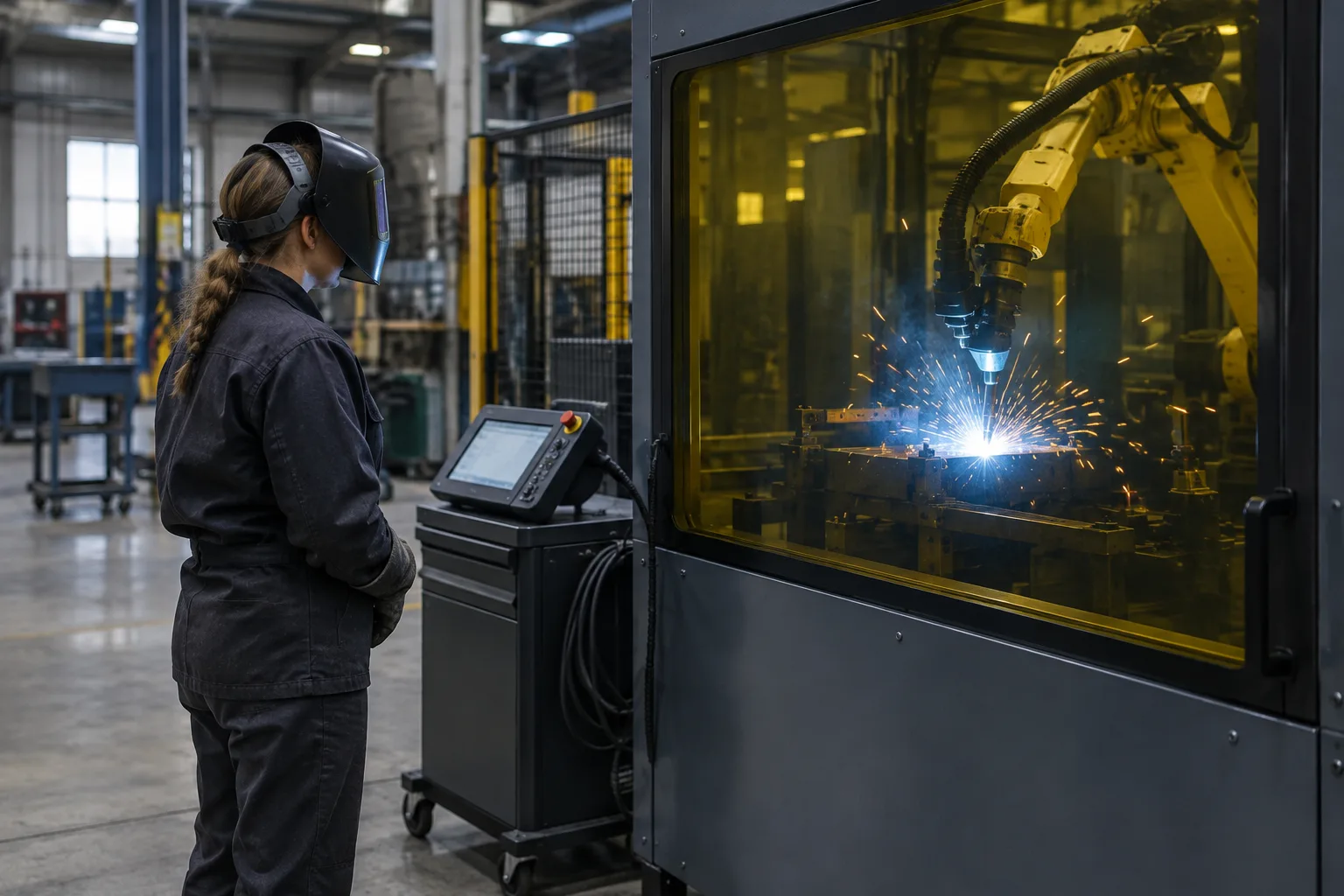

Path Robotics said on Nov. 10 that it raised a $300 million Series E led by Georgian at a $2.45 billion post-money valuation, one of the larger private financings this year for a manufacturing-focused AI company. The round matters less as another startup mark-up than as a test of whether physical AI is moving from eye-catching demos into contracted industrial production. Path says the money will help scale its platform beyond robotic welding into additional manufacturing tasks and robotic form factors, while increasing spending on model training, data, and compute.
The question readers should care about is simpler than the financing headline: can Path turn a promising welding wedge into repeatable, economically attractive factory automation, or is this valuation already pricing in new tasks that still have to survive long industrial qualification cycles?
What the $300 million is really buying
In its Series E announcement, Path said annual recurring revenue grew 17-fold over the prior 18 months and its workforce grew 97% year over year, with a plan to reach 400 employees by the end of 2026. Existing investors Addition, Drive Capital, IronArc Ventures, Tiger Global, and Yamaha Motor Ventures participated, joined by D. E. Shaw Ventures and NAVER Ventures.
According to Bloomberg reporting relayed by Investing.com, Path has now raised roughly $610 million in total, and its valuation has nearly quadrupled.
That capital is not just paying for software engineers. Path’s core product, Obsidian, uses machine learning and computer vision so robotic welding cells can identify joints, plan paths, and adapt to variable parts instead of simply replaying fixed motions. In manufacturing, that distinction matters. Welding is hard to automate because seams vary, workpieces are large, tolerances shift, and quality and safety requirements are unforgiving. A robot that can cope with imperfect, changing inputs has a much larger market than one that only succeeds in tightly controlled setups.
This is the company’s proposed flywheel: more cells in production generate more real-world data; that data improves perception and motion models; better models can handle more parts and industries; and new contracts finance more deployments and more training. Path also markets Rove, a mobile welding system that pairs Obsidian with a quadruped robot. Bloomberg reported, based on company information, that Obsidian can weld more than a dozen unique parts and that Path is working toward 50 Rove preorders for deployments beginning next year.
Those figures point to commercial ambition, but they do not yet answer the industrial question investors are paying for. Public information still does not show how many cells are in sustained production use, what uptime they deliver, how often humans intervene, or whether those preorders convert into paid, reliable deployments.
Why the HII program matters more than the valuation headline
The strongest independent signal in this story is not the $2.45 billion valuation. It is Huntington Ingalls Industries’ willingness to put Path into a milestone-based production framework. In an August announcement, HII said it signed performance-based production agreements with Path Robotics and GrayMatter Robotics through its High-Yield Production Robotics, or HYPR, program.
HII described the combined opportunity as up to $900 million of shipbuilding work over seven years. But that number needs to be read carefully. It is a combined maximum for Path and GrayMatter, not guaranteed revenue for Path alone, and it is contingent on technology, manufacturing-readiness, cost, schedule, and quality milestones. HII said the work begins in a development stage with smaller steel structures and could expand later to units and modules.
That conditional structure is precisely why the agreement matters. Defense-grade production is where industrial AI stops being a slide-deck story. A Navy supplier has to meet qualification, traceability, quality, and schedule requirements that are far more demanding than a warehouse pilot or a lab demo. If Path can perform there, it says more about commercial durability than a private valuation ever could.
There is also a real capacity problem behind the program. HII said it expected to outsource more than 2.5 million shipbuilding hours in 2026, 30% more than in 2025, as it expands distributed shipbuilding. For manufacturers and defense contractors facing skilled-labor shortages, the appeal of adaptive welding automation is straightforward: not eliminating people, but increasing throughput and shifting scarce workers toward supervision, integration, maintenance, and exception handling.
Path’s own materials separately refer to an earlier $600 million performance-based production agreement with HII. Public disclosures do not show how that Path-specific figure maps onto HII’s combined $900 million opportunity with GrayMatter, how the work is allocated, or how quickly dollars could be drawn down.
What has to go right from here
To grow into this financing, Path does not need to prove that one model can instantly automate every factory task. It does need to prove that welding is a repeatable beachhead: cells stay up, first-pass quality holds, throughput improves enough to matter, and each deployment adds reusable capability rather than becoming a bespoke integration project.
That is where physical AI remains expensive and qualification-heavy. A buyer still has to integrate sensors, robots, fixturing, power, safety systems, inspection, maintenance, worker training, and change control. In stable, high-volume processes, conventional fixed automation may remain cheaper and easier to justify. Path’s opportunity is in variable, labor-constrained manufacturing where part diversity makes rigid programming less attractive.
The current blind spots are the ones that usually separate a strong industrial narrative from an investable operating model: no public audited revenue, no disclosed gross margin or cash burn, no public count of live production cells, no average deployment time, no public uptime data, no scrap or rework rates, and no customer payback figures. The expansion beyond welding also has no public task-by-task rollout schedule.
That leaves a useful scorecard for the next year. Watch for production cells in sustained use, cycle time and quality versus skilled manual work and traditional automation, downtime and maintenance burden, qualification milestones in the HII program, and whether new deployments create reusable data without exposing sensitive customer designs.
For now, the financing shows that sophisticated investors and at least one major shipbuilder see enough potential to fund the experiment at scale. It does not settle whether Path becomes a durable control layer for shortage-constrained manufacturing or a well-financed specialist whose economics stay narrower than its valuation suggests. The next proof will come from factories, not fundraising.

 By
 By

 By

 By

 By

 By