
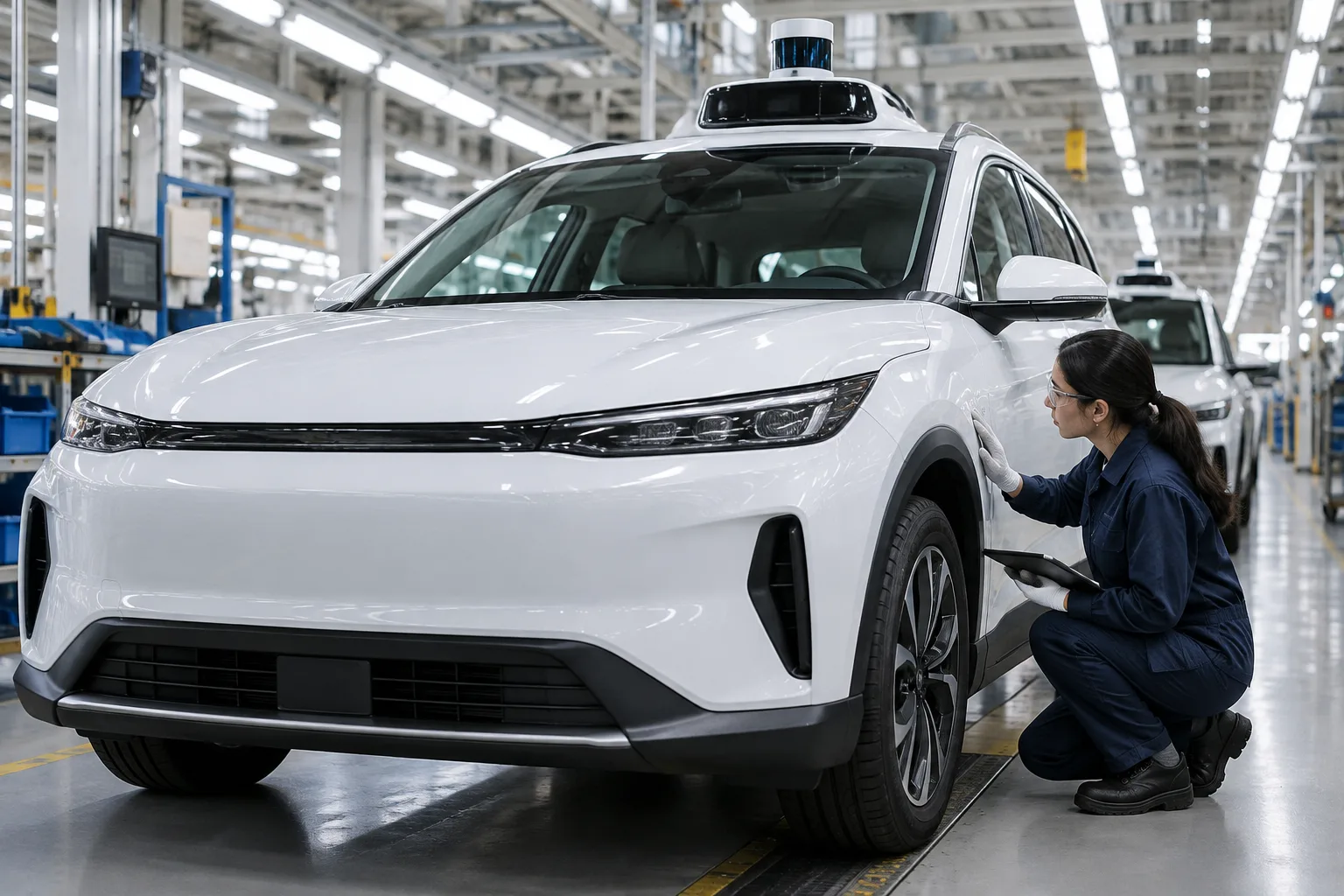

Toyota and Waymo have moved their autonomous-driving partnership from a broad strategic idea to a manufacturing program: the companies said Oct. 30 that Toyota will build a Toyota bZ4X fleet for Waymo at its Takaoka plant in Aichi Prefecture, integrate Waymo’s autonomous-driving hardware there, and begin initial test-and-validation operations in Japan in 2027. Later deployments are planned for the U.K. and other Waymo-serviced markets.
Why it matters is less about a new self-driving breakthrough than about industrial discipline. The real question for readers is whether an OEM-integrated bZ4X platform turns robotaxis into a repeatable product—or merely moves the hardest problems downstream to permits, local safety validation, remote operations, maintenance, insurance, and rider demand.
Right now, the evidence points to both. Toyota and Waymo have made a meaningful step toward repeatable vehicle supply. They have not shown that this is yet a repeatable transportation business.
The shift from retrofit to factory integration
According to Waymo’s announcement, the bZ4X will use Waymo’s fully autonomous technology and be designed as a Level 4 autonomous vehicle for defined operating conditions. That phrasing matters. Level 4 does not mean a car that can drive anywhere under any circumstance. It means a vehicle intended to operate autonomously within a specific operational design domain, with defined responses when conditions fall outside it.
The more important operational change is where the system gets built. Toyota will manufacture the base EV and integrate Waymo’s AV hardware at the same plant. For an industry that has often depended on retrofitting small batches of vehicles after they leave the factory, that could lower per-vehicle variability, tighten quality control, and give Waymo a more predictable pipeline of cars.
That is not a trivial improvement. Scaling a robotaxi fleet is partly a software challenge, but it is also a supply-chain and service challenge. A commercial network needs vehicles, replacement parts, calibration routines, charging, cleaning, maintenance, customer support, incident response, mapping updates, and some form of remote assistance. Moving hardware integration upstream into a high-volume manufacturing environment does not solve all of that, but it can remove one source of cost and complexity: bespoke vehicle preparation.
It also ties Waymo more closely to Toyota’s production cadence, model lifecycle, component availability, and regional service footprint. That is the trade. Standardization can reduce friction, but it also creates dependency.
Why Japan and the U.K. matter
Waymo co-CEO Dmitri Dolgov said the first target markets are right-hand-drive Japan and the U.K., a detail reported by Reuters. That gives the partnership a more concrete expansion logic than many autonomy announcements: it is not just “international growth,” but a stated path into right-hand-drive markets using a platform built for that context.
That matters because Waymo’s current operating experience is rooted in U.S. markets. Japan and the U.K. are attractive extensions, but they are not simple copies of Phoenix, San Francisco, or Los Angeles. Road geometry, curb rules, pickup behavior, weather, accessibility requirements, mapping workflows, data governance, insurance structures, and approval regimes all differ. A right-hand-drive vehicle platform is necessary for those markets; it is not sufficient.
The announcement is therefore best read as a bridge between autonomy software and a global automaker’s production system. It makes Waymo’s expansion story more credible than a plan that still depends on limited retrofit supply. It does not make international launch automatic.
Reuters reported that the initial Japanese operation will involve a small number of vehicles, with no disclosed fleet size or confirmed operating locations. That restraint is important. This is a test-and-validation phase, not a mass rollout. If anything, it underscores how much local work remains even after the vehicle platform is chosen.
What this solves—and what it does not
The immediate gain is manufacturing repeatability. If Toyota can produce bZ4X vehicles with Waymo hardware integrated at the plant, each added vehicle should, in principle, be less custom than a hand-fitted fleet car. That can help with cost, lead time, and consistency.
But the unresolved list is longer than the solved list.
The companies have not disclosed the initial vehicle count, the Japanese cities or service zones, production cadence, ownership structure, per-vehicle cost, charging setup, maintenance model, fare structure, utilization goals, or break-even point. They also have not laid out the approval timetable, the exact role of human or remote assistance, or what ride volume would count as a successful validation.
Those omissions are not unusual at this stage, but they define the business risk. A robotaxi service fails or succeeds on boring details as much as on perception software: how often cars are available, how quickly they recover from edge cases, how expensive they are to repair, how much downtime they incur, whether insurers are comfortable, and whether enough riders use them often enough to justify the capital tied up in the fleet.
This is also why the partnership should not be mistaken for proof of profitability. Toyota’s scale can reduce integration complexity. It cannot eliminate country-specific permits or create demand on its own.
The timeline reinforces that caution. Waymo and Toyota had already announced a preliminary agreement in April 2025. Eighteen months later, the public milestone is still test and validation beginning in 2027. That does not diminish the significance of this step, but it does show the pace of industrializing autonomy: slower, more operational, and more regulated than the technology narrative often suggests.
The broader business stakes
If this model works, the implications extend beyond Waymo’s next vehicle. It could show that autonomous-driving companies do not have to behave like specialty upfitters forever; they can plug into mainstream automaking earlier in the process. That would matter to suppliers, fleet owners, insurers, and other automakers deciding whether autonomy belongs in premium niche programs or standard vehicle manufacturing.
It also opens a second, more tentative track. Toyota and Waymo said they will explore applying Waymo’s technology to personally owned Toyota vehicles and using operational data and technology to improve safety for other road users. For now, that remains exploratory. It should be kept separate from the factory-integrated bZ4X fleet, which is the concrete program announced here.
Waymo has promoted its own safety record and said its technology has been up to 20 times safer than human drivers for serious crash injuries in areas where it operates. That may support the strategic case for expansion, but it does not answer the market-specific question facing this program. No independent safety evaluation of this bZ4X configuration in Japan or the U.K. was provided with the announcement.
So the most useful way to judge the partnership is by a practical checklist rather than the headline alone: first bZ4X production and hardware integration at Takaoka, Japanese testing in 2027, permit decisions, disclosed service zones, safety and intervention data, uptime, maintenance performance, ride volume, and then U.K. expansion.
That is why this announcement matters. It connects Waymo’s driverless system to a high-volume automaker and a real right-hand-drive expansion path. But it also makes clear where the next bottlenecks sit: not in the press release, and not only in the car, but in the operating system around the car.

 By

 By

 By


 By

 By