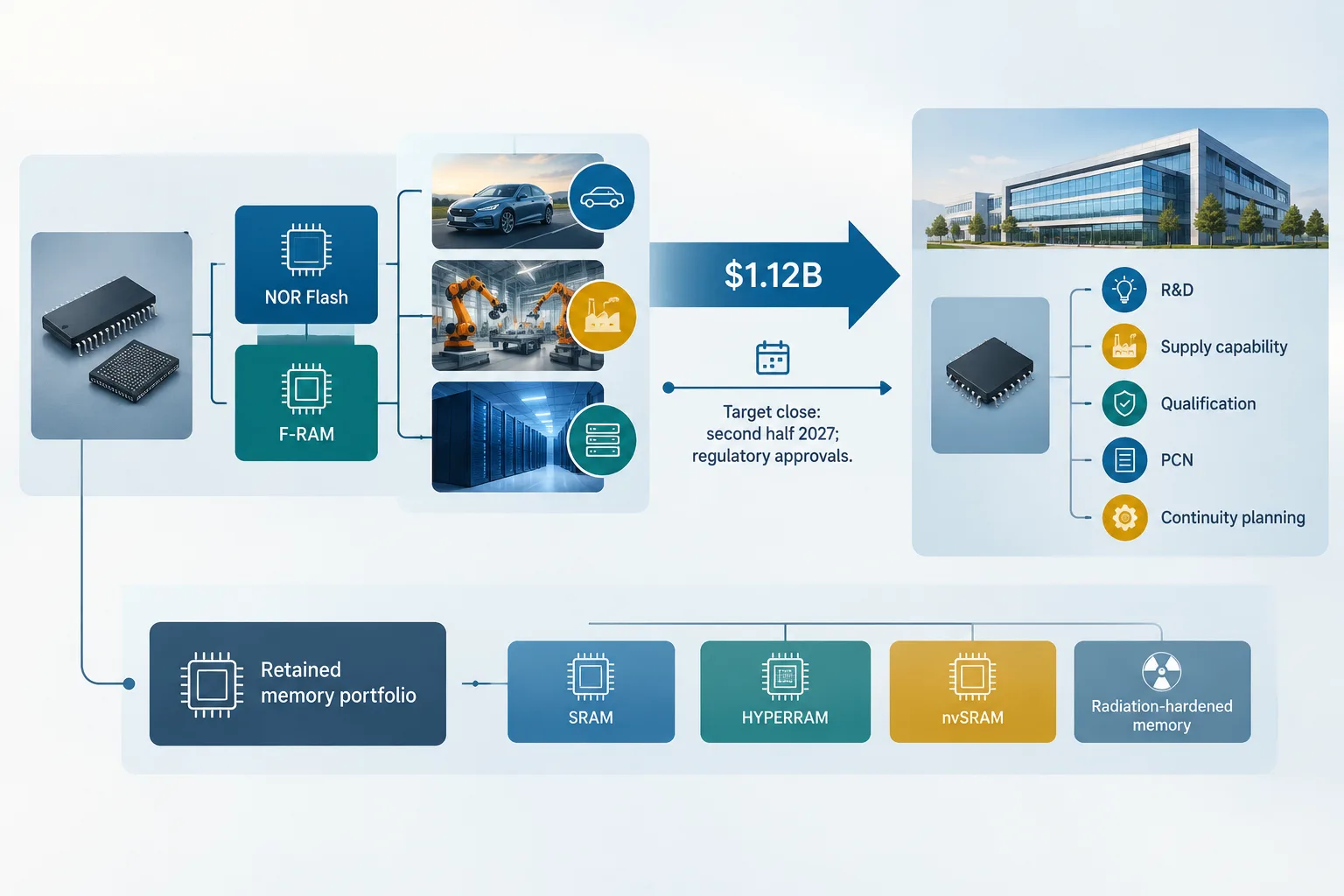

Infineon has agreed to sell its NOR Flash and F-RAM business to Winbond Electronics in an all-cash transaction valued at $1.12 billion, a same-day portfolio move that changes the future ownership of embedded memory used in cars, factory systems, and infrastructure equipment. The companies are targeting a close in the second half of 2027, subject to regulatory approvals and other conditions. That timing matters because for buyers of long-lived electronic systems, the practical question is not whether chip M&A is unusual. It is whether a supplier change will complicate product qualifications, firmware support, contracts, and supply continuity before and after the handoff.
According to Infineon’s announcement, the sale covers NOR Flash and F-RAM products. Winbond says it will acquire 100% of the equity interest in the business, run it as a standalone company headquartered in San Jose, California, and rename it Spansion after closing. None of that means the acquisition is complete now, and it does not by itself signal immediate changes to current product roadmaps or customer contracts. But it does start a transition clock for customers that depend on those memories in qualified, high-uptime systems.
What is changing — and what is not
Infineon is not exiting memory. It says it will retain specialty-memory products including SRAM, HYPERRAM, nvSRAM, and SONOS-based radiation-hardened memory for automotive, industrial, infrastructure, aerospace, and defense applications. That split is the first fact buyers should map into their own bills of materials: some Infineon memory lines are staying put, while the broader NOR Flash and F-RAM portfolio is the part slated to move.
For Infineon, the transaction looks like a sharpening exercise rather than a retreat. The company reported about 57,000 employees worldwide at the end of September 2025 and about €14.7 billion in fiscal-2025 revenue. Its public rationale is straightforward: sell a sizable but non-core memory business and focus capital allocation on growth areas it considers more central.
For Winbond, the logic is expansion. The Taiwan-listed memory supplier says the deal adds a complementary portfolio, expands global R&D resources and supply capabilities, and brings in talent from more than 10 countries. Winbond also says the acquired business will operate on a standalone basis from San Jose. That operating model could help reduce disruption if it preserves engineering teams, customer-facing processes, and product stewardship. It could also leave customers with a year-long checklist while they figure out exactly which legal entities, factories, backend partners, and support channels will sit behind each part number after closing.
Why embedded-memory buyers should care more than casual M&A watchers
NOR Flash and F-RAM are not glamorous components, but they sit in places where ownership changes carry real operational consequences. NOR Flash is commonly used to store code and firmware in embedded systems. F-RAM serves more specialized uses where fast writes, high endurance, and low power matter. In automotive electronics, industrial controls, and infrastructure equipment, those traits are tied to validated designs that can stay in service for years.
That is why this story matters less as a valuation headline than as a supply-chain and qualification issue. In long-life embedded markets, customers do not just buy a memory density and package. They qualify a specific supplier relationship: product documentation, change-notice procedures, quality systems, test history, manufacturing flow, and escalation path. A part can remain electrically compatible and still create work if the supplier of record changes, if a fab or assembly site changes later, or if support for firmware and endurance questions moves to a new organization.
The companies’ statements do not answer many of the questions buyers usually care about most. They do not disclose the business’s standalone revenue, profitability, backlog, customer concentration, manufacturing footprint, employee count, or product-by-product ownership. They do not say which fabs, foundries, assembly and test partners, distributors, contracts, trademarks, or certifications will transfer, or how customers will be notified if the supplier of record changes. They also do not establish that the deal will add capacity, shorten lead times, lower prices, or reduce geographic concentration. Buyers should not assume any of those benefits from the purchase price alone.
The diligence checklist to start now
The good news for customers is that the targeted close is still well out in the calendar, and the announcements do not suggest immediate disruption. The useful response is not panic requalification. It is structured diligence.
Start now on items that affect planning and documentation:
- Identify affected part numbers. Separate every NOR Flash and F-RAM device you buy from the Infineon memory lines the company is retaining. Ask for a product-by-product ownership map, not a portfolio-level summary.
- Ask for a named roadmap and support commitment. Buyers should request lifecycle expectations, continuity commitments through and after closing, and any last-time-buy policy if one eventually becomes relevant.
- Clarify the PCN process. Ask who will issue product change notifications before close, who is expected to issue them after close, and whether qualification timelines could be affected by any later site, packaging, or process changes.
- Confirm quality and qualification status. Automotive, industrial, and infrastructure programs do not all follow the same rules, so customers should ask for the specific quality certifications and qualification status that apply to their products and regions.
- Map manufacturing dependencies. Because the announcements do not disclose wafer fabs, foundries, assembly and test sites, or distributor arrangements, buyers should ask for that map directly and track any future updates.
- Review firmware and endurance assumptions. For NOR Flash, verify software compatibility and support contacts. For F-RAM, confirm endurance and power-related requirements in the actual application.
- Check second-source and escalation options. Even if no immediate change is planned, buyers should know their alternative sourcing position and who will own escalations during the transition.
Some questions can only be finalized later, closer to regulatory approval and legal closing. Those include the final contracting entity, invoicing arrangements, exact post-close escalation paths, and any re-papering of supply agreements. But waiting for those details is different from waiting to ask for them.
The risk signals are fairly plain. Vague answers on which part numbers move, inconsistent explanations of fab or backend locations, silence on how PCNs will be handled, shortened support windows, or premature contract renegotiation without clear continuity language would all deserve attention. A cleaner signal would be the opposite: a product-specific roadmap, stable change-control procedures, confirmed quality ownership, and named contacts for supply, engineering, and field support on both sides of the planned close.
So is this ordinary portfolio cleanup? Strategically, yes: Infineon narrows its focus, and Winbond broadens its memory reach. Operationally, it is more consequential than that. For embedded-equipment buyers, the transaction is a reminder that memory continuity is not just about whether a chip still ships. It is about whether the organization behind that chip remains legible, qualified, and accountable for the life of the system.
 By
By
 By
By
 By
By

 By
By