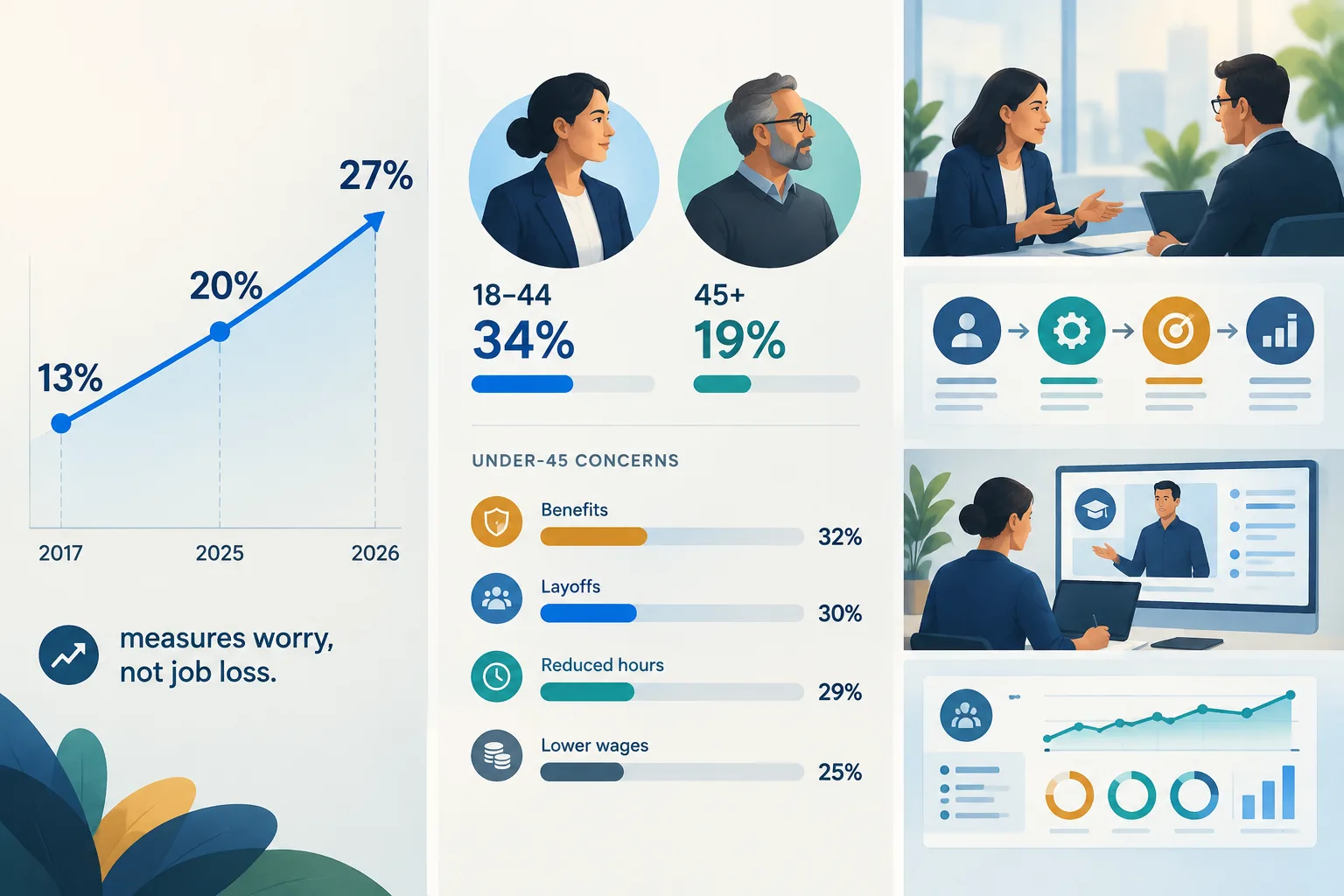

Gallup reported on Sept. 15 that 27% of U.S. workers worry technology could make their job obsolete, a new high that turns a familiar AI-era fear into a measurable operating problem. The share is up from 20% in 2025 and about double the 13% Gallup recorded when it first asked the question in 2017.
Why it matters now: companies are moving beyond AI pilots and into workflow redesign, agent deployment, and decisions about hiring, training, accountability, and output. When workers see software doing more of the tasks they once handled alone, the question is no longer abstract. Even if employers intend to use technology to raise productivity rather than cut jobs, employees may hear “efficiency” and infer “headcount.”
For younger workers, that anxiety is already competing with the usual recession-era worries. Among workers ages 18 to 44, 34% said they worry technology could make their jobs obsolete, compared with 19% of workers 45 and older. In that younger group, technology-related obsolescence was tied with benefit reductions as the most common concern, ahead of layoffs, reduced hours, and lower wages.
The reader’s real question is not whether this poll predicts a wave of immediate job losses. It does not. The more useful question is whether job anxiety around technology is becoming a business risk in its own right — one that can slow adoption, weaken trust, raise burnout, and push people to look elsewhere before any layoff ever arrives.
What changed in Gallup’s new reading
The new result comes from Gallup’s Aug. 3–24 Work and Education survey. The employed full- or part-time subgroup was 507 respondents, which gives the estimate a wider uncertainty band than the national adult sample. That matters most when readers start slicing small differences too finely. It does not change the broader signal: worry about technology has risen while Gallup says the more traditional job fears have stayed relatively stable and close to long-run norms.
Across all workers, benefit reductions ranked as the top traditional concern at 33%, followed by layoffs at 24%, with reduced hours and lower wages at 21% each. Technology anxiety is now in that same tier, and among younger workers it has moved to the front of the pack.
Gallup’s wording is also important. The survey asks workers whether they are worried that several events could happen to them personally in the near future. This is a measure of perceived risk, not proof of exposure to AI, not a management forecast, and not evidence of actual job loss. The question is about technology broadly, not generative AI alone.
Still, the pattern fits the current moment. The age gap has widened sharply since 2017 and 2018, when younger and older workers reported similar concern. Education no longer provides much separation either: 25% of college graduates now say they worry, versus 29% of workers without a degree. For graduates, that is a notable change from earlier in the decade. Gallup says their concern rose from 8% in 2021 to 20% in 2023 as generative AI tools emerged, then climbed again to 25% this year.
That combination matters for employers because it suggests anxiety is not confined to traditionally automatable work. It is spreading into knowledge work, where many AI budgets are now aimed.
Why frequent AI users may feel less secure, not more
A related Gallup workplace analysis, published Sept. 9, helps explain why daily use does not automatically reassure people. Using four waves of nationally representative Gallup Panel data from 2023 through early 2026, Gallup found that frequent AI users were more than twice as likely in most waves to say their jobs were very likely to be eliminated within five years compared with less frequent users. The reported gap peaked at 6.7 percentage points in 2024.
That does not mean AI use causes fear on its own. But the mechanism is intuitive. A worker who uses AI every day can see exactly which tasks have become faster, easier to standardize, or easier to hand off. Exposure makes the substitution question concrete.
Gallup’s management findings point in the other direction. Workers who said their organizations cared for their wellbeing, and those who gave the highest respect ratings, showed a smaller link between frequent AI use and displacement fear. Those are observational relationships, not proof of a managerial cure. Even so, they give leaders a better operating hypothesis than slogans about innovation.
The same analysis tied displacement fear to weaker workplace outcomes within individuals over time: lower engagement, higher burnout, lower job satisfaction, and a higher likelihood of actively searching for another job. That is why this issue belongs with operating metrics, not just change-management talking points.
Turn anxiety into a management KPI
The practical move for leadership teams is to measure job anxiety the way they measure adoption and productivity: by segment, over time, and against business outcomes.
A generic companywide question about whether employees are “excited about AI” will miss the point. The more useful cuts are age, role, function, level, frequency of AI use, and whether the tool mainly removes tasks, changes decision rights, or creates new work. If a team is using AI every day and engagement drops while output targets rise, leaders should not assume the problem is resistance to change. It may be fear that improved efficiency will be repaid with fewer roles, more monitoring, or permanently higher workload.
Managers should also be required to answer a few practical questions before and after rollout. What work is being removed? What work remains distinctly human? Does the tool change accountability for errors? Will performance evaluations reward judgment and quality, or only speed and volume? If headcount is not the immediate goal, have leaders said so clearly enough to be credible?
Training matters here, but not as a one-off skills class. Workers need a believable development path: how today’s task savings translate into broader scope, new responsibilities, internal mobility, or stronger performance. Without that, “upskilling” can sound like a request to automate your own job more efficiently.
The same goes for frontline management. A rollout plan that covers software access but leaves managers improvising on role boundaries is asking for rumor to fill the gap. Gallup’s workplace findings suggest respect and perceived care are not soft extras. They appear to shape how workers interpret the same technology.
What leaders should and should not take from the data
This is not evidence of an employment collapse. Gallup notes that concern is running ahead of observed AI displacement, recent hiring has been solid, and the unemployment rate was 4.1%. Also, 72% of employed respondents said they were not worried about technology making their jobs obsolete.
But treating the survey as mere mood would be a mistake. Sentiment often shows up first in willingness to experiment, candor with managers, burnout levels, and retention risk. By the time it shows up in hiring data, the organizational damage may already be harder to reverse.
The cleanest takeaway for executives is that AI adoption now has two scoreboards. One is the familiar list of usage, cycle time, cost, and output. The other is whether workers believe the company is using those gains to improve work or simply to redefine what one person is expected to absorb. Gallup’s new numbers suggest more employees — especially younger ones and increasingly college-educated ones — are asking that question for themselves. If leaders do not answer it directly, the technology rollout will answer it for them.

 By
By

 By
By

 By
By

 By
By