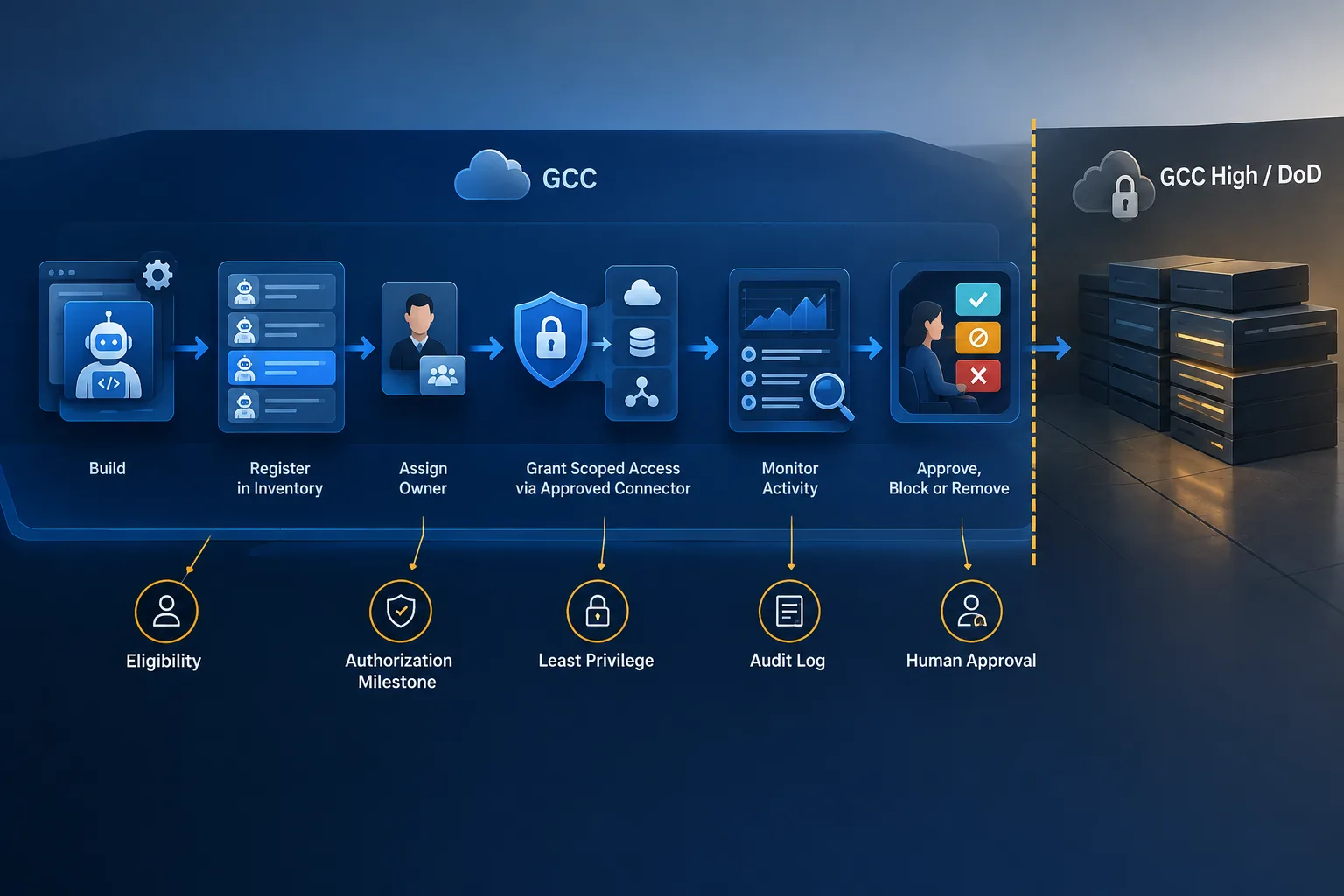

Microsoft has introduced Microsoft 365 G7, a new “Frontier Suite” for Government Community Cloud customers that bundles productivity, Copilot and other AI experiences, agents, security, identity, compliance, and governance. According to the Microsoft Cloud Blog announcement, agencies will be able to purchase G7 and Agent 365 on October 1, 2026, with additional capabilities arriving in phases as workloads clear required U.S. government-cloud authorization milestones.
That makes this less a simple “Microsoft adds AI” story than a concrete operations question for public-sector buyers: what, exactly, will be purchasable and usable inside GCC on October 1, and what remains a roadmap item until authorizations, licensing details, and cloud-boundary evidence are clearer?
For CIOs, CISOs, CDOs, and procurement teams, that distinction matters more than the launch language. In government, “announced,” “available for purchase,” and “operationally authorized” are three different states. Microsoft’s own framing points to a phased rollout, which means the core value proposition has to be judged in two parts: first, whether G7 gives agencies a more manageable way to buy and govern AI; second, whether the missing details delay real deployment decisions.
The real product is as much control as capability
The most consequential part of the announcement is not another chatbot. It is Agent 365, which Microsoft describes as the control plane for agent adoption. Its stated role is to help agencies discover which agents exist, register them, identify owners, manage and deploy them, and block or remove them when needed.
That sounds administrative, but it gets at one of the hardest practical problems in public-sector AI. A pilot Copilot assistant used by one team is one thing. A growing estate of mission-focused agents built by different offices, connected to different systems, and given different permissions is another. Once agencies move beyond experimentation, they need an inventory, named owners, scoped access, lifecycle actions, and logging that can survive audit and incident response. A directory of agents will not make an environment safe by itself, but without one, governance quickly becomes guesswork.
Microsoft is positioning G7 around that need. The initial model it described includes Microsoft agents such as Researcher and Analyst in GCC, Agent Builder, Copilot Studio for custom agents, Copilot Connectors, and managed connections to approved data and line-of-business applications. Microsoft also says G7 will ground mission-focused agents in Work IQ, organizational data, context, and tools, while policy-governed access connects agents to approved systems.
That is the right problem to target. Agencies do not just need smarter interfaces; they need a way to prove what an automated system can access, who approved it, who owns it, and how to shut it off.
October 1 is a buying date, not a blanket readiness date
The immediate caution is straightforward: purchasable does not mean fully available everywhere. Microsoft says G7 and Agent 365 can be purchased on October 1, but it also says capabilities will expand in phases as additional workloads complete authorization milestones. Buyers should read that as a packaging launch with staged operational availability, not as evidence that every described feature will be running in every GCC tenant on day one.
That matters because government cloud boundaries are not interchangeable. Microsoft’s government service documentation says eligible Microsoft 365 Government GCC customers can include U.S. government entities and sponsored nongovernment organizations that hold or process controlled information. The same documentation also separates GCC from GCC High and DoD, which have different eligibility requirements and control boundaries. G7 is specifically announced for GCC. That is not a trivial nuance for agencies that operate mixed environments or for contractors that assume “government cloud” is one market.
The same discipline applies to adjacent Microsoft announcements. Microsoft separately said Azure Government now has the Microsoft Foundry Agent Service and new GPT-5.6 models. That shows related government AI infrastructure is moving forward. It does not prove that every Microsoft 365 G7 capability is available in the same environment, on the same timetable, or under the same authorization posture.
What buyers still do not know
The gaps in the public material are the ones that tend to decide whether a government technology purchase becomes a deployment.
Microsoft has not published public pricing, exact SKUs, seat requirements, licensing boundaries, or a feature-by-feature matrix showing what is usable on October 1 versus later phases. It has not publicly specified which GCC regions and tenant configurations receive each capability, what authorization evidence applies to each workload, or whether the same Agent 365 controls are planned for GCC High or DoD.
The control questions go deeper than the bundle. Buyers still need to know what inventory metadata Agent 365 collects, how long that data is retained, which administrators can block or remove an agent, and what happens to connected credentials when an agent is disabled. They need to know how Copilot Connectors enforce least privilege in practice, including row- and field-level restrictions where relevant, and how Work IQ grounding is bounded and audited when an agent touches organizational context.
And the announcement does not close the loop with the controls agencies already depend on. A control plane for agents is useful; it is not a replacement for identity governance, data-loss prevention, endpoint controls, SIEM, records retention, incident response, human-approval workflows, or model safety testing. Agencies still need to see how G7 fits into those systems rather than assuming a new suite dissolves existing governance work.
How government teams should evaluate G7 now
The practical reading of G7 is that Microsoft is trying to lower two barriers at once: procurement friction and governance sprawl. For agencies already committed to Microsoft 365 in GCC, bundling AI experiences with a native agent inventory and management layer could simplify administration and policy enforcement. That is the strongest case for the announcement.
But the burden now shifts to validation. Before treating G7 as a production answer, agency teams should confirm the eligible cloud boundary for their environment; map which features are truly available at launch; verify the authorization status and data flows for each workload they plan to use; require a named owner for every agent; test least-privilege connector behavior; insist on logs and human approval for high-impact actions; and define block, rollback, and incident-response procedures before broad rollout.
They should also compare the bundle against what they already own across Microsoft 365, Azure Government, and third-party tooling. If G7 mainly repackages capabilities an agency already licenses, the value may come from centralized governance. If key governance functions remain phased, the suite may be more useful as a roadmap and procurement signal than as an immediate operational standard.
That is the answer to the reader’s question. Microsoft 365 G7 makes agent governance more actionable in concept by naming the control plane government buyers have been missing. Whether it makes that control plane operational on October 1 depends on details Microsoft has not yet published publicly: pricing, feature availability by tenant, workload authorization evidence, and how the new layer meshes with the agency controls that still carry the real compliance load.

 By
By


 By
By
 By
By
 By
By