
Temporal has raised $550 million in Series E financing at a $12.55 billion valuation, a sharp escalation in investor appetite for the software layer that keeps long-running AI agents and other distributed applications from losing their place when something fails. In Temporal’s announcement, the company said Lightspeed led the round, with Wellington Management, Growth Equity at Goldman Sachs Alternatives, and Tiger Global as co-leads, and said the money will fund global expansion and continued investment in its core platform and what it calls reliable AI infrastructure.
What makes this round matter beyond venture optics is the level of operating detail attached to it. Temporal said annualized revenue run rate is above $250 million, growth is running above 200% year over year, net dollar retention has stayed above 200% since February, paying customers now exceed 4,300, and Temporal Cloud processed more than 1.9 trillion actions in August, up more than 350% from a year earlier. The company also said open-source installs topped 43 million in August, up 134% since January, and named OpenAI, Snap, NVIDIA, Netflix, and JPMorgan Chase among customers.
That produces the real question behind the headline: are those numbers evidence that durable execution is becoming a standard control layer for production AI systems, or do they mostly reflect a small number of very large, fast-growing workloads? The answer so far is promising, but not settled.
Why this layer is suddenly valuable
Temporal’s product sits below the application layer and above the infrastructure that actually runs it. Its core abstraction is a workflow: break an application into durable steps and activities, persist the execution history, and let the system retry or resume work after a process crash, network failure, timeout, or broader outage.
That matters more in the AI-agent era because many tasks are no longer short, atomic requests. A single customer-support agent, onboarding flow, or back-office process may call a model, query a database, hit several APIs, wait for a human approval, then continue hours later. If the process dies at step four, a conventional service often has to reconstruct state, reissue completed work, or accept that something was lost.
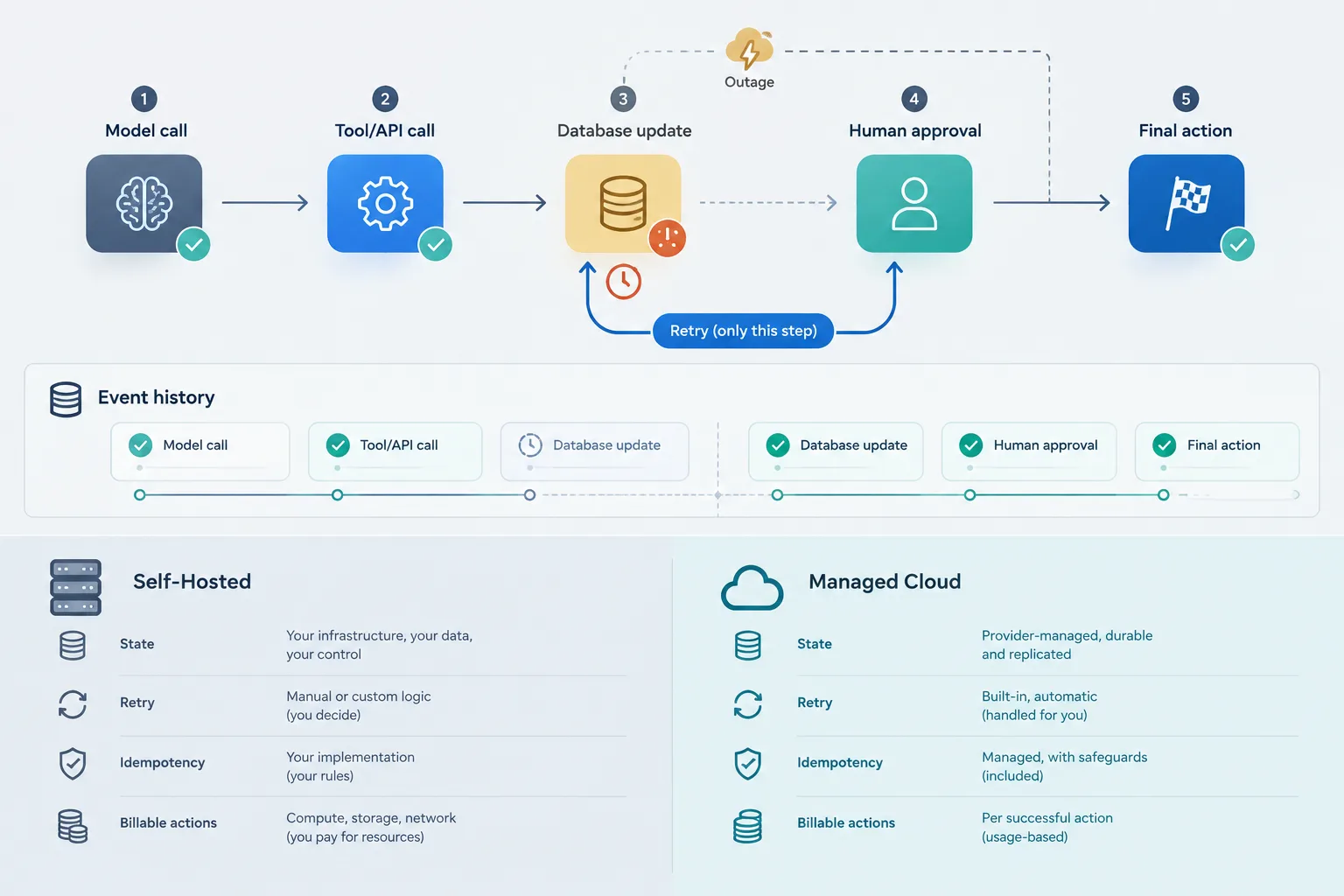
A concrete example shows the appeal. Imagine an agent that reviews a refund request, summarizes the case with a model, checks an order system, updates a database, requests a manager approval, and then issues a payment through an external API. If that payment API times out after the earlier steps have succeeded, durable execution preserves the event history so the workflow can retry only the failed activity or resume after an outage without replaying the entire chain. That is useful plumbing. It is not a guarantee that the model made the right judgment, that a payment is safe to issue, or that a poorly designed side effect will not fire twice.
That distinction matters for buyers. Workflow engines can recover state while still faithfully retrying a bad plan, a broken dependency, or a non-idempotent action. Temporal addresses orchestration and recovery semantics, not decision correctness, security policy, or human oversight.
The business case is strong enough to be interesting, but not complete enough to be final
Temporal’s commercial model helps explain investor enthusiasm. The SDKs are open source and can be self-hosted, lowering adoption friction for engineering teams. Revenue comes from Temporal Cloud, a managed service priced on consumption through billable actions and storage. Public documentation lists workflow starts, activity starts and retries, signals, timers, child workflows, and search-attribute updates as examples of billable actions.
That open-source-to-cloud path is a familiar software play, but it has unusual force here because durable execution tends to begin as a developer pain point and spread once teams standardize on it. If a company starts with a few workflows and then routes customer operations, payments, internal tooling, and AI-agent tasks through the same substrate, usage can expand quickly. Temporal’s reported net dollar retention above 200% since February is consistent with that kind of expansion.
The February-to-September valuation jump also explains why this round stands out. Temporal’s Series D was $300 million at a $5 billion valuation on February 17. Seven months later, the company is valued at $12.55 billion, more than doubling the private-market mark. That does not equal public-market validation, but it does signal that investors see this as more than an experimental AI accessory.
Still, the missing pieces are material. Temporal did not disclose profitability, gross margin, cash burn, or customer concentration. It did not say how much usage sits in self-hosted deployments rather than the monetized cloud service, how many of its 4,300 customers are meaningful revenue accounts, or how open-source installs convert to paid cloud workloads. Reuters has reported that the company has about 570 employees and that commercial revenue comes from Temporal Cloud even though the software itself is open source, but that still leaves the unit economics largely opaque.
The usage numbers also need careful interpretation. “Actions” are billing units, not end-user tasks, completed business processes, or model tokens. A platform can see action growth because customers are doing valuable work at scale, because workflows are becoming more complex, or because retries and orchestration events are multiplying. High action counts alone do not prove business value.
Competition also remains real. AWS Step Functions, Azure Durable Functions, other open-source orchestration tools, and in-house state machines offer overlapping capabilities. Buyers still have to weigh portability, operational ownership, latency, data residency, vendor dependence, and the engineering burden of self-hosting against the convenience of a managed cloud service.
What platform teams should test now
The practical takeaway is not that every enterprise suddenly needs a new workflow control plane. It is that the cost of failure and recovery is becoming easier to price.
For platform and engineering leaders, the useful test is concrete. Pick one workflow that actually breaks in production or is likely to: a claims process, an onboarding journey, an order flow, or a long-running agent task. Measure what a timeout, crash, or downstream outage costs today in duplicate work, manual intervention, delayed revenue, or customer harm. Then compare self-hosting with Temporal Cloud, model the likely action and storage charges, and test whether the workflow can satisfy deterministic execution requirements without creating unsafe side effects.
The shortlist of questions is operational, not theoretical: How are retries handled? Which steps must be idempotent? Where do human approvals enter? What observability exists around stuck or replayed workflows? What data crosses regions, and where is execution history stored? How hard would it be to migrate away later? Does the reliability gain justify adding another dependency at the center of application flow?
Temporal’s financing suggests investors believe the answer will increasingly be yes, especially for long-running AI systems. The stronger conclusion is narrower but still significant: as AI agents move from demos into revenue-bearing processes, the invisible software that remembers state, survives failure, and decides what to retry is turning into a real infrastructure market of its own.

 By
By
 By
By

 By
By
 By
By
 By
By
 By
By