
Air-delivered uncrewed surface vessels move from concept to credible capability
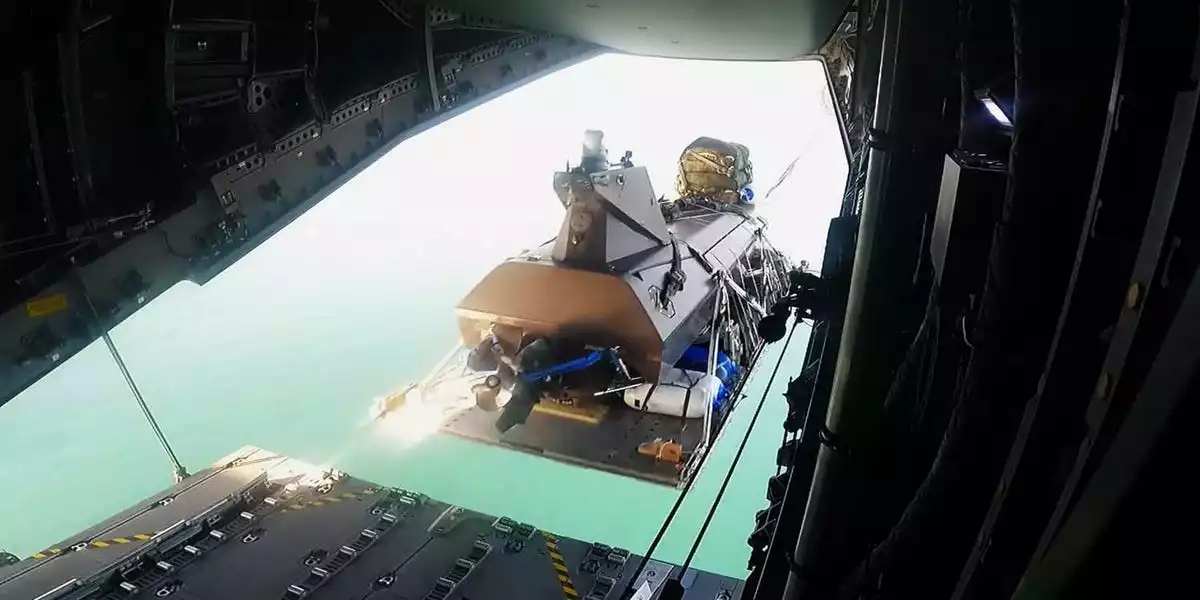
The UK Royal Navy’s successful trials of airdropping Kraken Technology Group’s 27-foot K3 Scout uncrewed surface vessel (USV) from an Airbus A400 transport aircraft mark a notable inflection point in maritime autonomy. Over six days above the North Sea, the K3 Scout was parachuted four times from roughly 1,300 feet, using Capewell’s sled-and-parachute system—a practical demonstration that unmanned boats no longer need a pier, a mothership, or permissive coastal access to enter the fight.
This matters because traditional USV deployment has been constrained by geography and logistics: launch from a port, a well deck, or a crane-equipped ship, then transit—often slowly—into an operating area. Air insertion changes the geometry. It enables over-the-horizon placement of a surface asset into waters where access may be contested, monitored, or politically sensitive. In modern naval planning, where adversaries increasingly invest in anti-access/area-denial (A2/AD) and long-range surveillance, the ability to “appear” at sea from the air is not a novelty; it is a new operational lever.
The Royal Navy’s procurement signal is equally clear. A contract for 20 K3 Scout units for £13 million (about $16.5 million) suggests intent to move beyond experimentation and toward routine integration—treating USVs as a standing element of force structure rather than an occasional adjunct.
What the North Sea trials reveal about engineering maturity and mission design
Airdrop is unforgiving. It tests not only parachute and rigging performance, but also the vessel’s structural resilience, electronics hardening, and post-splash autonomy. The K3 Scout’s ability to be delivered safely and then operate in Sea State 4 (conditions that can include strong winds and significant wave height) points to a platform designed for more than calm-water demonstrations.
Several technical implications stand out:
- Launch independence and rapid tasking: Air deployment reduces reliance on ports and host vessels, enabling faster response timelines and more flexible basing. In practical terms, it supports expeditionary operations where sea access is constrained or where forward staging is risky.
- Shock tolerance and systems robustness: Surviving the airdrop sequence implies durable hull design, protected payload bays, and resilient onboard power and compute systems. These are prerequisites for real-world operations where sea states, impacts, and handling are unpredictable.
- Payload capacity aligned with modern naval needs: The K3 Scout’s stated 600 kg payload capacity is substantial for a craft of its size. It creates room for modular mission kits—particularly electronic warfare (EW), communications relay, sensors, or specialized logistics payloads.
The mention of EW suites is especially consequential. Naval warfare is increasingly shaped by the electromagnetic spectrum: detection, deception, jamming, and network disruption. A relatively low-cost, unmanned surface platform that can carry EW payloads offers commanders a way to probe, distract, and degrade adversary sensing and command links without immediately risking crewed ships.
At the same time, the breadth of roles being discussed—forward screening, maritime strikes, and even casualty evacuation—highlights a familiar tension in defense technology: the temptation to treat a promising platform as universally adaptable. The K3 Scout’s value will ultimately depend on how clearly the Royal Navy defines mission priorities, rules of engagement, and command-and-control (C2) integration for each role.
The economics of “good enough” mass and the UK’s unmanned industrial stack
At roughly $825,000 per unit (based on the reported contract total), the K3 Scout sits in a strategically interesting price band: far cheaper than crewed patrol craft or corvette-class platforms, yet capable enough to host meaningful payloads. That positioning supports a procurement logic increasingly visible across NATO: buy systems that are affordable, scalable, and replaceable, then use numbers, networking, and tactics to generate advantage.
Economically, the trials also spotlight a maturing UK and allied supply chain for unmanned maritime systems:
- Kraken Technology Group provides the USV platform and mission modularity.
- Airbus contributes the airlift backbone (A400), a critical enabler for expeditionary concepts.
- Capewell supplies the specialized airdrop delivery mechanism, bridging aerospace delivery and maritime recovery.
This kind of cross-domain integration is not just a technical achievement; it is an industrial one. It creates a template for follow-on markets: improved airdrop kits, autonomous post-drop commissioning, recovery and docking solutions, and standardized payload modules. If the Royal Navy operationalizes the concept, it could catalyze a broader ecosystem of launch-and-recovery services and mission-package suppliers, with spillover potential into civil maritime autonomy over time.
Budgetarily, the appeal is straightforward. In an era of constrained defense spending and high capital-ship costs, USVs offer operational utility per pound that is hard to ignore—especially for missions that are dangerous, repetitive, or best performed at scale.
Strategic ripple effects: distributed maritime power, coalition interoperability, and escalation control
The strategic promise of air-deployed USVs is best understood as a contribution to distributed maritime operations. Instead of concentrating capability in a small number of high-value ships, navies can disperse sensing, EW, decoys, and even limited strike functions across many nodes. Air insertion adds another layer: it diversifies launch vectors and complicates adversary planning by creating unexpected threat axes.
Several second-order effects deserve attention:
- Coalition interoperability: Many allied forces operate A400 or C-130-class aircraft. A standardized approach to air-deployed USVs could enable joint tactics and shared training pipelines, improving rapid-response options in coalition scenarios.
- Contested logistics and sustainment: The same delivery logic could extend beyond surveillance and EW to modular resupply—fuel, batteries, medical stores—supporting dispersed forces under A2/AD pressure.
- Command-and-control discipline: The more autonomous and numerous maritime drones become, the more essential robust C2, identification protocols, and deconfliction measures will be—particularly in congested waters where misidentification and escalation risks rise.
The Royal Navy’s North Sea trials do not, by themselves, redefine naval warfare. They do, however, demonstrate that airborne insertion of meaningful unmanned maritime capability is now practical, not theoretical. As procurement scales and doctrine catches up, the central question will shift from “Can we drop a USV?” to “How do we integrate air-delivered USVs into credible deterrence, day-to-day maritime security, and high-end warfighting without creating new seams in control, attribution, and escalation management?”
 By
By
 By
By
 By
By

 By
By
 By
By
 By
By