

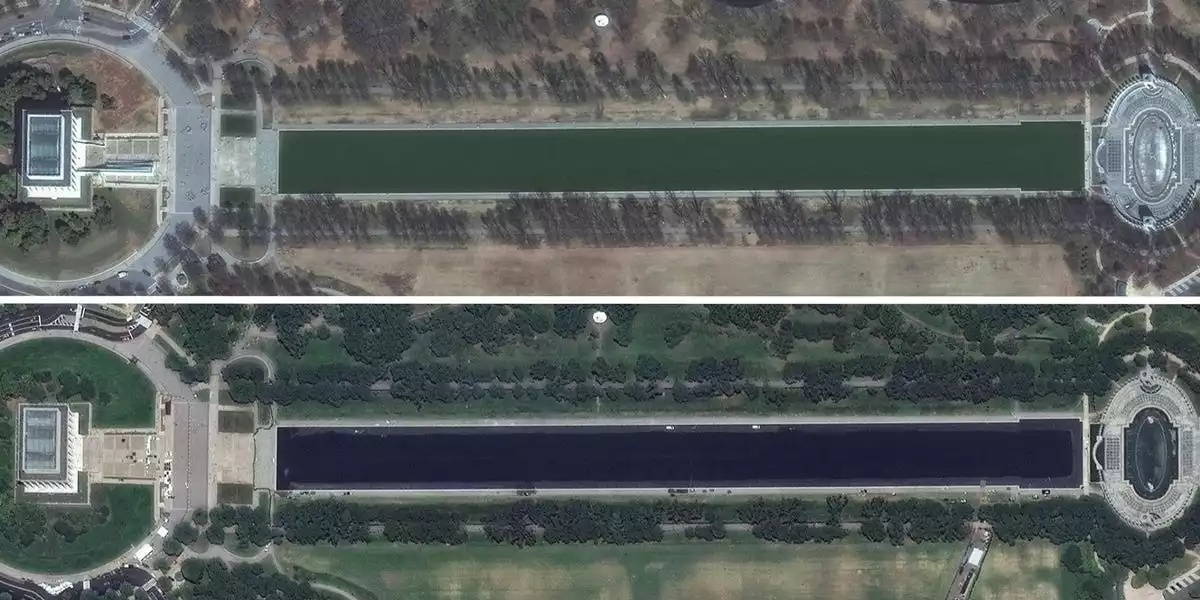

A landmark refurbishment that became a high-velocity, high-visibility infrastructure story
The expedited overhaul of the Lincoln Memorial Reflecting Pool has quickly evolved from a maintenance project into a case study in how public works can be reframed as national narrative, operational theater, and technology-enabled asset management. Completed in roughly two months and priced at $14.2 million—far above the early $1.5–2 million estimate—the renovation was positioned as a preparatory step toward America’s 250th anniversary. Yet the scale of the cost escalation and the intensity of the messaging around the project have ensured it is being read not only as restoration, but as strategy.
The most visible change is aesthetic and immediate: a basin once documented as algae-heavy and green in March 2026 shifted to a pristine deep-blue surface by early June, restoring the pool’s signature reflective clarity. The administration emphasized the use of a custom “American flag blue” coating, a detail that signals how modern infrastructure projects increasingly blend engineering specifications with symbolic design choices intended to resonate beyond the jobsite.
Former President Trump’s public praise of the outcome—and his signaling of additional capital enhancements such as a “Trump Promenade” and a proposed “Triumphal Arch”—further situates the reflecting pool work inside a broader conversation: when the built environment becomes a platform for legacy-building, the procurement, governance, and brand implications expand dramatically.
—
Materials science meets monument management: why the coating matters
At the core of the renovation is a technological bet: that advanced polymeric membranes and specialty coatings can deliver both improved aesthetics and more durable performance for large-scale aquatic installations. While the public sees color and clarity, the engineering logic is about sealing, longevity, and biological control.
Key technological dimensions with broader business relevance include:
- High-performance membrane coatings for aquatic basins
Modern formulations can improve water retention, reduce seepage, and resist degradation under UV exposure and temperature cycling. In some product categories, coatings can incorporate biocidal or anti-fouling properties designed to inhibit algae growth—an increasingly valuable feature as maintenance teams face tighter staffing and higher lifecycle costs.
- Aesthetics as a functional requirement
The “American flag blue” specification underscores a growing reality in public infrastructure: visual outcomes can be treated as deliverables on par with structural integrity, especially for heritage sites where visitor experience and media optics are inseparable from the asset’s perceived condition.
- Remote sensing as quality assurance and performance signaling
Satellite imagery documenting the pool’s transformation illustrates how geospatial analytics—including satellite and drone capture—can turn public works into measurable, time-stamped evidence. For construction executives and asset managers, this points to a future where maintenance is tracked through quantifiable KPIs: color consistency, surface uniformity, water clarity proxies, and anomaly detection over time.
For technology vendors, the project reads as a quiet endorsement of a new stack for civic asset stewardship: specialty materials + imaging + analytics, with the potential to expand into IoT water-quality sensing and AI-driven predictive maintenance.
—
The economics of speed: cost escalation, procurement scrutiny, and delivery “sprints”
The near tenfold jump from early estimates to final cost is the kind of delta that invites scrutiny—especially in a politically charged setting and on a site as symbolically central as the National Mall. Several forces plausibly converge in such outcomes: specialty chemical inputs, skilled labor premiums, accelerated schedules, and bespoke specifications that narrow supplier options.
From a business and governance perspective, the renovation highlights three structural dynamics:
- Time compression changes the cost curve
Delivering a full renovation in roughly two months implies accelerated permitting, tight sequencing, and supply-chain coordination under deadline pressure. This “sprint” model can be effective, but it tends to trade schedule certainty for higher unit costs and greater overrun risk, particularly when specialized materials and constrained work windows are involved.
- Public procurement in a high-scrutiny environment
The selection of Atlantic Industrial Coatings, described as initially linked to the former president’s private ventures, spotlights how contractor relationships can become part of the story. For firms operating in politically sensitive projects, the lesson is straightforward: reinforce compliance controls, conflict-of-interest safeguards, and documentation rigor, because reputational exposure can outlast the contract.
- Local multiplier effects are real—but uneven
High-profile refurbishments can stimulate nearby economic activity—tourism flows, hospitality demand, and retail traffic—especially in landmark districts. Yet these benefits are often diffuse and difficult to attribute, which makes them less persuasive as a primary justification than as a secondary outcome that cities and operators can plan to capture.
For investors and operators, the reflecting pool renovation is a reminder that speed is a procurement feature—and an expensive one—when the project is both technically bespoke and politically time-bound.
—
Infrastructure as narrative and platform: the strategic stakes of “placemaking” in Washington
Perhaps the most consequential dimension is not the coating chemistry or the schedule, but the way the project was framed: a restoration aligned with a national milestone, amplified through imagery, and linked to future proposals that would further reshape the capital’s monumental landscape.
Several strategic implications stand out:
- Symbolic design choices can function as brand architecture
The deliberate emphasis on “American flag blue” demonstrates how infrastructure can be used to project values—renewal, patriotism, permanence—through material and color. In corporate terms, this resembles flagship campus design or signature retail architecture: the physical environment becomes a communications asset.
- Digital visibility turns maintenance into stakeholder engagement
By leveraging before-and-after visuals—especially satellite documentation—the project became legible to the public in a way most maintenance never is. This is a playbook many organizations can adopt: pair operational milestones with transparent visual proof to build trust and momentum.
- Legacy-grade proposals raise the bar for governance and consensus
Ideas like a “Trump Promenade” or “Triumphal Arch” would move beyond refurbishment into identity-shaping placemaking. For any company bidding on or supplying such projects, the competitive edge will not be price alone; it will be the ability to navigate stakeholder complexity, regulatory review, and long-horizon reputational risk while delivering distinctive design and durable performance.
The reflecting pool’s new surface may look serene, but the forces beneath it—advanced materials, accelerated delivery economics, and the political economy of landmark infrastructure—are anything but still.

 By
By
 By
By
 By
By
 By
By
 By
By


 By
By







