

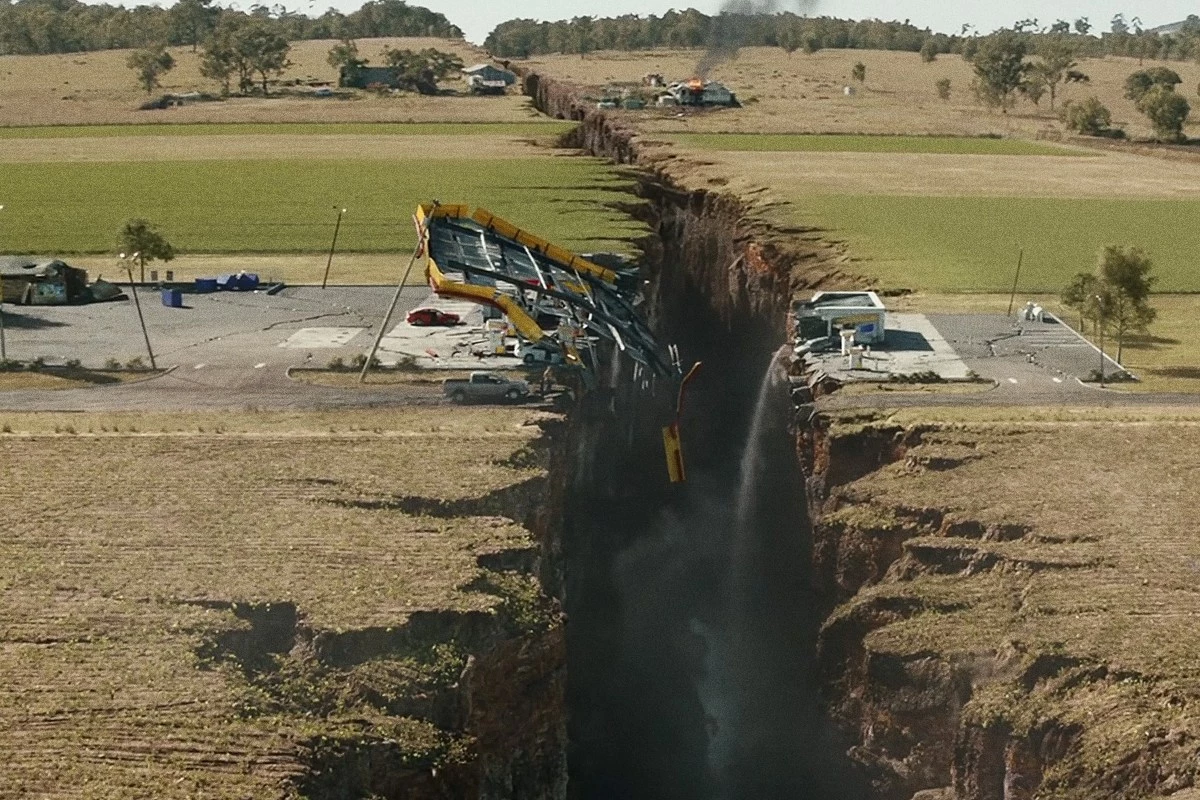

A millennium-scale stress peak reshapes the Southern California risk narrative
New research published in the *Journal of Geophysical Research*—led by Liliane Burkhard at the University of Bern—adds a sharper edge to what Californians have long understood intuitively: the San Andreas and San Jacinto fault systems are not isolated threats, but a tightly coupled network where stress can migrate, concentrate, and potentially synchronize failure. By reconstructing and simulating roughly 1,000 years of earthquake behavior, the study concludes that accumulated tectonic stress is now at its highest level in a millennium along key segments of these faults.
The focal point is the Cajon Pass junction, a strategically and geologically consequential corridor where fault geometry and stress transfer may combine to create a “linchpin” scenario—one in which rupture on one fault meaningfully increases the probability of rupture on another. The implication is not a deterministic prediction of an imminent earthquake, but a more sobering refinement: the system may be more primed for a multi-fault rupture capable of exceeding magnitude 7.0 than many static hazard narratives convey.
For Greater Los Angeles—dense, economically central, and infrastructure-heavy—this kind of time-dependent stress evolution matters. It reframes seismic risk from a background condition into a dynamic, stateful system whose current configuration may be unusually unfavorable, even if the clock on “when” remains fundamentally uncertain.
From static hazard maps to time-dependent “stress intelligence”
A key contribution of the study is methodological: it advances beyond conventional, largely static hazard assessments by modeling how stress changes through time. The research integrates multiple physical processes—interseismic loading, stress transfer between ruptures, and post-rupture relaxation—to produce a more realistic picture of how fault systems behave as interacting components.
Several technology and science themes stand out for business and policy audiences:
- High-performance fault-system simulation: The work leverages computational modeling to fuse paleoseismic records (the long memory of past ruptures) with modern geodetic measurements (the real-time deformation captured by GNSS and related tools). The result is closer to a living “stress-map” than a static probability overlay.
- Digital twin potential for earthquake systems: The study’s emphasis on junction behavior—how stress propagates across fault connections—aligns with the broader industrial move toward digital twins, where continuous simulation supports forecasting, scenario testing, and operational readiness. Earthquake science is not yet at the always-on maturity of aerospace or grid operations, but the architectural direction is increasingly recognizable.
- AI augmentation as the next uncertainty reducer: Future iterations could incorporate machine learning trained on global fault-junction analogues, improving probabilistic rupture scenarios and narrowing uncertainty ranges. Importantly, AI here is not a replacement for physics-based modeling; it is a candidate layer for pattern discovery, parameter tuning, and ensemble weighting.
This is the deeper signal for technology leaders: seismic risk is becoming a domain of data fusion and computational forecasting, where the competitive advantage may accrue to regions and organizations that treat hazard intelligence as an evolving, instrumented capability rather than a compliance checkbox.
Cajon Pass as an economic chokepoint: logistics, energy, and capital markets
The Cajon Pass is not merely a geological junction; it is a critical artery for freight, commuting, rail movement, and pipeline networks. That dual identity—fault nexus and infrastructure corridor—creates a compounding risk profile: a large rupture is not only a human safety crisis, but a systemic economic disruption event.
Material implications include:
- Supply-chain and logistics disruption: Major highways, rail lines, and lifeline utilities converge through the pass. A severe event affecting multiple faults could interrupt $50–100 billion in annual freight movement, with ripple effects extending from Southern California ports into inland distribution hubs and onward to national retail and manufacturing networks.
- Insurance repricing and risk transfer innovation: If market participants interpret the findings as meaningfully elevating tail risk, the knock-on effects may appear in catastrophe-bond spreads, underwriting terms, and model assumptions. This environment tends to accelerate interest in parametric insurance—products that pay out based on measured ground motion rather than loss adjustment timelines.
- Infrastructure investment pressure: Bridges, tunnels, water conveyance, power transmission, and communications networks face renewed scrutiny. The likely policy and financing response is not a single mega-project, but a multi-year retrofit cycle—potentially supported by public–private partnerships, resilience bonds, and blended finance structures that distribute cost and performance accountability.
For capital markets, the subtext is that seismic readiness can influence not only insured losses, but also municipal borrowing costs and credit narratives. A state’s reputation for preparedness—planning, retrofits, monitoring, and recovery capacity—can become a quiet input into how investors perceive long-term fiscal resilience.
Strategy and governance: resilience becomes an operating system, not an afterthought
The most actionable takeaway is not to treat this research as a countdown, but as a governance prompt. When hazard is time-dependent and networked, resilience must be similarly networked—across agencies, utilities, logistics operators, and corporate risk teams.
Priority moves that align science with execution include:
- Real-time monitoring and analytics expansion: Denser GNSS coverage, InSAR integration, and AI-driven anomaly detection can improve situational awareness and strengthen early-warning ecosystems.
- Digital-twin prototypes for regional stress testing: Open, interoperable platforms that simulate rupture scenarios can help utilities, transportation agencies, and large employers run realistic continuity drills and investment prioritization.
- Regulatory modernization with incentives: Building codes and lifeline standards—many shaped by lessons from the 1994 Northridge earthquake—may need targeted tightening, paired with mechanisms such as tax credits or accelerated depreciation for seismic upgrades.
- Cross-sector data-sharing protocols: A joint task force spanning CAL OES, USGS, utilities, and technology firms could standardize how stress-monitoring data is shared, secured, and operationalized.
The larger business lesson is that resilience is increasingly a competitive attribute. Organizations that embed seismic risk into enterprise risk management, supply-chain design, real-estate strategy, and ESG-aligned disclosure will be better positioned to sustain operations—and to demonstrate credibility to investors, regulators, and communities—when the fault system eventually converts stored stress into motion.

 By
By
 By
By

 By
By
 By
By

 By
By
 By
By







