


When typhoons meet autonomy: a new baseline for emergency response in China
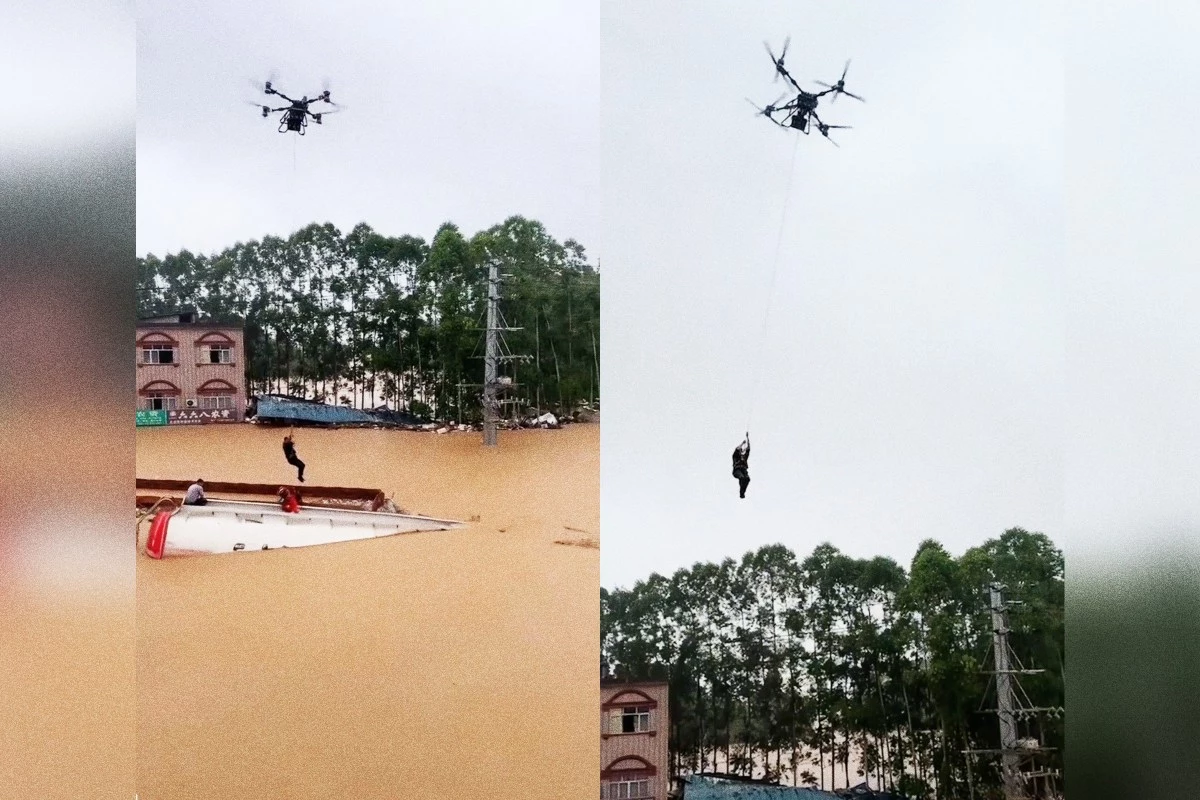
Footage released by Xinhua from China’s Guangxi autonomous region offers a stark snapshot of how disaster response is being rewritten in real time. In the wake of Typhoon Maysak, large quadcopter drones were deployed not merely for reconnaissance, but for direct human extraction—including a dramatic rescue in which a stranded man was winched from the roof of an oil tanker using a drone-mounted harness system. Alongside these heavy-lift missions, telecommunication drones were used to re-establish internet access for communities isolated by extreme rainfall—reported at nearly 35 inches—and damaged terrestrial networks.
The broader storm system’s impacts across Hubei and Gansu—from tornado-strength winds to landslides—displaced more than 130,000 people, while secondary disruptions (including the release of hundreds of snakes from a breeding facility) underscored how cascading effects can compound humanitarian and operational complexity. As China braces for additional typhoons, the Guangxi operation is less a one-off spectacle than a signal: extreme weather is accelerating the adoption of autonomous systems as core public-safety infrastructure.
Heavy-lift drones and airborne networks: what the technology actually proved
The most consequential takeaway is not that drones were present, but that they performed mission-critical roles traditionally reserved for helicopters, boats, and ground teams—often at lower cost, with faster deployment, and in conditions where conventional assets may be constrained.
Key technological validations from these operations include:
- Heavy-lift autonomy under real-world stressors
The ability for a quadcopter to hover stably while supporting a human payload implies advances in:
– Flight-control stability in turbulent wind and rain bands
– Redundant safety protocols (fail-safes, load monitoring, emergency descent logic)
– Power management and battery performance under high draw
– Winch and harness integration, where mechanical reliability becomes as important as software
- Beyond-Line-of-Sight (BLOS/BVLOS) connectivity restoration
Telecom drones acting as airborne nodes effectively create ad-hoc mesh networks—a form of “network-in-a-box” capability that can restore:
– Voice and data services for residents and responders
– Connectivity for IoT devices used in flood monitoring and infrastructure status
– Backhaul alternatives when fiber routes or cell towers are down
- Sensor fusion feeding unified command decisions
Real-time video, LiDAR, and environmental sensors can compress the time between “damage occurs” and “decision made.” In flood events, that time compression is often the difference between manageable evacuation and mass casualty risk. The operational value lies in integrating drone telemetry into command centers that can prioritize rescues, route vehicles, and estimate flood depth and structural integrity.
Collectively, these capabilities point to a maturing model of disaster response in which drones are not accessories but distributed, rapidly deployable infrastructure—airborne mobility, airborne sensing, and airborne communications in one ecosystem.
The “resilience economy” takes shape: market growth, telecom monetization, and supply-chain strategy
The Guangxi deployments also illuminate why the crisis-management drone sector is attracting sustained investment. Governments and private operators are expanding budgets for unmanned systems, supporting forecasts of 15–20% CAGR through 2030 for crisis-management drone markets. Yet the more durable story is how disaster response is becoming an anchor tenant for a broader resilience economy—where climate volatility forces technology adoption that would otherwise be incremental.
Three economic vectors stand out:
- Disaster-response services as a scalable industry
Drone operators, systems integrators, and maintenance providers can build recurring revenue around:
– Pre-positioned fleets and rapid activation contracts
– Training, simulation, and readiness audits
– Data services (mapping, damage assessment, situational intelligence)
- Telecom as a Service (TaaS) via airborne nodes
The success of aerial connectivity restoration opens a commercial pathway for carriers and equipment vendors:
– Temporary coverage for rural and under-served regions
– Rapid restoration after storms, earthquakes, or landslides
– Event-based deployments (large gatherings, remote worksites)
In effect, disaster zones become proving grounds for portable network architectures that can later be productized.
- Supply-chain resilience and localized manufacturing
As drone fleets scale, so does exposure to component bottlenecks—rotors, batteries, RF modules, and compute hardware. The push toward localized manufacturing is not only industrial policy; it is operational risk management in a world shaped by geopolitical tension and chip shortages. For procurement leaders, resilience increasingly means dual sourcing, modular design, and repairability—especially when drones are expected to operate during the very disruptions that break supply chains.
Governance, regulation, and dual-use realities: the constraints that will define scale
The operational promise of heavy-lift rescue drones and telecom relays will ultimately be bounded by governance: airspace rules, interoperability standards, spectrum policy, and data rights. The Guangxi case highlights how quickly technology can outpace the frameworks meant to manage it.
Stakeholders face several strategic imperatives:
- Public-private coordination and interoperability
Effective deployment requires shared protocols across municipal agencies, commercial teams, and—where relevant—military units. That includes:
– Joint training exercises and standardized incident playbooks
– Air-traffic management integration for emergency corridors
– Interoperable payloads and data formats across vendors
- Regulatory evolution for BVLOS and human-carrying operations
Scaling these missions hinges on certification regimes for Beyond-Visual-Line-of-Sight (BVLOS) flights, pilot-in-command requirements, and safety thresholds for carrying human payloads. Regulators will need to reconcile urgency with risk, especially in dense or infrastructure-sensitive environments.
- Data governance and civil liberties
Real-time mapping and location tracking can save lives, but it also creates sensitive datasets—movement patterns, identities, and private property imagery. Clear legal frameworks are essential to define retention, access, and oversight, ensuring emergency imperatives do not become open-ended surveillance precedents.
A final undercurrent is dual-use dynamics. Heavy-lift autonomy and resilient airborne communications are valuable in civilian rescue—and strategically relevant in defense contexts. That overlap can influence export controls, international partnerships, and the pace at which cutting-edge capabilities diffuse across borders.
What Guangxi ultimately demonstrates is a shift in expectations: as climate-driven disasters intensify, societies will increasingly judge preparedness not by plans on paper, but by whether autonomous systems can be activated fast, coordinated cleanly, and governed credibly—when the next storm makes landfall.

 By
By


 By
By
 By
By

 By
By
 By
By







