

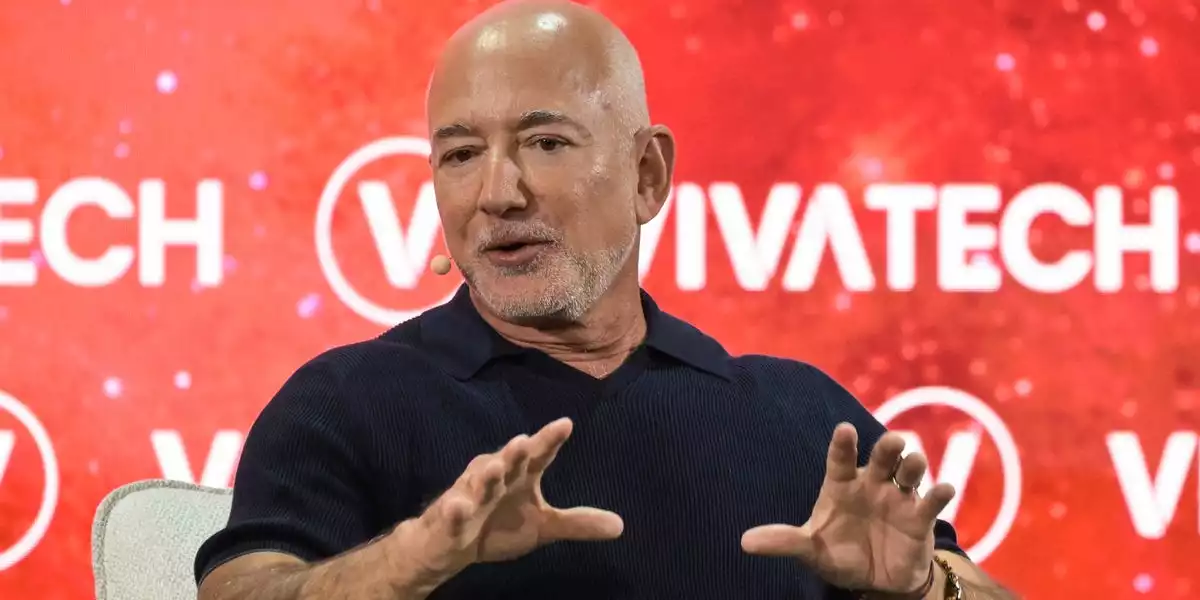

Bezos at VivaTech: Recasting AI From Job Threat to Opportunity Engine
Speaking at VivaTech in Paris, Jeff Bezos offered a pointed counterweight to the dominant public anxiety that artificial intelligence will hollow out employment. His thesis is not that disruption won’t happen, but that AI compresses the distance between imagination and execution—turning ideas into prototypes, products, and companies faster than prior technology waves allowed. In that framing, the labor market story is less about replacement and more about recomposition: tasks shift, workflows reorganize, and new categories of work emerge around what AI makes newly feasible.
That message lands against a stark backdrop. Surveys indicating that roughly half of Americans worry about AI’s impact on jobs and incomes reflect a credibility gap between executive optimism and household-level risk perception. Bezos’s intervention is best read as both a philosophical argument and a strategic one: a bid to define AI as a net-positive force for entrepreneurship and growth—at a moment when the technology’s social license is still being negotiated.
For business leaders, the key analytical question is not whether AI will “create jobs” in the abstract, but where, for whom, and on what timeline. The nearer-term reality is likely to be uneven: rapid productivity gains in some functions, displacement pressure in others, and a widening premium on workers who can translate AI capability into operational outcomes.
—
The “Dream-to-Build Loop”: Why AI Changes Startup Economics and Corporate Innovation
Bezos’s most consequential claim is that AI acts as a conversion engine for innovation. By automating portions of research, coding, design iteration, testing, and documentation, AI reduces the cost of experimentation and accelerates time-to-market. This is not merely incremental efficiency; it reshapes the economics of building.
Several mechanisms matter for executives and investors assessing the next cycle of company formation:
- Faster prototyping and iteration: Generative AI and agentic tooling can shorten product development loops, enabling more shots on goal with fewer resources.
- Lower R&D overhead: Automation of routine analysis, QA, and internal tooling can reduce the fixed costs that historically favored large incumbents.
- New “hybrid” roles at scale: The labor demand shifts toward people who can combine domain expertise with AI fluency—often less about writing every line of code and more about orchestrating systems responsibly.
This is where the rhetoric of “AI won’t take your job, someone using AI will” becomes operationally meaningful. The emerging labor premium is likely to concentrate around:
- AI-proficient engineers and data specialists who can productionize models and manage data pipelines
- Domain experts (healthcare, finance, logistics, manufacturing) who can specify requirements and validate outputs
- “AI translators”—product managers, analysts, operations leads—who bridge business intent and model behavior
- Governance and risk professionals who can audit, monitor, and document AI systems in regulated environments
Bezos’s framing also dovetails with the interests of hyperscalers—particularly Amazon’s AWS—because the “dream-to-build loop” increasingly runs on cloud infrastructure, model hosting, developer toolchains, and managed data services. The more AI becomes a default layer of product development, the more value accrues to platforms that can offer integrated AI stacks with security, compliance, and deployment baked in.
—
Labor Markets, Wages, and the Political Economy of AI Productivity
The optimistic narrative—AI expands opportunity—coexists with a harder macroeconomic question: who captures the productivity dividend? If AI boosts output per worker, the distribution of gains will shape everything from wage growth to political stability.
Two dynamics stand out:
- Artificial scarcity of talent: In the near term, demand for a relatively small pool of AI-capable professionals can drive wage inflation in key roles, with spillovers into adjacent functions (cybersecurity, cloud architecture, data governance, product).
- Productivity vs. wage tension: If productivity gains accrue primarily as corporate profit rather than higher real wages, public skepticism may intensify—fueling calls for stronger labor protections, new tax frameworks, or expanded safety nets.
This is why the public sentiment gap matters. When households fear income erosion, even pro-growth technology agendas face resistance. Bridging that divide will likely require more than corporate messaging; it will require visible, measurable upskilling pathways and credible commitments that AI adoption includes workforce transition planning.
For leadership teams, the practical implications are immediate:
- Treat reskilling as a core operating investment, not a reputational add-on
- Extend AI fluency beyond engineering into legal, HR, finance, procurement, and frontline management
- Build internal mobility programs that convert at-risk roles into AI-adjacent roles—before attrition and distrust set in
—
AI as the Enabler of Space Industrialization: A Long-Horizon Bet With Near-Term Spillovers
Bezos also used AI to reinforce a longer arc: space-based manufacturing and off-Earth industrialization, including concepts such as asteroid mining and relocating heavy industry away from Earth. While this vision remains speculative and capital-intensive, it is strategically coherent: if humanity is to build complex industrial supply chains beyond Earth, it will require autonomous robotics, resilient systems, and AI-driven operations that can function with limited human intervention.
In that sense, AI is not just a productivity tool—it is an enabling technology for environments where labor is scarce, latency is real, and failure is expensive. The parallels to other industry leaders, including Elon Musk, underscore a broader pattern: major technology figures are increasingly pairing AI narratives with civilizational-scale infrastructure ambitions.
The business relevance is not confined to rockets. Even if space manufacturing is decades out, the enabling stack has nearer-term commercial applications:
- Autonomous robotics for terrestrial logistics, warehousing, and hazardous environments
- Digital twins and predictive maintenance for Industry 4.0 manufacturing
- Advanced materials and energy systems that benefit aerospace, defense, and clean-tech supply chains
This trajectory also raises governance questions that will mature alongside the technology: resource ownership, space environmental stewardship, and multilateral coordination to prevent conflict in a domain where commercial incentives are accelerating faster than regulatory frameworks.
Bezos’s VivaTech message ultimately stakes out a high-ground position: AI as a force multiplier for human ambition, from everyday entrepreneurship to off-planet industry. Whether that vision becomes broadly credible will depend less on keynote optimism and more on execution—how effectively companies convert AI capability into shared prosperity, durable trust, and systems that are safe enough to scale.

 By
By
 By
By

 By
By
 By
By
 By
By

 By
By







