

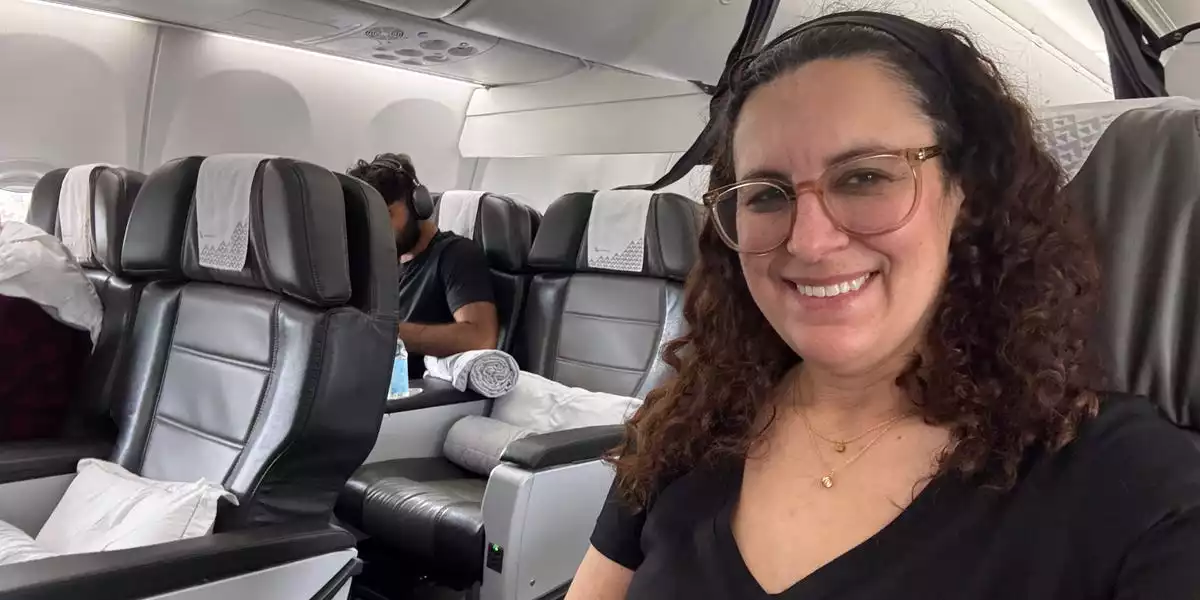

A “bridge-carrier” premium bet on the Baltimore–Copenhagen corridor
Icelandair’s Saga Premium on the Baltimore (BWI) to Copenhagen (CPH) route—priced around $2,637 round-trip—lands squarely in the widening space between standard economy and full business class. The proposition is not framed around the traditional hallmark of long-haul business travel—lie-flat sleep—but around a more holistic promise: arrive less depleted, stay productive in-flight, and move through the airport with fewer friction points.
At the center is a product that feels intentionally engineered as premium economy plus rather than a rebranded business cabin. The hard product delivers meaningful physical relief—20.5-inch-wide seats, 40-inch pitch, deep recline (without going fully flat), and footrests—while the soft product leans into Nordic cues: plated dining on porcelain, a printed menu, and unlimited beverages. On the ground, the value is amplified through priority check-in and boarding, two free checked bags, lounge access in Iceland, and expedited immigration—a suite of time-saving benefits that can matter as much as seat geometry for travelers trying to protect the first day of a trip.
For Icelandair, the strategic logic is clear: reinforce its identity as a North America–Europe connector via Reykjavík, and monetize travelers who want more than economy but are unwilling—or unable—to justify the price and expectations of traditional business class.
—
Cabin engineering and onboard connectivity as a deliberate product architecture
Saga Premium’s seat design reads like a disciplined compromise between comfort and operational efficiency. By avoiding lie-flat mechanisms, Icelandair sidesteps the weight, maintenance complexity, and cabin real estate demands that typically accompany true business-class suites. That choice has implications beyond passenger comfort; it shapes unit economics and fleet flexibility.
Key technological and product signals include:
- Ergonomic uplift without mechanical overreach: Deep recline and generous pitch can reduce fatigue on transatlantic segments, while keeping the seat architecture comparatively simpler than lie-flat systems.
- Weight and fuel-efficiency considerations: Lighter seating and fewer moving parts can support fuel-burn discipline—an increasingly material factor as airlines manage volatile energy costs and sustainability scrutiny.
- Digital passenger experience as a core feature: Complimentary Wi‑Fi for two devices and upgraded in-flight entertainment reflect how connectivity has shifted from perk to expectation, especially for “bleisure” travelers who treat cabin time as usable work time.
Connectivity also opens a second, less visible layer of value creation: data and monetization. Real-time internet access enables airlines to experiment with:
- Targeted ancillary offers (upgrades, onboard retail, destination experiences)
- Loyalty nudges based on traveler behavior and preferences
- Advertising and partner placements delivered through captive digital channels
In this framing, Saga Premium is not only a seat—it is a platform for a more measurable, personalized passenger journey.
—
Pricing strategy, yield management, and the economics of “not quite business class”
The roughly $2,637 round-trip price point signals a sophisticated approach to price segmentation. Airlines increasingly rely on a layered cabin strategy to capture multiple willingness-to-pay thresholds on the same aircraft. Saga Premium targets a specific middle: travelers who value comfort, time savings, and service upgrades, but do not require (or cannot expense) lie-flat sleep.
From a revenue-management perspective, the appeal is twofold:
- Yield expansion without full business-class costs: Premium pricing can be sustained through bundled benefits—priority services, baggage, lounge access, and elevated dining—without the capital intensity of a true business cabin.
- Load-factor resilience: A robust mid-tier product can reduce dependence on either high-volume economy demand or the more cyclical corporate travel segment.
This is particularly relevant in the current macro environment. Airlines face persistent cost pressures—labor, catering, financing, and fuel—and must decide where to invest for maximum return. Saga Premium’s model suggests a preference for modular upgrades (service design, connectivity, ground perks) over the most expensive hardware leap (lie-flat seating). It is a pragmatic play: protect margins while still offering a product that feels meaningfully elevated.
—
Where Saga Premium fits in the premium economy arms race—and what comes next
Saga Premium aligns with a broader industry trajectory: the rapid evolution of premium economy into more nuanced tiers that increasingly blur the line with legacy business class. The segment’s growth—often cited at 10%+ annually—reflects a structural shift in demand. Business travel has not fully returned to pre-pandemic patterns, while leisure travelers have shown a higher willingness to pay for comfort, health reassurance, and flexibility.
Icelandair’s emphasis on reduced friction—lounge access, expedited processes, and a more restorative onboard experience—speaks directly to travelers optimizing for arrival readiness, not just onboard luxury. That framing is likely to intensify as airlines compete for hybrid travelers who want to land and immediately perform: attend meetings, start a tour, or simply function without losing a day to recovery.
Forward-looking implications for the sector are already visible in the contours of this product:
- Personalization at scale: Wi‑Fi-enabled cabins make it easier to tailor offers—meal pre-orders, targeted upgrades, loyalty accelerators—based on real-time context and historical preference.
- Flexible cabin architectures: Expect more experimentation with reconfigurable zones that can shift between economy, premium economy, and “mini business” depending on route demand and seasonality.
- Integrated travel ecosystems: Airlines are increasingly positioned to bundle flights with tourism boards, hotels, and experience platforms—especially for stopover-friendly hubs like Reykjavík.
- Sustainable premiumization pressure: Premium seats consume more space per passenger, raising questions about emissions allocation and sustainability narratives. Carriers will need credible answers through fleet efficiency, operational improvements, and transparent climate commitments.
Saga Premium ultimately illustrates a modern airline truth: competitive advantage is less about any single feature—seat width, a plated meal, or Wi‑Fi—and more about how coherently those elements combine into a time-saving, comfort-forward, digitally enabled journey that travelers can justify paying for, even when it stops short of the full business-class promise.

 By
By
 By
By

 By
By
 By
By


 By
By







