

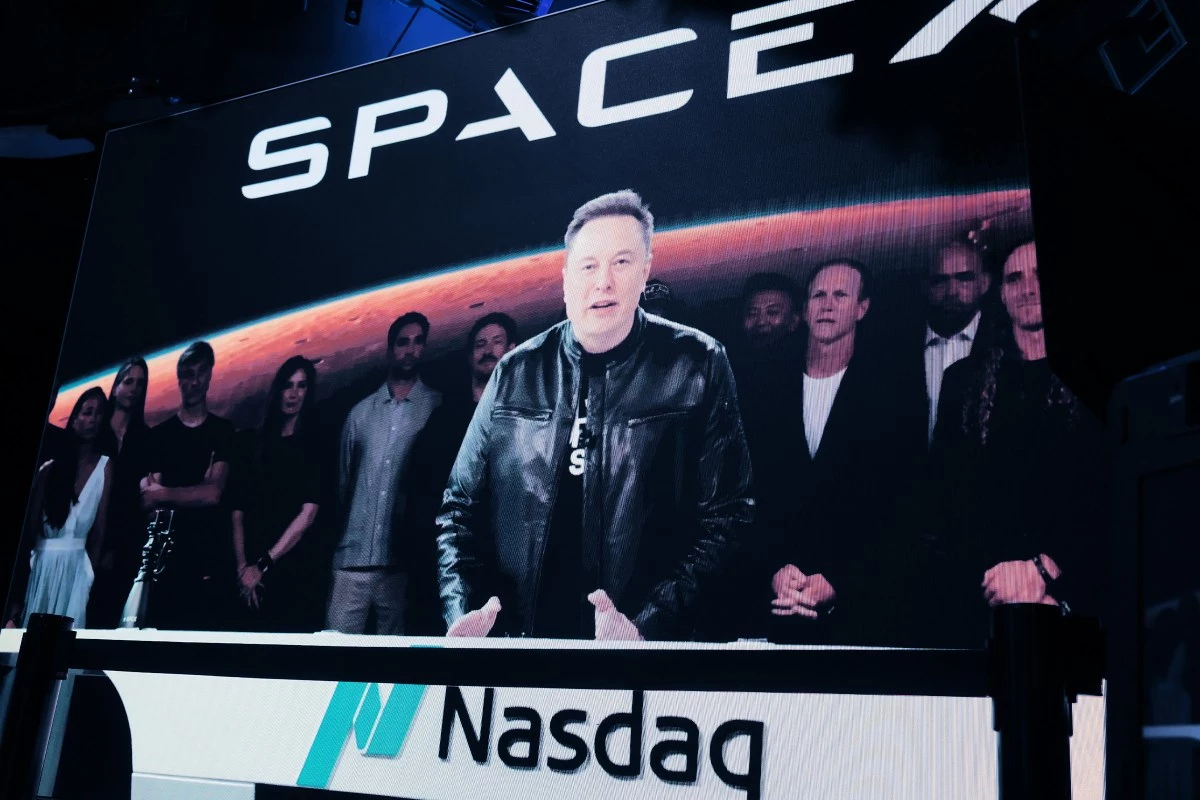

A blockbuster public debut that instantly raises the bar on accountability
SpaceX’s IPO arrival delivered the kind of opening-day spectacle that modern public markets rarely see at this scale. Shares debuting around $150 (roughly 11% above the offering price), surging intraday to $222, and stabilizing near $200 is more than a headline—it is a market signal. At its peak, SpaceX’s valuation briefly pushed past $2 trillion, placing it in striking distance of the world’s most valuable technology and consumer platforms and effectively reframing SpaceX from “aerospace disruptor” into a systemically important infrastructure-and-compute contender.
Yet the same price action that validates investor appetite also hardens expectations. Public markets are less forgiving than private capital when narratives outpace cash flows. With the company now under the continuous scrutiny of quarterly reporting and institutional governance, SpaceX’s valuation implies that investors are underwriting not only Starlink’s continued expansion, but also a broader thesis: that SpaceX can fuse launch economics, low-Earth-orbit (LEO) connectivity, and AI-adjacent compute into a durable profit engine.
Key tensions now sit in plain view:
- Valuation vs. operating reality: A multi-trillion-dollar market cap demands credible pathways to sustained profitability, not just technical milestones.
- Capital intensity: Space remains a high-fixed-cost domain; public investors will track whether scale reduces unit costs fast enough to offset expansion.
- Execution risk: The more ambitious the roadmap, the more markets will penalize delays, overruns, or regulatory friction.
Orbital data centers and “space edge computing” move from sci-fi to strategic thesis
The most provocative element of the forward narrative—deploying up to one million orbital data centers—is less important as a literal near-term plan than as a declaration of intent. It positions SpaceX as a would-be architect of orbital edge computing, where compute is placed closer to globally distributed data sources and users, potentially enabling sub-50 ms latency services when integrated with Starlink’s LEO network.
If realized even partially, this would challenge the traditional geography of cloud computing, which is currently anchored to terrestrial hyperscale regions and constrained by fiber routes, national borders, and physical security perimeters. The strategic appeal is clear: compute in orbit could serve latency-sensitive workloads, resilient communications, and specialized analytics where terrestrial infrastructure is degraded or unavailable.
Still, the engineering and commercial hurdles are not footnotes—they are the story:
- Thermal management: Data centers generate heat; radiating it in vacuum is non-trivial and may impose mass, power, and design penalties.
- Radiation and reliability: Space-grade hardening, fault tolerance, and redundancy requirements could reshape hardware economics versus Earth-based deployments.
- Inter-satellite backhaul: High-throughput optical links and routing complexity must scale without eroding the latency and cost advantages being promised.
- Maintenance and refresh cycles: AI compute evolves quickly; aligning GPU/accelerator refresh cadence with launch schedules and in-orbit servicing is a fundamental ROI constraint.
The xAI merger adds another layer: it suggests SpaceX is leaning into “data gravity”—the idea that compute should move toward data, not the other way around. In principle, training or running models closer to collection points reduces transfer costs and improves responsiveness. In practice, the market will demand clarity on what workloads truly benefit from orbital placement, and whether those workloads are large enough to justify the capex.
The financial equation: capital burn, competitive pressure, and the cost of ambition
The IPO pop does not eliminate the central investor concern: cash burn and persistent operating losses, reportedly amplified by the xAI integration and expansive capex ambitions. SpaceX now faces the classic public-market dilemma for frontier infrastructure businesses: growth is expensive, but the cost of capital is no longer negligible, and dilution is no longer abstract.
At a valuation north of $2 trillion, SpaceX is being priced less like an aerospace contractor and more like a platform company—implying future revenue streams that extend beyond launch services into connectivity, compute, defense-adjacent services, and potentially deep-space logistics. That optimism increases sensitivity to any mismatch between projections and execution.
Investors and enterprise customers will likely focus on a few measurable indicators:
- Capex-to-revenue trajectory: Whether new launches and constellation expansion translate into improving free cash flow over time.
- Starlink monetization quality: Growth in higher-margin segments such as enterprise, maritime, aviation, and government rather than pure consumer broadband.
- Unit economics discipline: Evidence that scale is reducing cost per delivered megabit and improving service reliability.
- Integration costs and synergies from xAI: Whether the merger creates defensible product differentiation or simply adds burn.
Competition also sharpens the stakes. Amazon’s Project Kuiper and OneWeb represent credible pressure on LEO broadband, while any move into orbital compute would place SpaceX in the crosshairs of cloud incumbents with entrenched enterprise relationships, pricing leverage, and mature compliance tooling. SpaceX’s advantage may be vertical integration—launch, satellites, and network control—but incumbents will counter with distribution, procurement familiarity, and hybrid-cloud lock-in.
Governance, regulation, and the new reality of being a public strategic asset
SpaceX now sits at the convergence of space infrastructure, telecommunications, AI-adjacent compute, and national security—a position that can diversify revenue but also multiplies oversight. The regulatory surface area is expansive: spectrum licensing, orbital debris mitigation, export controls, and data sovereignty expectations will increasingly shape product design and deployment timelines.
For institutional investors, the question is not whether SpaceX can innovate—it has repeatedly demonstrated that it can—but whether it can pair innovation with predictable execution, transparent governance, and capital discipline at public-company scale. Markets will reward credible sequencing: monetizing nearer-term opportunities while staging longer-horizon bets so that optionality does not become an open-ended liability.
The next chapters will be written in operational metrics rather than mythology: Starlink’s margin profile, contract durability in government and defense channels, capex efficiency, and the realism of orbital compute pilots. SpaceX’s IPO may have been priced like the future arrived early; the public market will now insist that the future also arrives on schedule—and on budget.

 By
By
 By
By

 By
By
 By
By

 By
By
 By
By







