

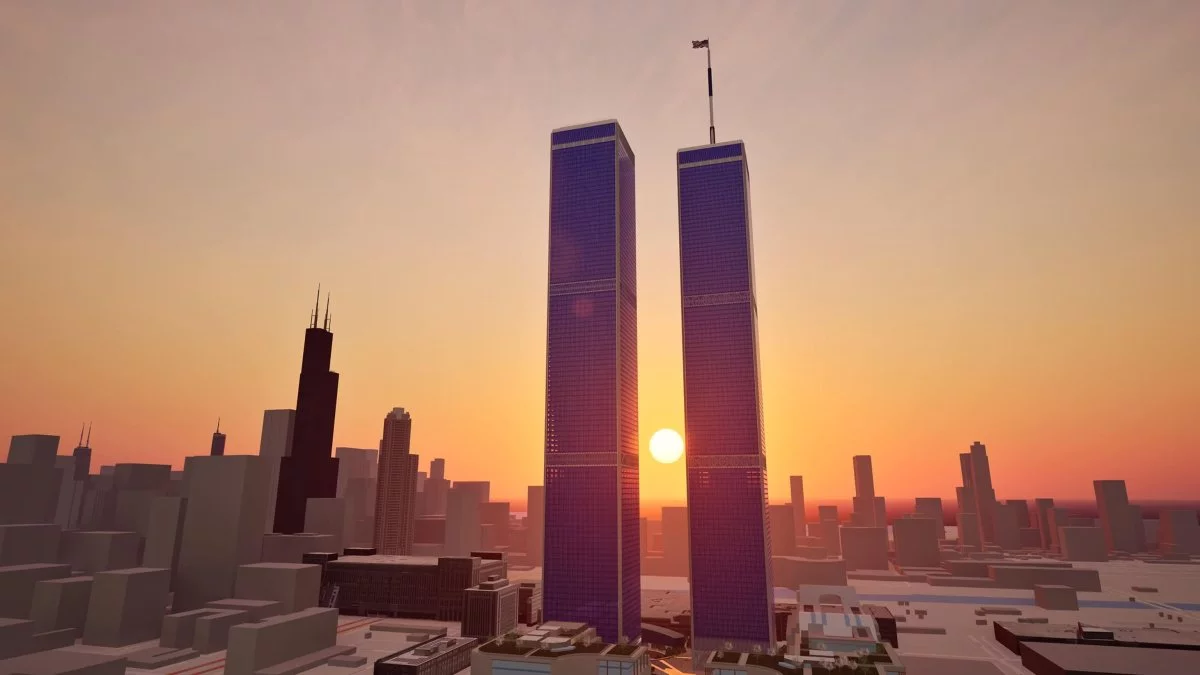

A bold recontextualization of an American icon into critical digital infrastructure
Raphael Chryslar’s World Tech Center proposal is, at its core, an attempt to fuse two powerful narratives: the emotional gravity of rebuilding the original Twin Towers and the pragmatic urgency of expanding hyperscale data-center capacity and STEM research infrastructure in the United States. The plan envisions a 35-acre, nine-building campus in Chicago, anchored by two towers described as “substantially safer” than their predecessors—using ultra-high-performance concrete cores, fire-proof steel I-beams, and advanced fire suppression systems.
What makes the concept unusually consequential for business and technology audiences is not simply the architectural symbolism, but the implied shift in how the next generation of strategic facilities may be designed: not as neutral commercial real estate, but as resilience-first, security-forward nodes in the national digital economy. With a notional opening date around 2050 and the project now positioned as being in a community engagement “phase 2,” the timeline suggests a long runway—one that could either enable careful coalition-building or expose the project to shifting political, regulatory, and market realities.
From an SEO and industry standpoint, the key framing is clear: this is a proposed Chicago data center campus + research park + security-hardened infrastructure initiative, built around a globally recognizable brand—the Twin Towers—repurposed as a platform for AI computing, cloud workloads, scientific laboratories, and national resilience.
The campus model: where hyperscale computing meets “digital-wet lab” R&D
The most commercially legible element of World Tech Center is its positioning as a hyperscale-grade data infrastructure hub. Demand drivers are well established: AI training and inference, regulated industry clouds, government modernization, and the continued growth of data-intensive science. The proposal’s emphasis on hardened cores and extreme safety engineering aligns with a broader trend: mission-critical workloads increasingly require facilities that treat availability and survivability as product features, not afterthoughts.
Equally notable is the plan’s co-location of compute with research functions—clean rooms, physics and life-science labs, university offices, and even NASA workshops. If executed, this would resemble an emerging “digital-wet lab” ecosystem, where high-performance computing and experimental environments are physically adjacent. That adjacency can matter in practical ways:
- Lower latency and faster iteration for AI-driven research (drug discovery, materials science, computational biology)
- Tighter feedback loops between simulation, prototyping, and testing (including semiconductor and advanced manufacturing workflows)
- Talent clustering effects, where universities, startups, and enterprise labs share a common campus fabric
For Chicago and the Midwest, the strategic implication is geographic: a project of this scale implicitly argues that the next era of innovation does not need to be anchored exclusively to coastal tech corridors. It also aligns with the broader U.S. industrial policy direction—where incentives resembling CHIPS Act-style logic could favor domestic capacity, supply-chain resilience, and regional diversification.
Security as a design principle: from cyber-physical hardening to aerial threat concepts
The most controversial—and arguably most revealing—component is the proposal’s mention of aerial-threat detection and neutralization, including radar and sensors and even speculative missile or laser defenses. In a civilian development context, that language is unorthodox. Yet it signals something important about the direction of critical infrastructure thinking: the boundary between cybersecurity and physical security is collapsing into a single cyber-physical risk model.
Data centers already operate as strategic assets; they host government services, financial systems, healthcare platforms, and industrial control data. As geopolitical tensions rise and infrastructure threats diversify, the market may increasingly reward “sovereign enclave” characteristics—facilities designed to withstand not only outages and cyberattacks, but also physical disruption. Whether or not aerial defense concepts are feasible, financeable, or permissible under regulatory regimes, the proposal is tapping into a real macro trend: resilience is becoming a competitive differentiator in cloud and colocation markets.
For stakeholders, the security dimension raises practical questions that will shape viability:
- Regulatory and legal constraints around defense-grade systems in civilian zones
- Governance and oversight models if public agencies, universities, and private tenants share a hardened campus
- Insurance, liability, and risk pricing, especially if the site is marketed as a high-value strategic node
- Data sovereignty and export-control compliance, particularly if advanced research and government workloads coexist
This is where the project’s ambition may either become its moat—or its friction point.
Capital, energy, and credibility: what will determine whether it becomes real
World Tech Center is capital intensive by design: towers, data halls, laboratories, hospitality, retail, and a performing-arts center imply a mixed-use megaproject with multiple revenue models and multiple risk profiles. That typically requires layered financing and early anchor commitments. The credibility pathway is likely to hinge on whether the project can secure a coalition that includes:
- Hyperscale cloud providers or major colocation operators (to underwrite data-center tenancy)
- Research universities and lab partners (to validate the STEM campus proposition)
- Federal or state economic development support (zoning, incentives, infrastructure upgrades)
- Energy and grid partners (to address power density, interconnection, and reliability)
Energy may be the decisive constraint. A hyperscale campus in 2050 will be judged not only on uptime, but on carbon intensity and grid impact. To align with corporate net-zero commitments and municipal decarbonization goals, the project would likely need credible plans for microgrids, on-site renewables, advanced cooling (including liquid or immersion), and waste-heat reuse—especially if laboratories and clean rooms are part of the footprint.
Finally, there is the branding dimension. Rebuilding the Twin Towers—outside New York, in Chicago—would inevitably carry symbolic weight. For some stakeholders, that symbolism could be a magnet for talent and sponsorship; for others, it may invite scrutiny about intent, stewardship, and historical sensitivity. In business terms, the brand is powerful, but it is not neutral—and the project’s long-term success would depend on whether symbolism and utility can be aligned without either overwhelming the other.
If World Tech Center advances beyond engagement phases into binding partnerships, it will be less a real estate story than a signal of where the market is heading: toward fortified, energy-aware, research-integrated compute campuses that treat resilience, sovereignty, and innovation velocity as a single strategic package.

 By
By
 By
By

 By
By
 By
By

 By
By
 By
By







