

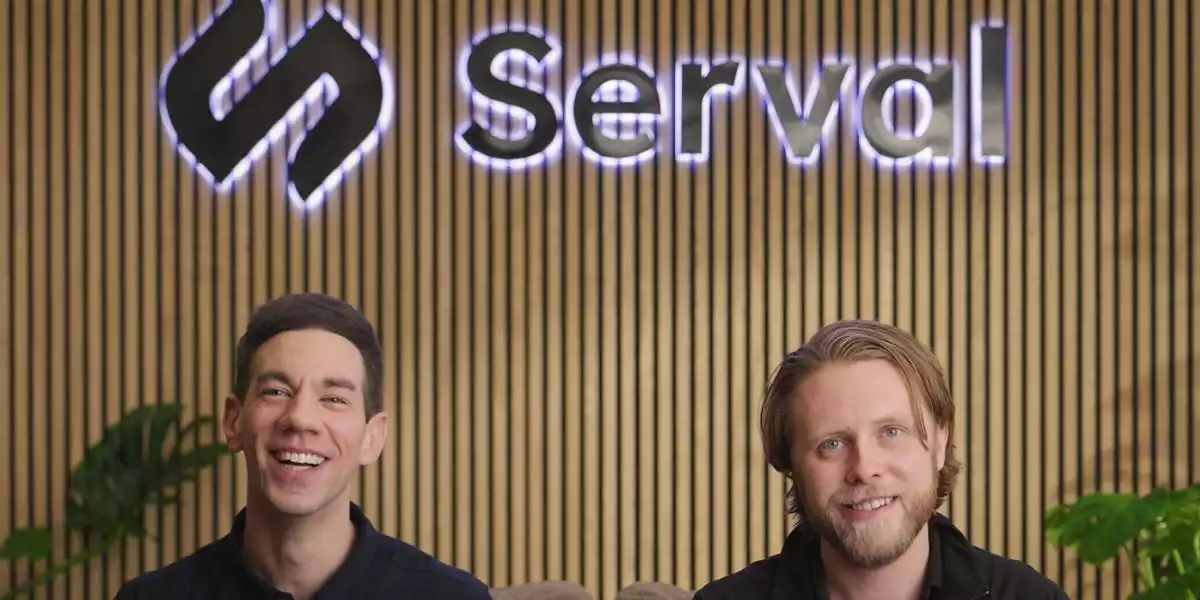

A visible talent signal amid SaaS market turbulence
A notable migration of senior enterprise sales talent from ServiceNow—including leaders tied to its Moveworks acquisition—to AI-native startup Serval is emerging as more than a recruiting story. It is a market signal: when experienced go-to-market operators move in clusters, they often reflect shifting beliefs about where enterprise software value will be created next.
This wave comes as ServiceNow’s share price has fallen roughly 40% over six months, a drawdown widely interpreted as part of a broader “SaaS-pocalypse” narrative—investor concern that generative AI could erode traditional subscription economics, compress margins, and weaken the durability of incumbent platforms. Against that backdrop, Serval’s $75 million Series B led by Sequoia—and a reported $1 billion valuation—does more than fund product development. It confers legitimacy, reduces perceived career risk, and strengthens the gravitational pull for senior operators who can translate product promise into revenue.
Several dynamics make this moment unusually catalytic:
- Risk parity has changed: layoffs and restructuring at large tech firms (including Block and Meta) have narrowed the psychological gap between “safe incumbents” and “ambitious startups.”
- Capital is concentrating: well-capitalized AI startups can now offer competitive compensation, meaningful equity, and clearer ownership of outcomes.
- Sales leaders follow velocity: when product cycles compress, sales cycles often follow—creating a compelling environment for customer-facing leaders who are measured on momentum.
In short, this is not simply a story of individuals leaving a large company for a smaller one; it is a story about how AI is reshaping the career calculus inside enterprise software.
Why AI-first architectures are changing the enterprise software playbook
The deeper driver behind the ServiceNow-to-Serval exodus is architectural. Generative AI has introduced a credible alternative to the long-dominant model of monolithic enterprise suites: AI-first platforms that assemble workflows dynamically, integrate rapidly, and iterate in weeks rather than quarters.
For incumbents, the promise of end-to-end workflow platforms remains powerful—especially in regulated environments where governance, security, and procurement favor consolidation. Yet AI’s modularity is changing buyer expectations. Enterprises increasingly ask not only “Does this platform cover everything?” but also “How quickly can it prove ROI in one narrow workflow, and can it plug into what we already have?”
That shift creates an “agility premium” for AI-native firms:
- Less legacy drag: startups unburdened by older codebases and long release trains can integrate new models (LLMs, fine-tuned transformers, retrieval-augmented generation) faster.
- Proof-of-concept acceleration: customer-facing teams gravitate to environments where pilots can be deployed quickly, measured, and refined—often compressing sales engineering timelines.
- Best-of-breed resurgence: generative AI can act as a unifying layer across tools, making modular stacks more feasible and reducing the lock-in advantage of large suites.
Talent becomes a technology vector in this context. Senior sellers and sales leaders do not just bring contacts; they bring deal heuristics, procurement navigation, pricing instincts, and repeatable go-to-market playbooks. When multiple leaders move together, the startup gains a compounding advantage: faster enterprise credibility, tighter messaging, and a shorter path to product-market fit.
Margin anxiety, valuation pressure, and the new war for enterprise profitability
The market’s unease is not about whether AI will add features; it is about whether AI will reprice value. Investors are increasingly focused on the possibility that generative AI could commoditize certain software functions, reduce differentiation, and pressure renewal pricing—especially where AI features become table stakes rather than premium add-ons.
This is the economic backdrop to ServiceNow’s drawdown and to the broader SaaS multiple compression seen across public markets. Three forces stand out:
- Margin anxiety: AI can raise infrastructure costs (compute, inference, model tuning) even as it accelerates feature delivery. If customers perceive AI as “included,” pricing power may weaken.
- Capital discipline: with interest rates elevated, both public and private markets reward clearer paths to profitability. Late-stage startups must show revenue traction, not just narrative.
- Labor as a balance-sheet lever: in a tighter macro environment, human capital becomes a high-impact asset. Poaching senior revenue leaders can create immediate upside for startups—and force incumbents into retention spirals via compensation resets and counteroffers.
Serval’s funding round matters here because it changes the negotiation landscape. A well-funded AI startup can credibly promise runway, product investment, and enterprise readiness—making it easier for senior talent to justify the move internally and to customers externally.
What this migration implies for ServiceNow, Serval, and the enterprise AI market
For incumbents like ServiceNow, clustered departures are rarely existential on their own, but they can become culturally and commercially contagious. One high-profile move creates social proof; alumni networks amplify it; LinkedIn becomes a broadcast channel for momentum. The risk is less about headcount and more about confidence—inside the sales organization, among partners, and eventually in the customer base.
The strategic response for large SaaS vendors is increasingly clear, even if execution is difficult:
- Make AI roadmaps legible: employees and investors want milestones, not slogans—concrete commitments to conversational workflows, autonomous service operations, and measurable automation outcomes.
- Rebuild speed inside scale: “startup pods” and skunkworks structures can help, but only if they have real authority, modern tooling, and incentives aligned with long-duration outcomes.
- Use M&A with retention teeth: acquiring AI-native capabilities without retaining the builders and go-to-market leaders is a short-lived win; earn-outs and retention structures become central.
For Serval and similar AI-native challengers, the opportunity is significant—but so is the burden. High-profile hires raise expectations for execution, enterprise-grade reliability, and repeatable ROI. The startups that win this cycle will be those that convert talent inflows into durable customer outcomes, not just faster demos.
Ultimately, the ServiceNow-to-Serval talent migration reads like an early indicator of where enterprise software is heading: toward AI-defined workflows, faster iteration, and a labor market that increasingly rewards velocity over incumbency—a competitive landscape where the next platform leaders may be decided as much by talent density and execution tempo as by product breadth.

 By
By

 By
By
 By
By
 By
By

 By
By
 By
By







