
Open-ear gaming audio as a deliberate bet on awareness, not isolation
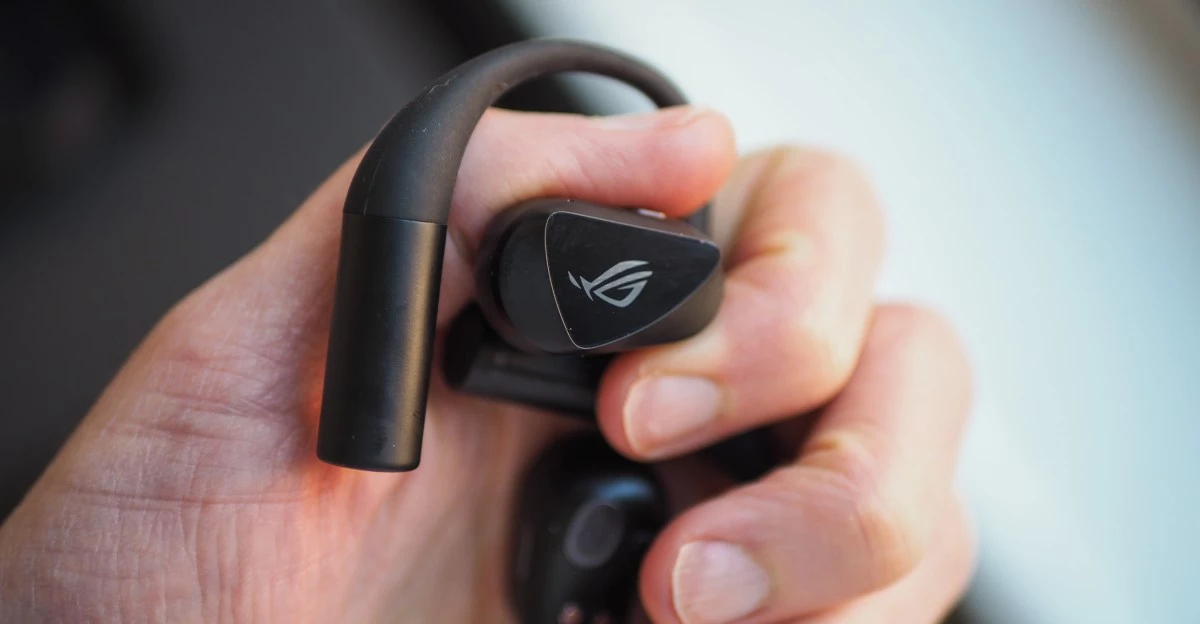
Asus’s launch of the Cetra Open Wireless earbuds signals a notable shift in how gaming audio is being productized: away from the traditional “sealed-in” in-ear monitor experience and toward an open-ear, ambient-integrated listening model. Instead of forming an in-ear seal, the Cetra Open rests outside the ear canal, intentionally allowing environmental sound to mix with game audio.
For a segment of gamers—particularly those playing in shared spaces, streaming while interacting with others, or using handheld devices in living rooms and cafés—this design choice is less a compromise than a philosophy. The product’s core value proposition is situational awareness and comfort, not maximum isolation.
That trade-off is technically unavoidable: without a seal, sub-bass extension and passive noise attenuation are inherently limited compared with snug-fit earbuds that can leverage the ear canal as an acoustic chamber. Asus’s answer is Phantom Bass enhancement, a software-and-tuning approach meant to restore perceived low-end impact. Whether that satisfies bass-focused users will depend on expectations; what’s clear is that Asus is optimizing for a different kind of immersion—one that keeps the outside world present rather than excluded.
From a user-experience standpoint, the open-ear approach also intersects with a growing, under-discussed differentiator in wearables: listening fatigue. By reducing ear-canal pressure and the occlusion effect, open designs can be more tolerable over long sessions—an advantage that matters in marathon gaming, travel, and hybrid work.
—
Low-latency wireless plus power pass-through: a peripheral architecture statement
The Cetra Open’s most strategically interesting engineering choice may not be the acoustic design, but the wireless architecture. Asus includes a USB‑C 2.4 GHz low-latency transmitter—a dedicated RF link designed to address one of gaming audio’s persistent pain points: latency variability over standard Bluetooth stacks.
Just as importantly, the dongle supports USB‑C pass-through charging up to 60 W, effectively turning the transmitter into a “middle layer” between a handheld gaming device and its power source. This is a subtle but meaningful convergence of audio peripheral + power delivery, and it aligns tightly with how modern portable gaming is used: plugged in, charging, and expected to behave like a console.
Key implications for gaming and device ecosystems include:
- Latency as a competitive feature, not a footnote: A stable, purpose-built 2.4 GHz link is a direct response to competitive gaming expectations where timing and lip-sync matter.
- Port economy for handhelds: Pass-through charging reduces the friction of choosing between “charging” and “using accessories,” especially on devices with limited ports.
- Multipoint connectivity as a lifestyle feature: Support for two Bluetooth devices or Bluetooth plus the RF dongle reflects how gaming increasingly coexists with calls, chat apps, and media consumption.
Asus also leans into product theater and identity—common in gaming peripherals—through RGB lighting, paired with practical features like voice-pickup microphones and rapid charging. Battery claims—up to 16 hours on Bluetooth and 10 hours on 2.4 GHz—position the Cetra Open as viable for travel and long sessions, though real-world performance will vary with volume, lighting, and codec behavior.
—
Software-defined differentiation: Armoury Crate, Gear Link, and the pull of ecosystem gravity
The Cetra Open is also a software product, not merely an audio one. Asus supports customization through Armoury Crate (mobile) and the browser-based Gear Link platform, extending the company’s broader strategy: make peripherals configurable, updatable, and identity-bearing within a single ecosystem.
This matters because gaming audio is increasingly shaped by software-defined experience layers: EQ profiles, mic tuning, firmware updates, and device-specific presets. Over time, these layers can become more valuable than incremental hardware revisions—especially as drivers and radio components commoditize.
From a business and platform perspective, this software footprint creates several strategic options:
- Community and retention loops via downloadable presets, updates, and device-wide profile syncing
- Potential premium feature tiering (for example, advanced spatial processing, noise gating, or game-specific tuning packs)
- A pathway to partnerships with esports teams, streamers, or game publishers through branded audio profiles and co-marketing
The broader implication is ecosystem gravity. As Armoury Crate expands from PC components into peripherals, Asus increases the likelihood that a user who buys one Asus device will consider another—an approach that mirrors how major platform players defend accessory margins and deepen lifetime value.
—
Competitive positioning and what it suggests about the next phase of gaming wearables
In a market crowded with snug-fit earbuds offering active noise cancellation (ANC) and deep isolation, the Cetra Open’s differentiation is intentionally orthogonal. It is not trying to out-ANC the category leaders; it is trying to normalize the idea that gaming immersion can coexist with ambient reality.
That positioning looks particularly tailored to handheld gaming systems such as the Nintendo Switch 2 and Steam Deck, where play often happens in semi-social environments and where a single USB‑C port must serve multiple roles. The inclusion of a low-latency dongle with power pass-through reads like a direct response to that usage pattern, and it may pressure competitors to treat dongles not as optional accessories but as integrated, power-aware modules.
Beyond gaming, the open-ear concept aligns with two macro trends that are increasingly shaping consumer electronics roadmaps:
- Hybrid work and “aware audio”: Users want to hear meetings, media, and notifications without fully disconnecting from colleagues or surroundings.
- AR/VR and mixed-reality audio principles: Maintaining environmental audibility while preserving positional cues is consistent with early mixed-reality design logic, where audio must blend digital and physical spaces.
The Cetra Open Wireless ultimately reads as a product designed for the overlap between gaming, mobility, and everyday life—where comfort, context switching, and power logistics matter as much as raw acoustic isolation. If the market responds, it won’t just validate an open-ear earbud; it will validate a broader thesis that the next wave of gaming peripherals will be defined by ambient integration, software ecosystems, and converged accessory architectures rather than by louder bass and tighter seals alone.

 By
By
 By
By
 By
By
 By
By


 By
By
 By
By