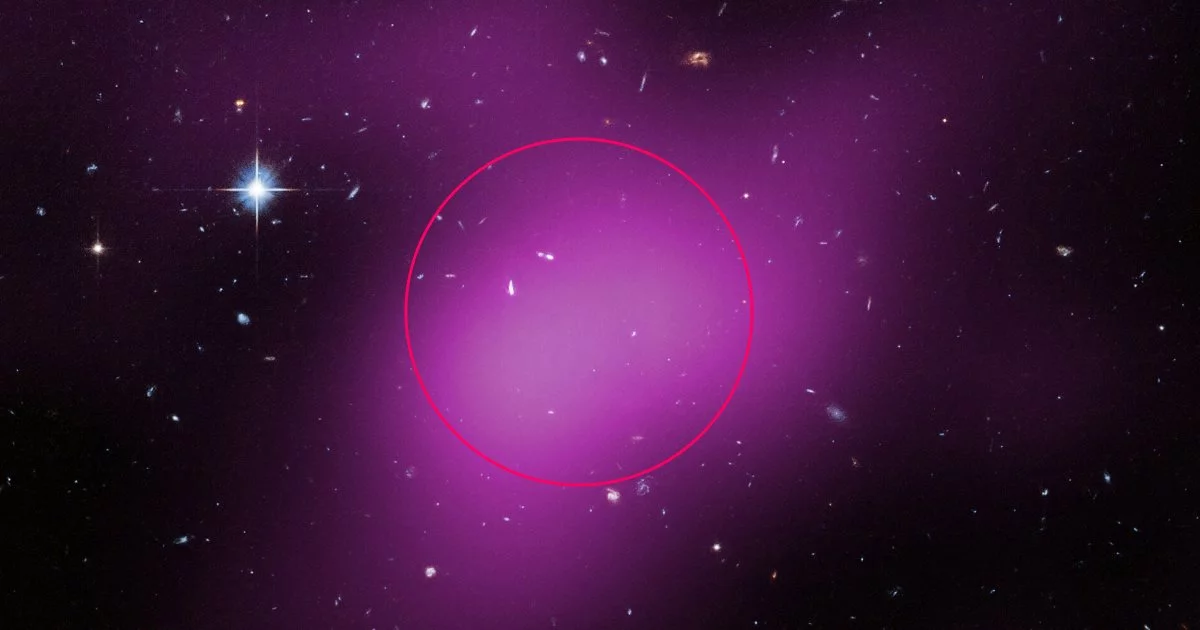

A Starless Giant: Cloud-9 and the Unveiling of Cosmic Infrastructure
In the vast, unlit corridors of intergalactic space, the discovery of “Cloud-9”—a 4,900-light-year-wide, starless, gas-rich dark-matter cloud—has electrified the scientific community and rippled through the corridors of business and technology. Situated some 14 million light-years from Earth, Cloud-9 is a cosmic anomaly: a million solar masses of hydrogen gas gravitationally bound within a dark-matter halo weighing in at five billion suns, yet never kindling the fires of star formation. This “failed galaxy,” first glimpsed by China’s FAST radio telescope and confirmed by the Hubble Space Telescope, is not merely a new entry in the astronomical ledger—it is a challenge to the foundational assumptions of how galaxies, and perhaps the universe itself, are built.
Rethinking the Cosmic Blueprint: From Baryons to Dark Matter
The prevailing cosmological narrative, long centered on the luminous drama of stars and galaxies, is now being rewritten in the shadowy ink of dark matter. Cloud-9’s existence is a direct refutation of the notion that galaxies are defined by their stellar populations. Instead, it stands as a living testament to the gravitational primacy of dark matter—a silent architect, shaping the fate of baryonic (normal) matter.
- A Laboratory for ΛCDM Models:
Cloud-9 offers a rare, pristine laboratory to test the Lambda–Cold Dark Matter (ΛCDM) paradigm at dwarf-galaxy scales. Here, the usual divergence between simulation and observation is brought into sharp relief, providing an opportunity to recalibrate our understanding of cosmic structure formation.
- Instrumental Synergy:
The discovery underscores the power of multimodal, multinational instrument stacks. FAST’s sensitivity to faint 21-cm hydrogen emissions and Hubble’s optical imaging together have created a contiguous, high-fidelity “digital twin” of Cloud-9. This approach—soon to be augmented by the James Webb Space Telescope’s infrared capabilities—heralds a new era of astrophysical research, one that is collaborative, data-rich, and increasingly reliant on AI-driven analytics.
Technology’s Ripple Effect: From Deep Space to Earthly Markets
The technological demands of uncovering Cloud-9 have catalyzed innovations with far-reaching commercial implications. The relentless pursuit of faint cosmic signals has driven advances in sensor and detector ecosystems, many of which are migrating into terrestrial markets.
- Sensor Innovation:
Ultralow-noise receivers and cryogenic amplifiers, honed for deep-sky observation, are now foundational to 5G/6G millimeter-wave front-ends, quantum photonics, and high-dynamic-range medical imaging.
- Manufacturing and AI:
The quest for ever-larger apertures—FAST, the Square Kilometre Array, and next-generation space telescopes—has accelerated breakthroughs in precision metal-forming, adaptive optics, and AI-assisted calibration. These capabilities are already being repurposed for satellite communications and autonomous-vehicle LiDAR.
- Data Workflows:
The petabyte-scale data reduction and AI-enhanced noise filtering required for Cloud-9’s detection mirror the data-intensive workflows of financial anomaly detection and real-time supply-chain analytics. The commercialization of exascale high-performance computing, particularly via cloud hyperscalers, is collapsing the time between observation and insight for both astrophysics and enterprise digital twins.
Strategic Implications: Business, Geopolitics, and the Space Economy
Cloud-9’s discovery is not merely a scientific milestone; it is a harbinger of strategic shifts in economic and geopolitical landscapes.
- Soft Power and Collaboration:
The joint efforts of China’s FAST and NASA’s Hubble telescope represent a rare nexus of U.S.–China scientific cooperation, even as broader relations remain fraught. Such flagship projects serve as geopolitical signaling tools, reinforcing the value of scientific soft power.
- Investment and Market Dynamics:
Each breakthrough in deep-space exploration fuels investor confidence in next-generation observatories and in-orbit servicing platforms. The $1 trillion space economy is tightening the public–private innovation loop, lowering launch costs, and expanding the reach of small-satellite constellations. The resulting surge in demand for deep-space telemetry is intensifying spectrum-management challenges, creating new regulatory and trading opportunities.
- Enterprise Strategy:
For firms active in radio-frequency components, cryogenics, or advanced materials, astrophysical instrumentation is emerging as a dual-use market, buoyed by stable public funding and defensible intellectual property. Venture capital and corporate venture arms are beginning to treat dark-universe research as a high-upside frontier, reminiscent of early genomics.
- Data-Driven Management Lessons:
Cloud-9 is a potent metaphor for the unseen forces that govern complex systems. Executives building predictive models—whether for customer churn or climate risk—would do well to consider the latent variables that, like dark matter, exert profound influence from the shadows.
The discovery of Cloud-9 is a clarion call: the next wave of competitive advantage will be forged at the intersection of deep-space exploration, AI-augmented data pipelines, and advanced hardware manufacturing. Those who heed the lesson of “hidden mass”—investing in both technology and analytical paradigms—will be best positioned to navigate, and shape, the emergent space-enabled economy.

 By
By
 By
By

 By
By
 By
By

 By
By
 By
By