

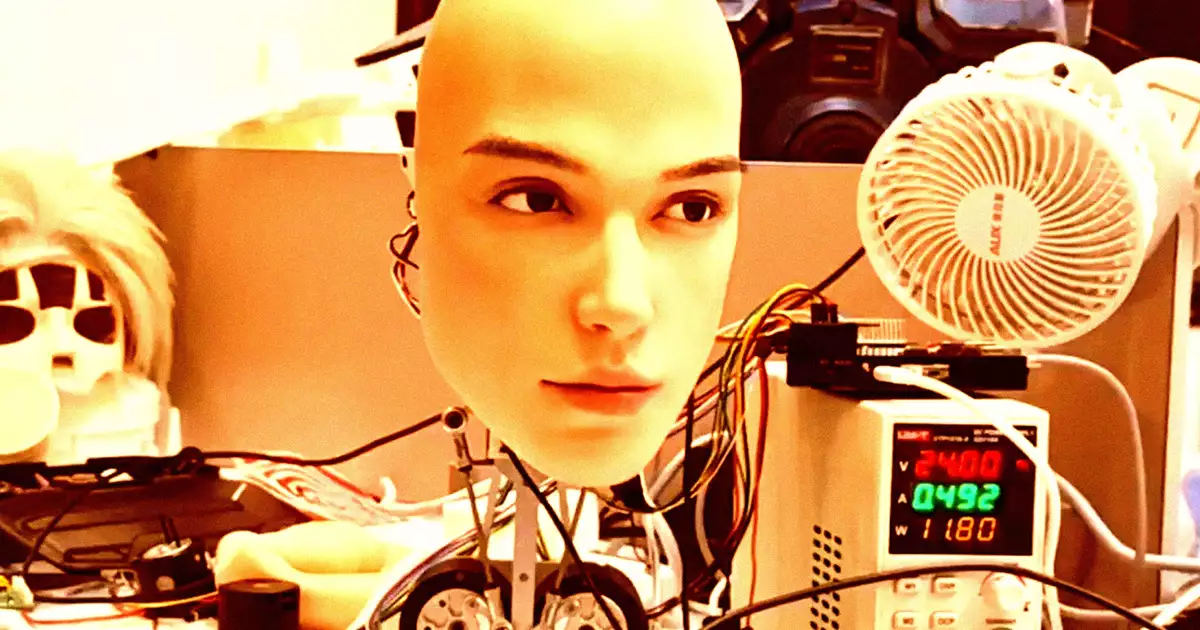

The Dawn of Emotionally Expressive Humanoids: AheadForm’s Lifelike Leap
In the heart of Hangzhou, a quiet technological revolution is underway. AheadForm, a company previously known to insiders for its deft integration of robotics and artificial intelligence, has unveiled a humanoid robotic head that does more than mimic human features—it emulates the subtlety of human emotion. With micro-actuators orchestrating blinks, frowns, and quizzical looks, and a self-supervised AI core learning from social context, this creation has electrified Chinese social media, hinting at a future where the line between machine and companion grows ever thinner.
Engineering Empathy: The Technology Behind the Face
What sets AheadForm’s innovation apart is not merely the realism of its expressions, but the sophisticated convergence of several technological frontiers:
- Self-Supervised Multimodal Learning: By training its AI to interpret and generate emotional nuance without relying on expensive, human-labeled datasets, AheadForm sidesteps a major bottleneck in affective computing. This approach allows the system to adapt in real-time to new social environments, making it as much a student of context as a performer of emotion.
- Advanced Bionic Actuation: The company’s micro-servo architecture, inspired by biological tendons rather than traditional linear actuators, marks a significant leap toward lifelike movement. This innovation, echoing advances in soft robotics, opens the door to applications far beyond humanoids—think next-generation prosthetics, immersive haptics, and telepresence avatars.
- Systems Convergence: The integration of high-bandwidth sensors, edge AI chips, and cloud-based self-learning creates a feedback loop where perception, cognition, and action are tightly coupled. The result is a platform that can not only navigate and manipulate the physical world, but also emote with a coherence that was, until now, the exclusive domain of humans.
This technical alchemy positions humanoid robots as the next evolutionary step in human-machine interaction, following the arc from smartphones to voice assistants and now to embodied, emotionally intelligent agents.
Economic Imperatives and Strategic Realignment
The timing of this breakthrough is no accident. China’s shrinking working-age population and rising labor costs across advanced economies are fueling demand for robotic labor. Humanoid platforms, designed to operate within existing human-centric environments, promise rapid, frictionless deployment—a stark contrast to the rigid, task-specific robots of the industrial age.
- Supply Chain Resilience: Amid tightening export controls on high-end AI accelerators, AheadForm’s focus on domestic supply chains and indigenous edge computing could prove a decisive advantage, insulating it from the geopolitical turbulence that threatens competitors reliant on foreign semiconductors.
- Capital Markets and Intellectual Property: Investor sentiment is shifting from pure software AI to full-stack robotics, where hardware innovation creates defensible moats. Early movers who secure patents in biomimetic actuation and facial micro-mechanics may unlock lucrative licensing streams across healthcare, entertainment, and defense.
This strategic calculus is already reshaping the competitive landscape. While giants like Tesla optimize for manufacturing and logistics, AheadForm is carving a niche in social fidelity—targeting sectors where emotional nuance is not a luxury, but a necessity: eldercare, mental health, hospitality, and immersive media.
Navigating Uncanny Valleys and New Frontiers
Yet, the path forward is anything but straightforward. The so-called “uncanny valley”—that uneasy space where robots seem almost, but not quite, human—remains a formidable hurdle. Ergonomic constraints, cost-to-payload ratios, and the ever-present specter of job displacement raise profound questions for executives and policymakers alike:
- Workforce Transformation: As humanoids take on more interactive roles, the demand for manual labor will shift toward fleet orchestration and oversight, necessitating new training paradigms and labor relations frameworks.
- Regulation and Trust: With expressive robots blurring the boundaries of personhood, issues of biometric data governance, consent, and psychometric safety will move from technical debates to boardroom imperatives.
- Cyber-Physical Security: The very actuators that enable nuanced expression also introduce novel attack surfaces—spoofed datasets or malicious code could induce not just malfunction, but misinformation or psychological harm.
For decision-makers, the challenge is to balance innovation with caution: to pilot deployments in high-value service niches, secure critical intellectual property, and engage early with regulators to shape the standards of tomorrow.
Amid this landscape, the emergence of emotionally expressive humanoids is more than a viral curiosity. It signals a paradigm shift, where affective computing, advanced actuation, and trustworthy autonomy become the new pillars of human-machine coexistence. The companies that master this triad will not only define the next decade of robotics—they will help redraw the boundaries of the social contract itself.

 By
By
 By
By
 By
By

 By
By
 By
By
 By
By
 By
By







