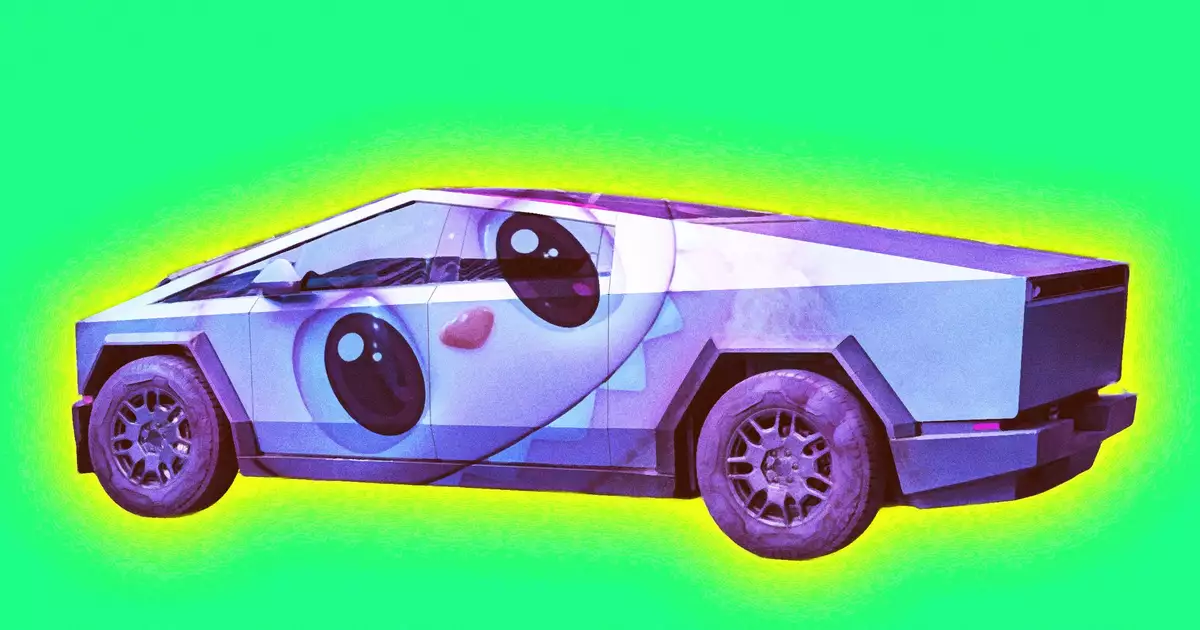

When Steel Meets Storybook: The Cybertruck’s Unexpected Canvas
The sight of a Tesla Cybertruck—already a lightning rod for design discourse—wrapped in the mischievous, wide-eyed characters of Kasing Lung’s Labubu universe has sent ripples far beyond the highways of California. Here, the once-impenetrable exoskeleton of Elon Musk’s most controversial vehicle becomes a rolling tableau for Asian folklore, upending expectations and igniting a fresh debate about the future of automotive identity. The Labubu-wrapped Cybertruck is not merely an aesthetic oddity; it is a harbinger of how pop culture, technology, and consumer psychology are converging to redefine what it means to own—and be seen in—a car.
Personalization as Platform: The Economics of Expressive Mobility
The global appetite for automotive customization is no longer a subcultural niche; it is a $380 billion market on the cusp of transformation. For electric vehicle manufacturers, whose margins are increasingly pinched by battery costs and commoditizing hardware, the wrap phenomenon represents a lucrative adjacent revenue stream. Tesla’s own official wraps, priced north of $6,000, are just the beginning. Viral, third-party collaborations—such as the Labubu Cybertruck—hint at an untapped total addressable market, especially if automakers formalize partnerships with artists and license limited-edition designs.
This trend is not merely about surface treatments. It’s about turning vehicles into platforms for ongoing engagement and monetization:
- Dynamic Pricing Models: Limited-run artist collaborations can command premium pricing, much like luxury-streetwear drops.
- Digital-Physical Bundling: Imagine subscription packages where a Labubu wrap unlocks matching dashboard themes or custom sound profiles.
- Data Feedback Loops: Augmented reality configurators, letting buyers visualize wraps in real time, generate invaluable data on consumer taste clusters—fuel for future product development and targeted upselling.
For creative IP holders, the automotive sector is an emerging canvas. As Asian pop-culture brands like Labubu, Pokémon, and Hello Kitty leap into Western consciousness, the car becomes a vessel for cross-cultural soft power and diversified royalty streams. The implications for licensing are profound, extending from physical exteriors to in-car UI skins and even XR overlays.
Technology, Regulation, and the New Materiality of Cars
The Cybertruck’s stainless-steel body, once touted as a triumph of material science, is also a challenge for traditional paint—and a boon for the wrap ecosystem. Non-destructive, easily reversible, and endlessly customizable, wraps are accelerating innovation in materials and installation techniques. Start-ups are already investing in rapid-install, self-healing films engineered specifically for EV exoskeletons.
But the technological leap is not without friction. Highly reflective or intricately patterned wraps may interfere with LIDAR and camera-based advanced driver-assistance systems, raising questions for regulators. Standards bodies such as SAE and UNECE are now tasked with updating guidelines to ensure that the pursuit of expressive mobility does not compromise safety or sensor integrity. The regulatory landscape is poised for rapid evolution as personalization becomes mainstream and autonomy scales.
Culture, Brand, and the Meme-ification of Mobility
What does it mean when a vehicle designed as a “post-apocalyptic tank” is draped in the innocence of storybook creatures? The Labubu Cybertruck embodies a kind of ironic affordance, a playful incongruity that echoes the logic of luxury-streetwear collaborations—think Louis Vuitton x Supreme, but on four wheels. This is not just about taste; it is about the economics of attention. Each viral wrap becomes a zero-cost billboard, driving engagement and brand reach far beyond the limits of traditional marketing.
For Tesla, whose brand is increasingly polarized between technological admiration and sociopolitical fatigue, third-party aesthetic overlays offer a reputational hedge. By decoupling the vehicle from its creator’s divisive persona, wraps like Labubu’s provide a palette for new narratives—ones that are more inclusive, playful, and culturally resonant.
As global EV demand cools in mature markets and inflation drives consumers toward “instagrammable” experiences, the personalized car occupies the same aspirational space as limited-edition sneakers or NFTs. The wrap is no longer an accessory; it is the product.
The industry stands at a crossroads. Automakers who architect robust artist-collaboration pipelines, data-driven customization tools, and forward-thinking regulatory strategies will not only capture margin—they will shape the cultural meaning of mobility itself. The Labubu Cybertruck, in all its whimsical defiance, is a signal: the future of automotive differentiation will be written as much in pixels and licensing agreements as in kilowatt-hours and torque.
 By
By
 By
By
 By
By
 By
By
 By
By