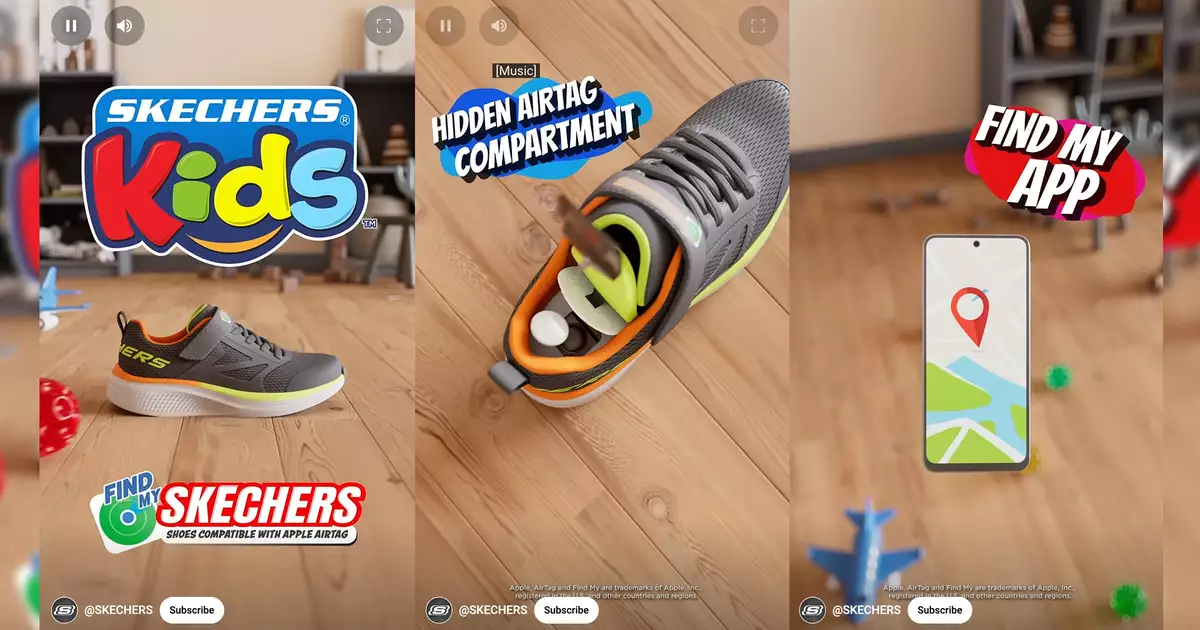

Footwear as a Platform: Skechers’ Bet on Ambient Connectivity
Skechers’ recent unveiling of “Find My Skechers” marks a pivotal moment in the convergence of consumer IoT, retail innovation, and parental peace of mind. At first glance, the product—a $60 children’s sneaker with a hidden AirTag pocket—seems a clever, if incremental, response to the perennial problem of lost shoes. But beneath the surface, this launch signals a deeper shift: the transformation of everyday apparel into nodes on a global, location-aware network.
By leveraging Apple’s Find My infrastructure, Skechers sidesteps the immense capital and technical hurdles that have historically dogged “smart” wearables. There are no proprietary apps to maintain, no batteries to manage, and no cloud platforms to secure. Instead, the company deftly inserts a thin, under-insole sleeve, sized precisely for an AirTag or similar BLE/UWB tracker, into a standard sneaker chassis. The result is a product that delivers high-perceived value with minimal incremental cost—an asset-light model that outsources the digital heavy lifting to Apple, effectively renting a piece of Silicon Valley’s R&D for free.
This strategy is not unique to Skechers; luxury luggage brands like Rimowa have already adopted similar architectures. Yet the implications for the $40 billion global children’s footwear market are profound. Safety-oriented segments routinely command 10–15% price premiums, and the incremental $15 upcharge over a baseline sneaker is a masterclass in margin defense. For Apple, every pair of “Find My Skechers” sold is a potential trigger for an ancillary AirTag purchase, illustrating the symbiotic, cross-category demand that can arise when consumer brands piggyback on platform ecosystems.
The Surveillance Trade-Off: Parental Assurance Meets Privacy Dilemma
The genius—and controversy—of Skechers’ approach lies in its framing. By marketing the feature as a way to “find shoes,” the company sidesteps, at least rhetorically, the thornier issue of tracking children. Yet the reality is that item-level geolocation, when embedded in products designed for kids, inevitably raises questions about surveillance, consent, and regulatory oversight.
Already, privacy advocates are sounding alarms. In the European Union, the combination of a product “likely to be used by children” and persistent geolocation data invokes not only GDPR-K but also the emerging strictures of the EU AI Act. In the United States, legislative momentum is building behind the Kids Online Safety Act and COPPA extensions, which may soon extend duty-of-care requirements to physical products with connected features. For Skechers and its peers, the message is clear: invest in privacy-by-design audits, transparent data-handling charters, and robust parental consent flows—or risk regulatory whiplash.
Yet, the normalization of such tracking capabilities is unlikely to stop at children’s sneakers. Apparel resale platforms, hungry for anti-counterfeit assurance, see item-level identifiers as authenticity tokens. Insurers and retailers, eyeing risk reduction and targeted advertising, may seek to subsidize tagged products in exchange for data access. The mesh between consumer goods and cloud intelligence is tightening, and with it, the boundaries between convenience, commerce, and surveillance are blurring.
Competitive Dynamics and the Coming Wave of Smart Apparel
The rapid commoditization risk looms large. Once rival brands add similar AirTag pockets—or leapfrog with embedded low-power modules—the first-mover advantage erodes. Major athletic brands, already boasting digital ecosystems like Nike Run Club or Adidas Runtastic, are well-positioned to embed proprietary trackers, capturing valuable first-party data and sidestepping Apple’s gravitational pull. Private-label retailers may adopt open, standards-based tags, pushing the market toward interoperability and away from platform lock-in.
Technological progress is accelerating. Ultra-wideband chips are approaching sub-$1 price points at scale, promising centimeter-grade accuracy and tamper alerts within 12–18 months. Energy-harvesting midsoles could soon power always-on sensors, transforming footwear from passive apparel into active health and performance monitors. The absence of on-shoe electronics in today’s “Find My Skechers” is merely a placeholder for a future where biometric chips and subscription analytics become commonplace.
Navigating the Ambient Future: Strategic Imperatives for Brands
For executives, the lesson is unmistakable: the ambient-computing era is arriving, and with it, the expectation that physical goods will not only be smart, but also contextually aware and networked by default.
Key strategic imperatives include:
- Hedging Platform Dependency: Building bridges to non-Apple ecosystems—Samsung SmartThings, Tile, Matter—will be critical to avoid single-vendor lock-in and to expand the addressable market.
- Investing in Trust Capital: Transparent privacy practices, third-party certifications, and early engagement with child-safety NGOs will become non-negotiable as reputation risk scales with adoption.
- Exploring Adjacent Revenue Streams: Piloting loss-protection insurance, subscription geo-notifications, and aggregated footfall analytics can unlock new annuity revenue and behavioral data.
- Anticipating Regulatory Shifts: Mapping global privacy and IoT security statutes, and baking compliance costs into product P&Ls, can turn early compliance into a durable competitive moat.
As “Find My Skechers” steps onto the market, it is less a novelty than a harbinger. The mesh of location, identity, and—soon—biometrics within consumer products is set to redefine not only retail economics, but also the very architecture of trust and competition in the digital age. Brands that recognize this inflection point, and act with both agility and foresight, will shape the contours of the ambient future.

 By
By
 By
By
 By
By

 By
By


 By
By