

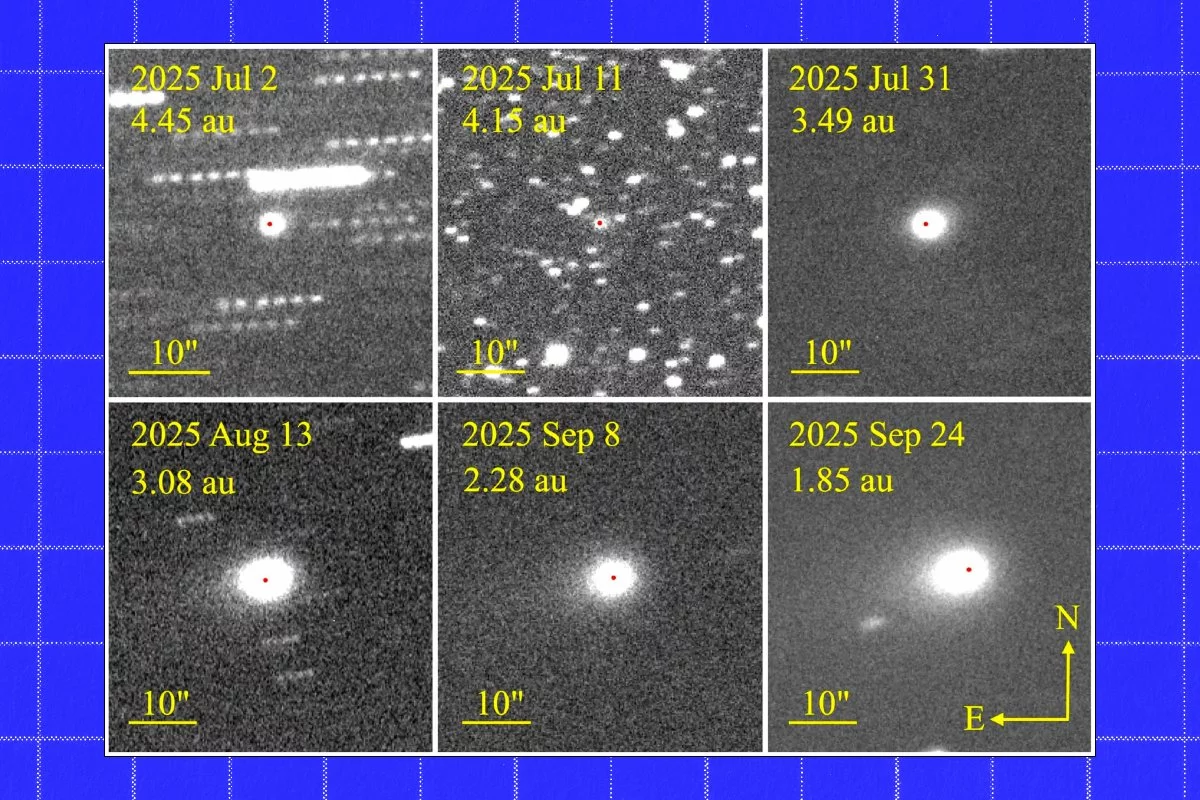

The Arrival of 3I-ATLAS: A Catalyst for the New Space Economy
The recent detection of 3I-ATLAS—only the third confirmed interstellar object to traverse our Solar System—has electrified both the scientific community and the broader public imagination. While most astronomers classify it as a cometary wanderer, the more provocative hypothesis, advanced by Harvard’s Avi Loeb, suggests a controlled spacecraft executing deliberate maneuvers. Regardless of its true nature, 3I-ATLAS has become a crucible for a set of transformative trends reshaping the global space ecosystem: the maturation of sensor networks, the convergence of public and private capital, and the potent influence of narrative economics.
Deep-Space Sensing: From Terrestrial Eyes to Heliocentric Networks
The identification of 3I-ATLAS by the Asteroid Terrestrial-impact Last Alert System (ATLAS) marks a milestone in automated, wide-field optical surveillance. ATLAS, operating as part of a rapidly expanding global sensor lattice, exemplifies how persistent, multi-platform monitoring—ranging from ground-based telescopes to solar observatories and, soon, AI-enabled small-satellite constellations—has become the backbone of deep-space situational awareness.
Yet, the episode also exposes the limitations of an Earth-centric perspective. As 3I-ATLAS slips behind the Sun, a “data gap” emerges, underscoring the need for out-of-plane and heliocentric sensor nodes. The growing interest in deploying observatories at Lagrange points or in solar-polar orbits is not merely an academic pursuit. It represents a strategic investment to close observational blind spots, ensuring that transient interstellar phenomena do not escape scrutiny. The transfer of GPU-powered analytics from time-domain astronomy to dual-use applications—such as missile warning and orbital debris tracking—demonstrates the fluidity with which technological advances are migrating across sectors.
Capital, Competition, and the Narrative Economy
The spectacle of 3I-ATLAS has not only captivated scientists but has also triggered a surge of speculative capital. History suggests that heightened media attention, even when tinged with conjecture, correlates with increased funding for early-stage astrophysics ventures. Start-ups focused on spectrometry, advanced propulsion, and off-Earth resource mapping are likely to benefit from a short-term “Loeb premium,” as grant proposals invoking technosignature searches or rapid intercept missions gain traction.
This narrative-driven funding cycle is not lost on communication strategists. The episodic spike in public fascination with extraterrestrial possibilities can be harnessed to accelerate investment and talent acquisition—provided that scientific credibility is carefully maintained. Meanwhile, insurance underwriters for commercial satellite operators are recalibrating their risk models. The prospect of anomalous, potentially artificial trajectories introduces new variables into collision risk assessments, prompting discussions around specialized insurance riders for interstellar object encounters.
Security, Geopolitics, and the Fusion of Space Agendas
For defense establishments, 3I-ATLAS is more than a scientific curiosity. It serves as both a calibration target and a stress test for protocols designed to respond to unanticipated space events. The mere suggestion that such an object could be an engineered probe, however remote, is a valuable forcing function—compelling military planners to expand threat frameworks beyond terrestrial adversaries.
Geopolitically, the race to track and characterize interstellar objects is intensifying. China’s deep-space radar initiative at Jiuquan and the European Space Agency’s Flyeye telescopes in Sicily are emblematic of a broader convergence: space situational awareness is now a domain where astronomy, defense, and commercial interests intersect. The emerging consensus around data-sharing norms and space-traffic management will shape the regulatory environment for years to come.
Strategic Imperatives in an Era of Cosmic Uncertainty
The 3I-ATLAS episode offers a blueprint for forward-leaning enterprises. Five imperatives stand out:
- Invest in Non-Terrestrial Sensor Platforms: Capital allocation should favor heliophysics-adjacent assets to mitigate observational blind spots.
- Leverage Narrative Economics: Harness public fascination to drive funding and recruitment, while safeguarding scientific rigor.
- Anticipate Regulatory Complexity: Prepare for legal ambiguities surrounding ISO interception, ownership, and planetary protection.
- Pursue Dual-Use Analytics: Repurpose astronomy-grade AI for terrestrial intelligence, surveillance, and reconnaissance, unlocking cost efficiencies.
- Monitor Key Reacquisition Windows: The object’s post-December trajectory will serve as a market signal, informing both scientific consensus and investment flows.
The arrival of 3I-ATLAS is more than a fleeting astronomical event; it is a harbinger of the accelerating fusion between astronomy, defense, and commercial space. Organizations that treat this moment as a strategic rehearsal—upgrading their sensors, data infrastructure, and policy frameworks—will be best positioned to navigate, and lead, the high-growth, high-uncertainty landscape of the New Space economy. As the next chapter in interstellar discovery unfolds, the stakes are no longer confined to academic journals—they are written in the language of capital, strategy, and global influence.

 By
By
 By
By

 By
By
 By
By


 By
By







