

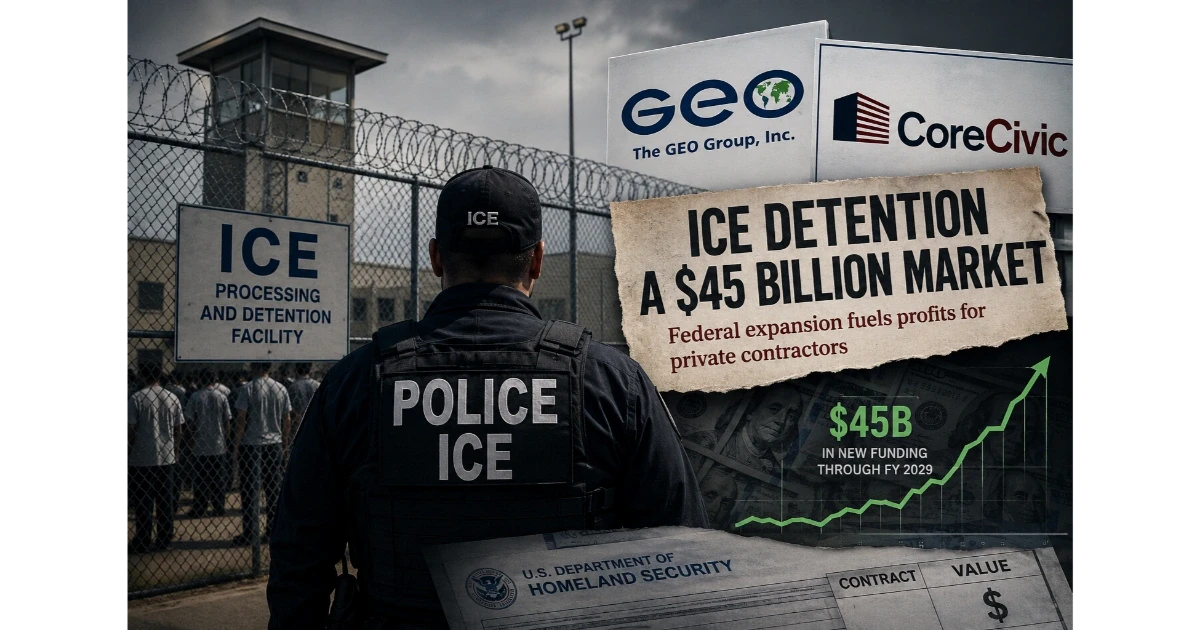

Federal immigration expansion is creating a lucrative ecosystem spanning detention facilities, electronic monitoring, transportation and data-driven location services
The rapid expansion of U.S. immigration detention is becoming a major government-contracting growth market, with tens of billions of dollars in new federal funding flowing into an ecosystem of private detention operators, transportation providers, monitoring companies and other enforcement contractors.
A new analysis published by researcher Sherafgan Khan on Sherafy.com traces that emerging market through congressional appropriations, federal audits, corporate financial reports, lobbying disclosures and political spending records. Its central finding is difficult to ignore: as Washington expands immigration enforcement capacity, some of the largest private contractors serving U.S. Immigration and Customs Enforcement are reporting sharply higher revenue, new multiyear contracts and reopened facilities.
The numbers behind the expansion are substantial.
Public Law 119-21 provided ICE with roughly $75 billion in additional funding through fiscal 2029, including $45 billion specifically for detention capacity, according to the Government Accountability Office. The Department of Homeland Security has said the funding is sufficient to support an average daily detention population of approximately 100,000 people and roughly 80,000 additional ICE beds.
For companies positioned to supply that capacity, immigration policy has rapidly become a revenue catalyst.
GEO Group Turns Detention Expansion Into Record New Business
The GEO Group, one of the largest private operators serving ICE, described 2025 as the most successful year for new business wins in its history.
Its annual report shows the company secured new or expanded contracts representing as much as $520 million in incremental annualized revenue during the year. Five facility activations alone represented approximately $400 million in annualized revenue, including four new ICE facilities totaling roughly 6,000 beds and the reactivation of the 1,940-bed Adelanto ICE Processing Center.
GEO also expanded transportation services for ICE and other federal agencies, representing approximately $60 million in incremental annualized revenue. Its BI Incorporated subsidiary won a new ICE skip-tracing contract valued at as much as $60 million per year, adding another piece to an increasingly diversified immigration-enforcement portfolio that already includes electronic monitoring and case management.
The financial momentum continued into 2026.
GEO reported second-quarter revenue of $732.1 million, up 15% year over year, while net income attributable to GEO operations climbed 63% to $47.5 million. Management said revenue growth was being driven by contracts secured during the company’s record-setting 2025.
The company has since secured additional five-year ICE agreements. A 1,188-bed facility in Colorado is expected to generate about $85 million during its first full year of operations, while a 1,320-bed facility in North Carolina is expected to generate approximately $80 million. ICE will also reimburse GEO for certain capital expenditures and startup costs associated with activating the facilities.
The result is a business model increasingly tied not merely to prison management, but to a broader chain of immigration-enforcement services.
CoreCivic Sees ICE Revenue More Than Double
CoreCivic is experiencing a similar acceleration.
The company reported $2.2 billion in revenue for 2025, up 13%, while annual net income increased 69% to $116.5 million.
More striking is the change in its ICE business.
CoreCivic said management revenue from ICE — which it describes as its largest government partner — reached $244.7 million during the fourth quarter of 2025, compared with $120.3 million a year earlier.
That means quarterly ICE revenue more than doubled.
The company attributed the increase to reopened and newly activated facilities, higher detention populations and acquisitions. CoreCivic has also been positioning previously idle properties for potential reactivation as federal demand increases.
For investors, the operating relationship is straightforward: higher government demand for detention capacity can translate into higher occupancy, additional facility activations, new per-diem payments and greater revenue.
That linkage is now visible directly in corporate earnings.
Immigration Enforcement Is Becoming a Services Platform
One of the most important points in Khan’s analysis is that the commercial opportunity extends well beyond detention beds.
GEO’s portfolio demonstrates how a single government contractor can participate across several stages of the enforcement process.
Its businesses can provide electronic monitoring and case management for people who are not detained, conduct location research through skip-tracing services, transport people in federal custody and operate facilities where detainees are confined.
Commercially, that transforms immigration enforcement from a narrowly defined detention market into something closer to a vertically integrated government-services sector.
For technology vendors, that distinction matters.
Electronic monitoring, identity verification, data matching, location intelligence, case-management software, secure transportation logistics and detention-facility infrastructure increasingly sit within the same federal spending environment.
The $45 billion detention appropriation therefore represents more than a construction or corrections story. It is part of a larger public-sector technology and services market whose growth is being driven by policy.
Fixed-Cost Contracts Create a Procurement Problem
The expansion also carries significant procurement risk.
A 2021 GAO investigation found that ICE had increasingly used contracts containing guaranteed minimum payments, under which the government paid detention operators for a fixed number of beds regardless of whether those beds were occupied.
During May 2020 alone, ICE spent approximately $20.5 million on more than 12,000 unused beds per day on average, according to the watchdog.
More significantly, GAO documented a case in which ICE officials said detainees were moved out of a Louisiana facility partly because the agency had acquired capacity elsewhere with guaranteed minimums and therefore needed to transfer detainees to meet those minimum commitments.
ICE has since told GAO that it intends to phase out traditional guaranteed minimum arrangements in favor of other fixed-cost structures. But as of June 2026, GAO said the agency still had not demonstrated that its revised approach had fully addressed the watchdog’s recommendation.
The issue is not confined to older agreements.
At Camp East Montana, ICE’s enormous detention facility at Fort Bliss, federal auditors found that fixed pricing resulted in millions of dollars being spent on unused services.
The facility held roughly 1,600 detainees at the end of February 2026, yet ICE continued paying for meals based on capacity for 5,000 people. GAO calculated that approximately $7.1 million was spent on meals that were not needed between October 2025 and March 2026.
For procurement leaders, the lesson is broader than immigration policy: rapidly scaling government capacity under fixed-price arrangements can create severe utilization risk when demand forecasts, contract design and operational reality diverge.
Lobbying Adds Another Layer of Risk
The expanding market also intersects with federal lobbying.
Official disclosures show GEO lobbying the House, Senate, ICE and the Office of Management and Budget on matters including immigration enforcement, government appropriations and the use of public-private partnerships.
GEO states in those disclosures that it does not advocate for policies determining the basis or length of an individual’s immigration detention.
CoreCivic has made a similar distinction, stating that its lobbyists do not advocate for policies determining who should be incarcerated or detained.
That distinction is important.
But companies do not need to lobby over individual detention decisions for federal policy to materially affect their businesses. Decisions involving detention appropriations, private-sector participation, facility construction and contract structures can alter the size of the addressable market without changing the legal standard governing who may be detained.
That creates an increasingly sensitive overlap between public policy and shareholder value.
What This Means for the Government-Technology Market
For executives and investors, several market signals are emerging:
- Federal immigration spending is creating a multiyear demand cycle. The $45 billion detention appropriation extends through fiscal 2029, giving contractors unusual visibility into a politically driven government market.
- Idle physical assets have become strategic capacity. Previously dormant detention facilities can be reactivated as federal demand rises, turning underutilized real estate into potentially valuable government-contracting infrastructure.
- The opportunity extends into technology. Electronic monitoring, case-management platforms, location research, logistics systems and other services increasingly surround the detention business.
- Contract design is becoming a material governance issue. GAO findings involving unused beds, unused meals and fixed-price capacity show how quickly aggressive procurement can generate taxpayer waste.
- Political and reputational risk will remain high. Vendors dependent on immigration-enforcement revenue are exposed not only to changes in administrations and appropriations, but also to litigation, activist campaigns, employee opposition and changes in government procurement policy.
The same policies creating unprecedented growth opportunities can therefore produce unusually concentrated risk.
A New Government-Contracting Economy Takes Shape
The most consequential takeaway from the emerging detention market may be how closely policy and revenue now move together.
ICE’s average daily detained population increased 71% between January 20, 2025 and April 1, 2026, rising from 39,314 to 67,204, according to GAO. Over the same period, the number of authorized ICE detention facilities increased sharply as well.
Private contractors responded by reopening facilities, hiring workers, expanding transportation and monitoring services, securing new agreements and raising financial guidance.
That does not establish that profit is the sole reason the federal government detains immigrants. Immigration enforcement involves legal requirements, public-safety arguments, electoral politics and longstanding policy disputes independent of private-sector contracting.
What the financial record does establish is that Washington has created a market in which more enforcement can mean more private-sector revenue.
For GEO Group, CoreCivic and the expanding network of companies supplying the infrastructure around ICE, immigration policy is no longer merely a political issue.
It is a growth market.


 By
By
 By
By
 By
By
 By
By
 By
By

 By
By







