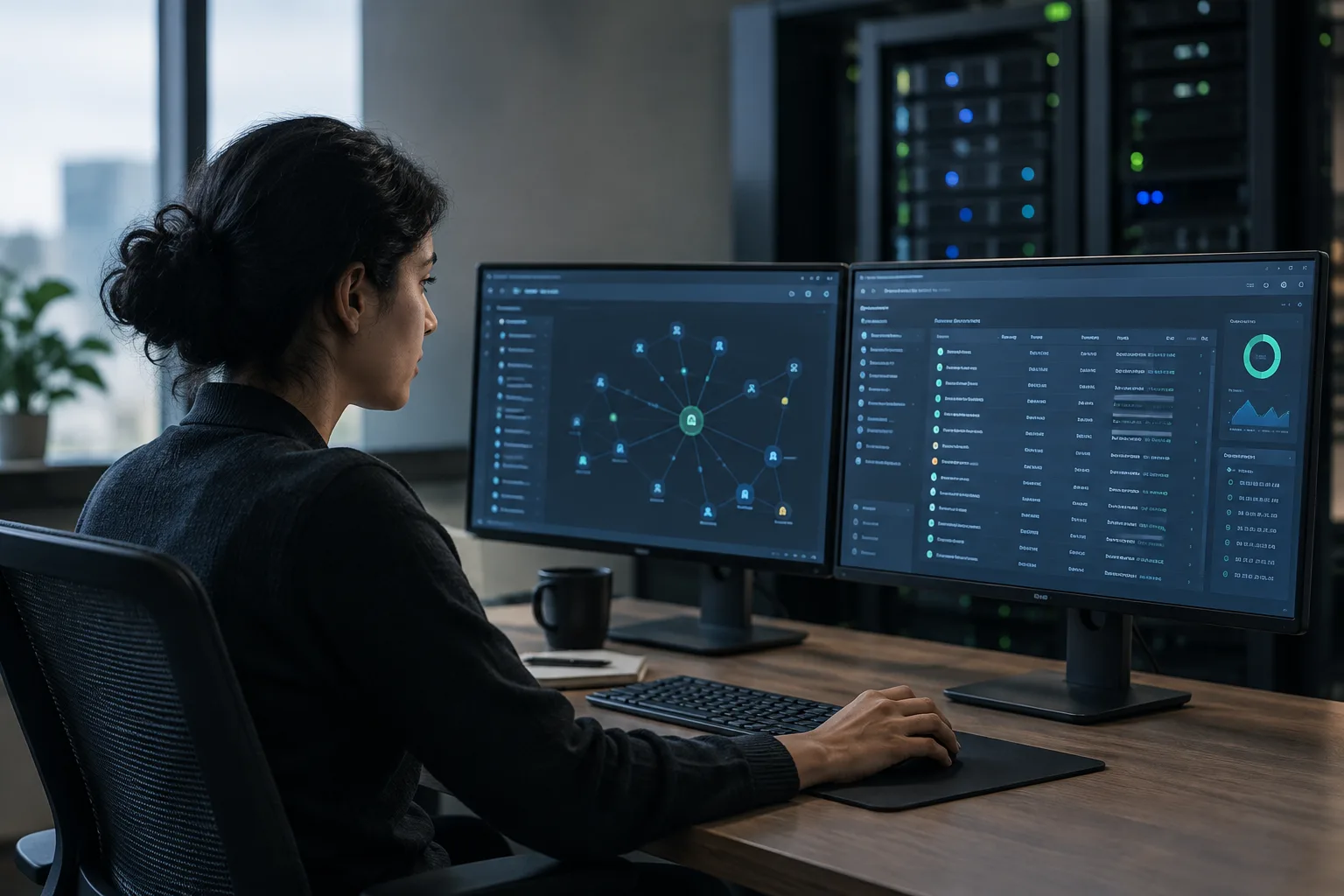

NVIDIA on Monday introduced the NVIDIA Open Agent Safety Platform, a new software-and-hardware stack aimed at a problem that has moved from theory to operations: how to keep autonomous AI agents from taking actions they should never be allowed to take.
The launch matters because the security question around agents is changing. For chatbots, buyers worried about bad answers. For coding agents, enterprise copilots, finance workflows, and robotics, the harder question is what a system can actually do once it has tools, credentials, and live access to applications or machines. NVIDIA’s answer is to make agent safety less about persuading a model to behave and more about enforcing boundaries outside the model itself.
That is the real issue readers are trying to sort out: is this a practical defense-in-depth layer for autonomous agents, or a strategic bid to make NVIDIA the control plane for the agent economy? Based on what the company disclosed, the answer is: potentially both.
What NVIDIA actually launched
The platform combines two pieces.
The first is OpenShell, which NVIDIA describes as an open-source runtime that sits outside the model and agent harness and enforces policy as an agent executes tasks. Instead of trusting the model’s own reasoning or prompt safeguards, OpenShell is meant to decide what the agent is allowed to do with tools, data, and side effects. NVIDIA says it traces actions, records allow-or-deny decisions, and centralizes sandbox logs.
The second is Sentry, a reference design built on NVIDIA’s BlueField-4 DPU that acts as an out-of-band watchdog. NVIDIA says Sentry monitors behavior in an isolated trust domain, separate from the host and the agent workload, and can stop or quarantine behavior that leaves the permitted boundary in milliseconds. The important architectural point is separation: if the agent process or host software is the thing you worry might be compromised or manipulated, NVIDIA wants the monitoring and enforcement path to live elsewhere.
OpenShell is the broader part of the launch. NVIDIA says it is broadly available, designed to run on NVIDIA Vera CPUs, and extendable to third-party compute platforms including Arm and Intel. The company’s materials also say it can run on supported local, on-premises, cloud, and Kubernetes infrastructure without BlueField-4. Sentry is where the hardware tie-in becomes explicit. The extra isolation depends on BlueField-4 and NVIDIA’s DOCA stack for telemetry, identity, and policy enforcement.
That mix of openness and lock-in is not a contradiction. It is the business model.
Why this matters for security teams now
The security value proposition is easy to understand if you separate model behavior from runtime behavior. Prompts, model tuning, and guardrails influence what an agent tries to do. Runtime controls determine what it can do.
That difference is why this launch lands as infrastructure, not just another AI safety feature. An agent can still be dangerous while faithfully following a prompt. It might use the wrong credential, call the wrong API, exfiltrate data through an approved tool, or keep acting after the business context has changed. In robotics or industrial settings, a bad tool call is not merely an embarrassing output; it can affect a physical system.
For CISOs and AI platform teams, that makes OpenShell adjacent to identity and access management, secrets management, application permissions, sandboxing, network segmentation, endpoint monitoring, and human approval processes. It does not replace those layers. It tries to give them an agent-specific enforcement point with logs and a stop button.
NVIDIA’s own examples show why buyers will pay attention. The company says the platform supports existing agents and models including Claude Code, Codex, OpenCode, GitHub Copilot CLI, OpenClaw, and custom agents. In its technical blog, NVIDIA says Cadence is using OpenShell in chip design, Slack is building an on-demand agent platform on it, and Gecko Robotics is using it to govern agents making decisions on physical robots. According to an Associated Press report carried by The Washington Post, NVIDIA also said more than 100 organizations were using the platform at launch, including Microsoft, Perplexity, Accenture, and JPMorgan Chase.
Those names show interest, not proof of outcomes. The public launch does not say how many are in production, what workloads they run, or how many use OpenShell alone versus the OpenShell-plus-Sentry design. It also does not publish independent measures for false positives, false negatives, performance overhead, or how often “milliseconds” holds up under realistic network, credential, or host-compromise conditions.
The strategic bet behind the security pitch
NVIDIA is making a more ambitious play than adding another security feature to its AI stack.
If agent runtime control becomes a standard enterprise requirement, the company has a path to influence policy formats, telemetry expectations, and procurement decisions even when the underlying model comes from another vendor and the CPU is not NVIDIA’s. OpenShell’s portability is what gets NVIDIA into heterogeneous environments. Sentry’s hardware isolation is what gives NVIDIA the strongest claim once it is there.
That matters because buyers are starting to look for a control plane, not just a model. Security teams want auditable decisions, clear ownership of policy, and a mechanism to halt execution when something drifts out of bounds. If OpenShell becomes a common software boundary for agent actions, NVIDIA gains leverage well beyond GPUs.
Still, the control-plane ambition runs into the same limits every runtime-governance product faces. A policy engine can enforce only the policy it has been given. It cannot prove the business process was modeled completely, that an approved tool will return truthful data, or that compromised credentials are safe because they were used inside the rules. The launch materials also leave open practical questions that matter in real incidents: how teams handle prompt injection, malicious tools, emergency exceptions, policy changes during active jobs, or failures when the security layer itself is unavailable.
That is why the near-term buyer question is less “Is this safe?” than “Can this be operated?”
For most organizations, the sensible test is narrow. Start with one bounded agent workflow. Enumerate the tools, data sources, credentials, and side effects that are allowed. Run both benign and adversarial tasks. Measure what gets blocked, what gets through, how noisy the alerts are, how complete the logs remain, how quickly the system recovers from a quarantine, and what latency or overhead the controls add. Then test portability across CPUs, clouds, models, and failure states.
If OpenShell delivers consistent policy enforcement and useful audit trails across mixed infrastructure, it has a plausible future as a foundational security layer for agents. If Sentry’s hardware boundary materially improves containment in environments where host software cannot be fully trusted, BlueField-4 dependency may look less like lock-in than like a familiar tradeoff for stronger isolation.
That is the practical takeaway from NVIDIA’s launch. The company has not proved that rogue-agent risk is solved, and it has not shown enough public evidence yet to settle the performance or efficacy questions. But it has done something important: turned agent safety from a vague model promise into an infrastructure product with boundaries, telemetry, and a quarantine path. Whether that becomes a new enterprise category, or a new way to pull buyers deeper into NVIDIA’s stack, will be decided not by the announcement but by operational evidence in the months after it.
 By
By
 By
By
 By
By
 By
By

 By
By
 By
By