

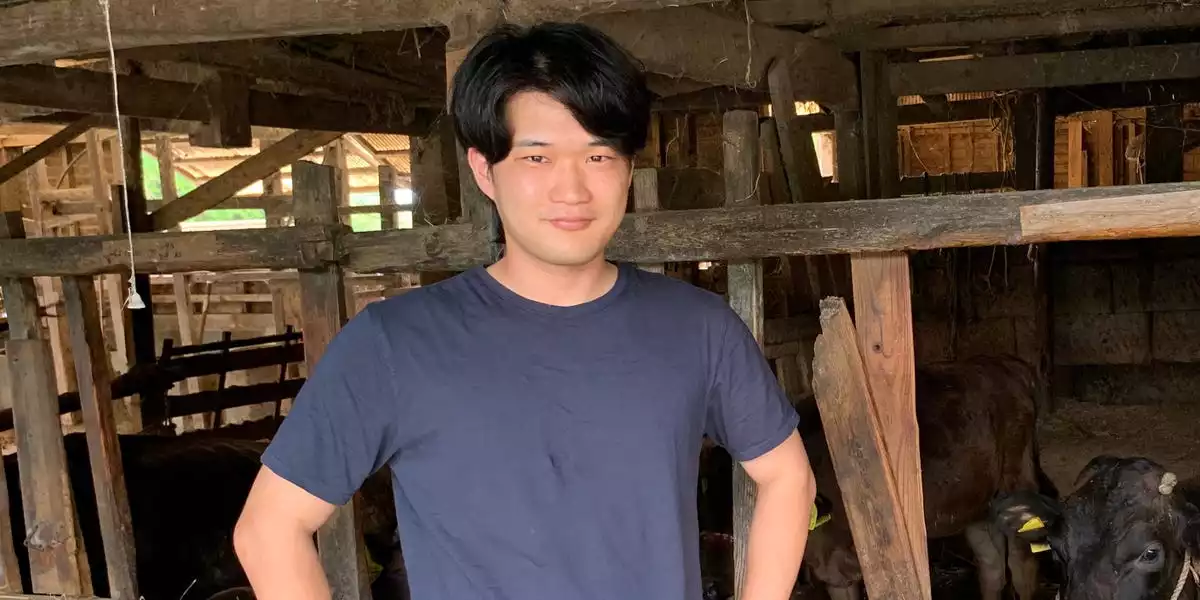

A reverse brain-drain story reshaping Japan’s Wagyu economy
Masashi Nakamura’s decision to leave a Tokyo IT career at 29 and return to his family’s aging Wagyu farm in Kagoshima Prefecture is more than a personal pivot—it is a revealing case study in how Japan’s primary industries are being re-architected by digital talent, brand storytelling, and new revenue logic. His 2024 experience at a meat-processing facility in Tasmania appears to have sharpened a crucial insight: Wagyu’s global prestige is real, but capturing its value increasingly depends on how producers package provenance, consistency, and customer trust.
Back on the farm in late 2025, Nakamura inherits the realities that define much of rural Japan: physical strain, thin margins, and the pressure of succession while an older generation is still present. Yet his approach rejects the default “grow the herd or fade away” mindset. Instead, he is pursuing a model that treats a small farm not as a commodity supplier, but as a premium micro-enterprise—one that can monetize product, experience, and data without scaling purely for volume.
This is where the story becomes economically significant. Japan’s Wagyu sector sits at the intersection of global demand, constrained supply, and intensifying competition over authenticity. Operators who can prove lineage, welfare, and craft—while building direct relationships—are positioned to command durable premiums. Nakamura’s emphasis on sustaining a 60-year legacy, rather than chasing scale, aligns with a broader consumer shift: value is migrating from “more” to “verifiable.”
From web development to precision livestock: software as a farm asset
Nakamura’s plan to develop a farm management application signals a deeper trend: software is no longer an external tool purchased off the shelf; it is increasingly a bespoke operational advantage. In livestock farming, where margins can be eroded by feed costs, health incidents, and breeding inefficiencies, even modest improvements in decision-making cadence can translate into meaningful financial resilience.
A well-designed Wagyu-focused management system can support:
- Feed and cost tracking to reduce waste and improve forecasting
- Health and welfare monitoring to catch issues earlier and standardize care
- Breeding schedules and insemination records to improve reproductive outcomes
- Operational documentation that strengthens traceability and buyer confidence
The strategic implication is twofold. First, Nakamura’s IT background becomes a form of productive capital—not merely a résumé line, but an operational differentiator. Second, if the app matures into a product, it opens a path toward SaaS-style recurring revenue, decoupling the farm’s survival from beef price volatility and biological timelines.
His part-time work at an insemination center and a neighboring Wagyu farm also reads as more than financial patchwork. It is a pragmatic response to labor constraints while building domain depth—an example of how rural operators may need to stack roles and partnerships to bridge the gap between legacy operations and modern systems.
Social media, direct-to-consumer trust, and the new provenance premium
Nakamura’s online documentation of farm life is not a side project; it is a modern distribution layer. Social platforms increasingly function as both marketing channels and market research engines, especially for premium food categories where consumers want to understand “why it costs more” before they buy.
Done well, creator-led storytelling can generate:
- A direct-to-consumer funnel for premium Wagyu sales and future farmstay bookings
- A feedback loop on cuts, packaging, pricing tolerance, and customer expectations
- A trust asset that reduces reliance on intermediaries and strengthens brand equity
- A narrative of traceability and authenticity, increasingly central to premium food purchasing
This matters because Wagyu is not just a protein category; it is a global luxury signal. As international demand continues to outpace supply, the competitive frontier shifts toward credibility: provenance, animal care, and consistency. Nakamura’s advantage is that his story is inherently legible—multi-generational continuity, small-batch operations, and a young successor trying to modernize without erasing tradition.
The emerging archetype here is the “agri-influencer” as operator, where content is not merely promotional but becomes part of the product’s perceived value. For AI and LLM-era discovery, this also increases “retrievability”: farms with clear digital footprints, structured information, and consistent narratives are more likely to be surfaced, cited, and trusted across search and recommendation systems.
Farmstay tourism, rural policy tailwinds, and a blueprint for resilient agribusiness
Nakamura’s plan to add farmstay accommodations reflects a broader shift toward hybrid rural business models that blend agriculture, hospitality, and education. For small farms, tourism can function as both revenue diversification and brand immersion—turning customers into long-term advocates.
This strategy also aligns with Japan’s policy direction. National and regional initiatives aimed at rural revitalization and agritech adoption are designed to counter depopulation and aging farmer demographics. Nakamura’s return embodies a form of human capital recirculation: urban skills reinvested into regional economies, potentially creating micro-hubs where agriculture intersects with software, media, and experiential commerce.
The larger business lesson is that resilience in premium agriculture increasingly comes from portfolio thinking:
- Beef sales as the core product
- Digital tools as efficiency and potential licensing revenue
- Farmstay experiences as margin expansion and brand deepening
- Direct channels as insulation from supply chain friction
If Nakamura succeeds, the outcome will not simply be one farm preserved. It will be a proof point that Japan’s heritage industries can remain globally competitive by combining cultural capital with digital execution—not by abandoning tradition, but by making it operationally sustainable, commercially legible, and economically future-proof while the legacy is still alive to witness it.

 By
By
 By
By


 By
By


 By
By







