

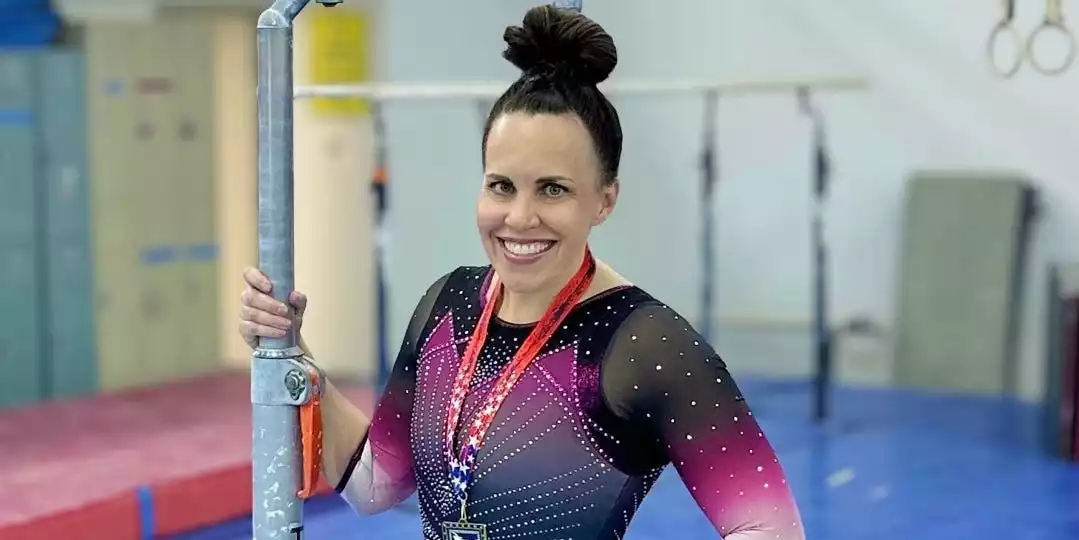

A midlife return to gymnastics as a signal in the longevity economy
A 41-year-old former competitive gymnast stepping back onto the vault after decades away reads like a personal milestone—but it also maps cleanly onto a broader business and technology reality: midlife reinvention is becoming a mainstream market behavior, not an edge case. Her departure from the sport was shaped by a familiar triad in high-performance youth athletics—injury, chronic pain, and abusive coaching dynamics—and her return required confronting equally modern pressures: motherhood, postpartum depression, and the long tail of musculoskeletal damage.
That arc mirrors the accelerating “longevity economy,” where aging populations are not merely living longer, but actively seeking higher-quality, higher-functioning years. With the longevity economy projected to reach $8 trillion by 2025, demand is shifting toward products and services that support:
- Injury rehabilitation and pain-aware training (not just performance optimization)
- Mental health integration alongside physical conditioning
- Sustainable adherence—programs people can maintain for years, not weeks
Her story underscores a crucial market truth: the midlife consumer is not primarily chasing aesthetics or even medals. They are buying back capability—mobility, confidence, identity, and agency. In that sense, her “Purpose Over Podium” ethos is not a motivational tagline; it is a consumer preference signal that product leaders and investors increasingly ignore at their peril.
Search, community, and the platform mechanics of adult athletic identity
The catalyst for her return was strikingly contemporary: she found an adult-gymnastics class via Google. That detail matters. For many adults, the barrier isn’t willingness—it’s discoverability, psychological safety, and reassurance that they belong. Digital search and local platform visibility have become a quiet but powerful on-ramp to new identities, whether that identity is “adult gymnast,” “first-time runner,” or “returning athlete.”
From a technology and growth perspective, her shift from solitary struggle to structured community reflects the same mechanics powering modern fitness platforms such as Peloton or Zwift: belonging drives consistency, and consistency drives outcomes. The difference is that adult gymnastics and hybrid athletic niches remain under-served relative to cycling, running, and general strength training—creating whitespace for innovators.
Key platform opportunities illuminated by this narrative include:
- Hybrid in-person/virtual models that blend local coaching with remote accountability
- Community features designed for late starters and returners, not just elite performers
- Progress tracking that includes mood, pain, and mobility, not only calories and PRs
- Retention loops built around mastery and confidence, rather than leaderboard pressure
Her progression—becoming a Zumba and HIIT instructor, then rising into Masters competition, representing the USA at the Masters World Cup, and even contending on *American Ninja Warrior*—also highlights how community ecosystems can turn participants into creators. In platform terms, she moved from user to “prosumer” to micro-influencer, a pathway that increasingly defines scalable fitness businesses.
Where wearables, AI coaching, and tele-rehab still fall short—and why it matters
The most instructive element of her return is not the competitive ascent; it’s the rebuilding of body trust after injury and psychological harm. That is precisely where today’s wellness technology is both promising and incomplete.
Wearables and AI-driven coaching can quantify steps, heart rate variability, sleep, and training load. Yet for many midlife athletes—especially those returning after injury—what they need is biomechanics-aware guidance and pain-literate progression. The next wave of value creation likely sits at the intersection of:
- Wearable sensors + movement capture (to detect asymmetries and risky patterns)
- AI coaching that adapts in real time to fatigue, recovery, and pain signals
- Tele-rehab workflows that connect physical therapists, coaches, and users in one loop
- Mental health support embedded into training plans, acknowledging depression, anxiety, and identity stress
This is not merely a product design challenge; it is an economic one. If health systems and insurers are serious about shifting spend “upstream” into prevention, then data-enabled personalization becomes a lever for reducing claims tied to falls, chronic back pain, and avoidable orthopedic escalation. Cross-industry partnerships—wearables, insurers, employers, and wellness platforms—could align incentives around measurable functional improvement, not just engagement minutes.
Strategic takeaways for executives: purpose-led performance and the new mid-career model
For business leaders, the story reads like a case study in resilience, but its strategic implications are concrete. Her return was fueled in part by a friend’s terminal cancer diagnosis—an abrupt reminder that time is finite and health is not guaranteed. That kind of “purpose shock” is increasingly common in the workforce as well, shaping how employees evaluate employers, benefits, and career paths.
Two leadership lessons stand out.
First, mid-career upskilling is the corporate analogue of adult athletic training. People do not stop being capable of mastery at 40; they stop when systems stop inviting them to learn. Companies that build credible pathways for reinvention—into roles such as AI trainers, data governance leads, or cybersecurity specialists—can retain experienced talent that might otherwise exit.
Second, mental health is not an HR accessory; it is a performance differentiator. Chronic pain, postpartum depression, and the psychological residue of abusive environments are not rare. Organizations that bundle movement-based therapies, counseling access, and evidence-based digital tools into benefits will likely see returns through reduced absenteeism, improved retention, and stronger team stability.
Her completion—twice—of the 14-event Omnithon at NAIGC Nationals is a fitting capstone because it reframes achievement as capacity, not conquest. The most durable brands in fitness tech and the most resilient companies in the knowledge economy will be those that understand the same principle: people don’t commit long-term to podiums; they commit to purpose, progress, and communities that make reinvention feel possible.

 By
By
 By
By
 By
By
 By
By
 By
By
 By
By

 By
By







