


Volvo’s High-Stakes Reboot: Electrification, Software, and the Battle for Premium EV Relevance
Volvo’s recent announcement to retrofit its flagship EX90 SUV with a cutting-edge 800-volt electrical system and Nvidia’s formidable Drive AGX Orin computing platform marks more than a technical refresh—it is a high-wire act to reclaim its standing in a fiercely competitive, rapidly electrifying automotive landscape. Amid a 14% global sales contraction in August and mounting pressure from both legacy rivals and insurgent EV titans, Volvo’s move is as much about narrative control as it is about engineering prowess.
From Hardware Bottlenecks to Software-Defined Ambitions
The shift from a legacy 400-volt architecture to an 800-volt platform is not merely incremental. It is a categorical leap that aligns Volvo with the likes of Porsche, Hyundai-Kia, and Lucid—brands that have set the benchmark for rapid DC fast charging. By slashing charging times from roughly 34 minutes to under 20, Volvo responds to a consumer expectation forged in the crucible of convenience, where refueling parity is the new standard.
The integration of Nvidia Orin, delivering a staggering 254 trillion operations per second, transforms the EX90 from a component-driven vehicle into a software-defined entity. This central compute powerhouse enables sensor fusion across lidar, radar, and vision, unlocking Level-2+ advanced driver-assistance features. More importantly, it centralizes over-the-air (OTA) update pathways, reducing long-term warranty costs and establishing a foundation for subscription-based ADAS up-sell—a profit pool McKinsey forecasts could swell to $225 billion by 2030.
- Key Upgrades:
– 800-volt architecture for ultra-fast charging
– Nvidia Orin compute for sensor fusion and OTA updates
– Activation of dormant lidar hardware for advanced safety
The EX90’s re-architecture is emblematic of a broader industry migration: from hardware-constrained EVs to platforms where software is the primary differentiator. For Volvo, this transition is not just about catching up—it is about future-proofing its portfolio against the risk of 400-volt “stranded assets” whose resale values could rapidly erode.
Safety as Strategy: Reasserting Brand Identity
Volvo’s brand equity has always rested on the bedrock of safety. Yet, the delayed activation of its lidar hardware threatened to erode this hard-won reputation. The introduction of Emergency Stop Assist—an intelligent, software-driven safety function—serves as both a technological milestone and a narrative reset. It anticipates looming EU GSR2 mandates and NHTSA rulemakings on driver monitoring, positioning Volvo ahead of regulatory curves and opening new avenues for insurance-rate arbitrage.
This move is not merely defensive. The telematics data generated by these new safety systems holds latent value for insurers eager to underwrite medical-incident risk, hinting at a future where B2B monetization of safety features becomes a meaningful revenue stream. In a market where Tesla’s $25,000 model threatens to compress the premium pricing umbrella, differentiation through safety innovation and Scandinavian design ethos becomes existential.
Manufacturing, Policy, and the Geopolitical Chessboard
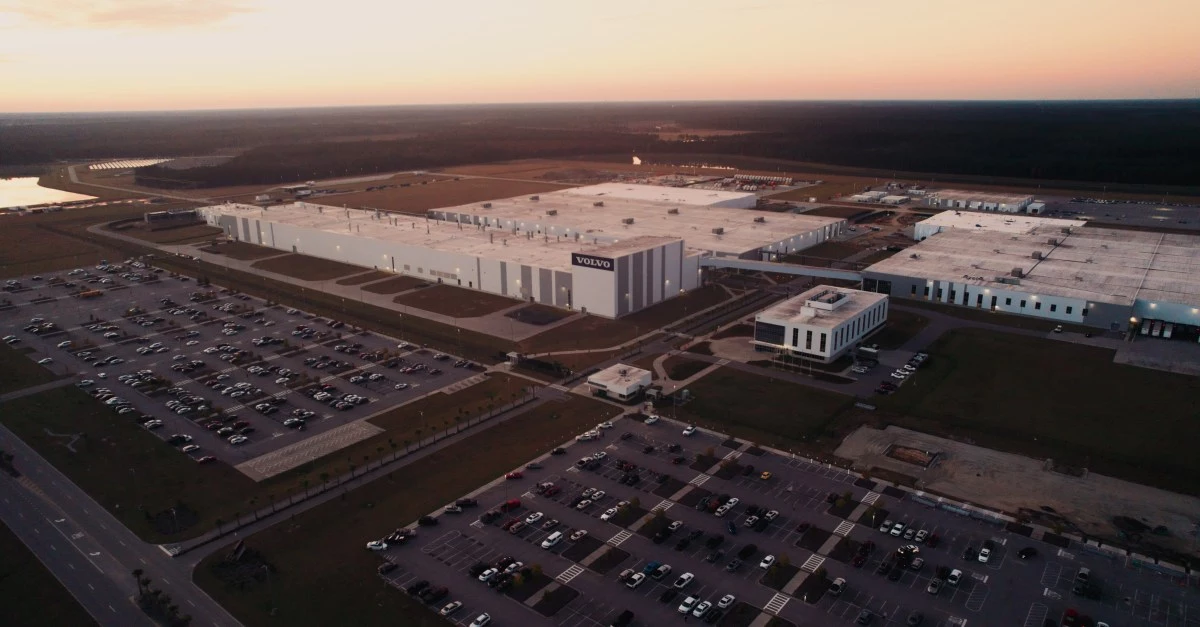
Volvo’s $1.3 billion expansion of its Charleston, South Carolina plant is a strategic hedge against the volatility of global supply chains and shifting geopolitical winds. By localizing assembly and, crucially, battery module sourcing, Volvo positions itself to capture partial Inflation Reduction Act (IRA) credits—up to $3,750 per vehicle—a competitive lever unavailable to EU-built rivals in the lucrative $50,000–$80,000 segment.
- Strategic Implications:
– U.S. production enables IRA credit eligibility
– Vertical integration of hybrid and BEV lines hedges against powertrain-mix uncertainty
– Nvidia’s U.S.-origin silicon insulates Volvo from export-license turbulence affecting Chinese semiconductors
This manufacturing investment mirrors the counter-cyclical strategies of automakers like BMW during previous downturns—betting on capacity expansion when demand is soft, with the expectation of capturing outsized share as the market rebounds. Yet, with net debt/EBITDA at 1.8×, the margin for error is narrow; execution risk looms large if the EX90 relaunch slips or quality metrics falter.
Navigating an Electrified Future
Volvo’s EX90 overhaul is a microcosm of the broader transformation sweeping the automotive industry. The convergence of fast-charging, centralized compute, and software-driven safety is rapidly erasing the boundaries between hardware and digital experience. For decision-makers across the value chain, the message is clear: accelerate the migration to scalable, software-centric architectures or risk obsolescence.
As regulatory, technological, and economic forces converge, Volvo’s gambit is a test of whether a storied brand can not only survive but thrive amid the relentless logic of electrification and digitalization. In this crucible, execution—not aspiration—will determine who leads and who is left behind.

 By
By
 By
By
 By
By
 By
By
 By
By


 By
By







