

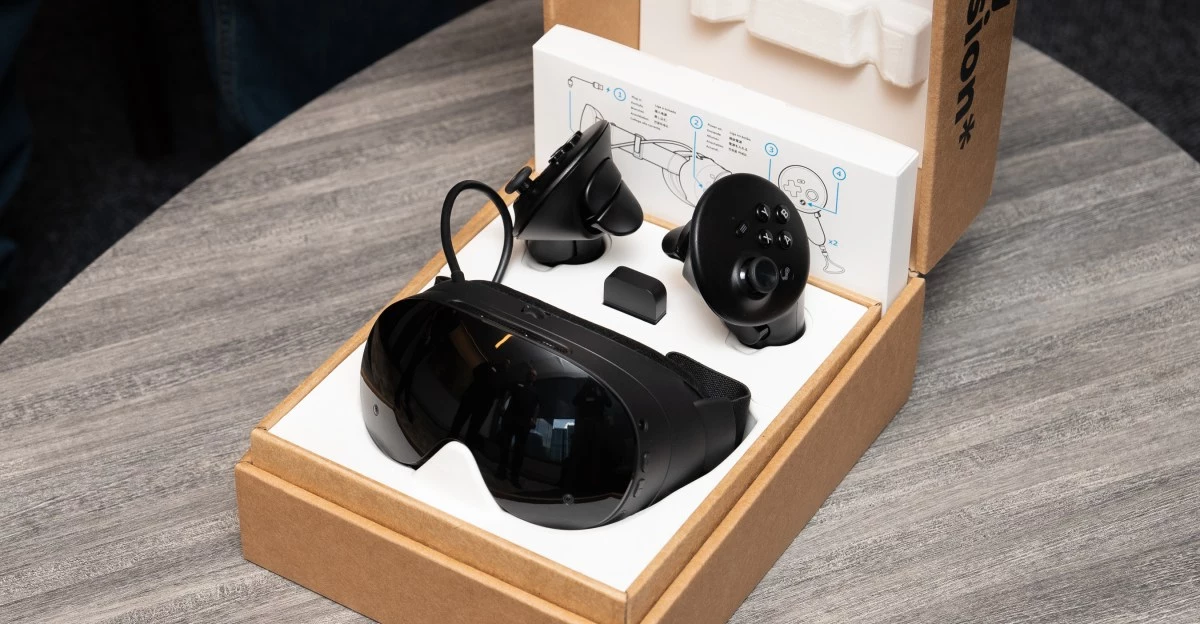

Valve’s Steam Frame: A Hybrid VR Gambit Reshaping the Gaming Landscape
The announcement of Valve’s Steam Frame headset signals not just a new hardware cycle, but a fundamental reimagining of how virtual reality (VR) can intersect with the established PC gaming ecosystem. With a featherweight 185-gram core and a launch target set for early 2026, Valve’s latest foray into XR (extended reality) is less about chasing the mixed-reality productivity wave and more about doubling down on gaming’s core constituency: the enthusiast.
Breaking the Mold: Emulation, Arm, and the End of Wintel’s Reign
At the heart of Steam Frame’s innovation is its hybrid compute architecture. Valve’s embrace of Qualcomm’s Snapdragon 8 Gen 3 marks a decisive shift away from the x86-centric paradigm that has dominated PC gaming for decades. The device runs SteamOS natively on Arm silicon, but crucially, it leverages real-time x86 emulation to unlock the vast majority of the Steam library—over 30,000 titles—without developers needing to recompile or port their games.
This approach mirrors Apple’s Rosetta 2, but Valve’s engineers face a tighter thermal and power envelope, given the fanless, ultra-lightweight design. The result is a delicate balancing act: dynamic recompilation must be ruthlessly efficient, and developers are being urged to optimize for lower device-side performance, even compared to the Steam Deck. Occasional stutters in early demos underscore the technical challenge, but the promise is clear—a single device that bridges the old and new worlds of gaming hardware.
The implications are profound. As gaming’s silicon foundation shifts, the once-ironclad Wintel alliance—Windows plus Intel—faces further erosion. Valve’s move normalizes the idea that high-volume game libraries can decouple from x86 at the client level, opening the door for a new generation of Arm-powered gaming hardware.
Streaming, Sensing, and the New Network Edge
Steam Frame’s hybrid model doesn’t stop at emulation. The headset can operate as a standalone device, but its real power emerges when paired with a PC via Valve’s proprietary wireless dongle. This custom stack, likely based on Wi-Fi 6E/7, is engineered to slash round-trip latency, enabling a split-rendering workflow: the headset handles latency-sensitive tasks locally, while the PC’s GPU tackles the heavy lifting.
This architecture foreshadows a broader industry trend: the blurring of boundaries between device, console, and cloud. By offloading and distributing workloads, Valve is not just future-proofing its own platform—it’s setting a template for edge-accelerated VR that telecoms and infrastructure providers are already eyeing. ISPs, for example, may soon offer “XR-certified” service tiers, echoing the fiber-to-the-gamer revolution seen in South Korea.
On the optics front, Steam Frame’s 2160 × 2160 pixels per eye at up to 144 Hz positions it squarely in the upper-mid-range, just shy of Apple’s Vision Pro. Integrated eye tracking enables foveated rendering, a technique that reduces bandwidth and compute demands by sharpening only the user’s gaze point. This not only enhances performance but also generates valuable telemetry—data that could inform both game design and, potentially, new monetization models within Valve’s storefront.
Economic Calculus and the Shifting Competitive Terrain
Valve’s pricing strategy is as calculated as its engineering. By targeting a sub-$999 MSRP, the company threads the needle between Meta’s aggressively subsidized Quest 3 and its own high-end Index. The bill of materials—driven by optics, silicon, and sensors—leaves room for margin, especially as component prices fall post-2024.
Unlike Meta, which relies on hardware subsidies and walled-garden app monetization, Valve’s model amortizes hardware costs through its established game sales commission. This allows for more aggressive pricing without sacrificing profitability, and more importantly, it preserves the open, developer-friendly ethos that has defined Steam for two decades.
Strategically, Steam Frame’s 2026 launch aligns with the maturation of Snapdragon’s XR3 platform and the broader adoption of Wi-Fi 7. This timing leapfrogs current hardware constraints and positions Valve to capitalize on a projected $50 billion XR market by 2027—particularly the enthusiast segment that mobile-first XR forecasts often overlook.
Industry Ripples: From Developer Playbooks to Global Supply Chains
The Steam Frame’s ripple effects extend well beyond gaming. For publishers, the message is clear: prioritize Vulkan or DirectX 12 translation layers, and optimize for Arm-based emulation to secure a coveted spot in the launch window. Eye tracking and foveated pipelines are no longer optional—they’re prerequisites for competitive performance.
Telecoms and edge infrastructure providers are on notice: the bandwidth and latency demands of hybrid VR will stress suburban networks but create opportunities for differentiated service offerings. Meanwhile, semiconductor vendors see Valve’s endorsement of Arm/x86 translation as validation of heterogeneous ISA strategies, likely spurring renewed interest in binary-translation IP and co-optimized toolchains.
Supply-chain dynamics also come into play. Valve’s volume commitments to optics suppliers strengthen its negotiating position amid a market still dominated by Apple’s micro-OLED demand. Yet, the reliance on advanced TSMC nodes introduces geopolitical risk—any escalation in Taiwan could ripple through cost structures and timelines.
As the industry digests Valve’s bold experiment, decision-makers across hardware, content, and connectivity must recalibrate their roadmaps. The Steam Frame is more than a device; it is a bellwether for the next era of gaming—one where open platforms, hybrid compute, and Arm-powered innovation redraw the boundaries of what’s possible in virtual reality.

 By
By
 By
By
 By
By

 By
By


 By
By







