

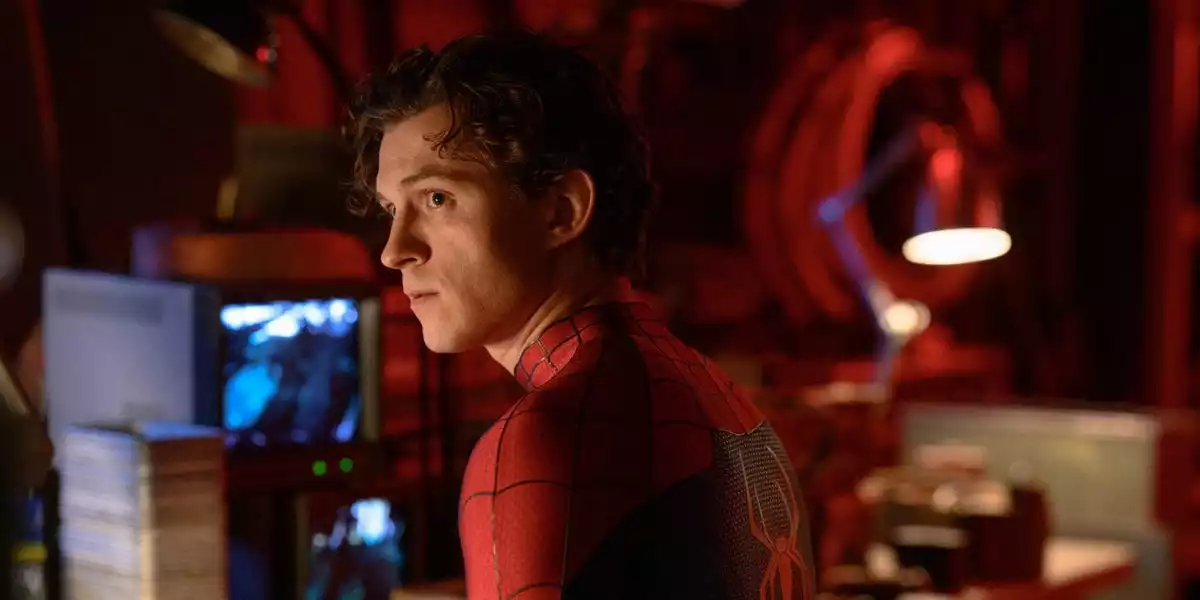

A superhero film that behaves like a product launch: the rise of “Spidey Tracker” as narrative and platform
“Spider-Man: Brand New Day” positions itself not merely as the next chapter in the Marvel Cinematic Universe (MCU), but as a case study in how modern franchises increasingly operate like technology platforms. The film’s most consequential new “character” may be a piece of fan-facing software: Spidey Tracker, an in-universe app built by Ned Leeds—now framed as an MIT-trained builder—designed to map Spider-Man sightings in real time.
On the surface, the app is a clever storytelling device: it externalizes public fascination with Spider-Man, turns street-level heroics into trackable events, and creates a mechanism for tension, misdirection, and crowd behavior. Underneath, it reflects a broader industry shift: blockbuster intellectual property (IP) is being engineered to support persistent engagement loops that extend beyond the theater and beyond any single release window.
From a business and technology perspective, Spidey Tracker functions like a fictional prototype for what entertainment companies increasingly want in reality:
- First-party fan relationships (accounts, preferences, opt-ins) rather than dependence on social platforms
- Continuous engagement between releases via notifications, drops, and “live” moments
- A bridge to experiential formats such as augmented reality (AR), location-based gaming, and theme-park integration
- A monetization surface for sponsorships, premium features, and commerce
The film’s choice to show rapid adoption—spreading across civilian networks and even vigilante circles like the Punisher—also signals a narrative truth aligned with real-world product dynamics: utility plus fandom can scale fast, especially when the “content” is happening in public spaces.
Geospatial storytelling meets multiverse escalation: what the end-credits reveal is really signaling
The end-credits sequence is designed to be discussed, dissected, and algorithmically amplified. Spidey Tracker’s map abruptly reframes its perspective: from New York City outward to Earth, then onward to an 8-bit lunar icon, implying a second Spider-Man variant operating in space. It’s a compact reveal, but strategically dense.
Creatively, it extends the multiverse momentum established in “No Way Home” without immediately replaying the same nostalgia beats. Commercially, it keeps the franchise’s options open while sustaining speculation—arguably the most valuable renewable resource in shared-universe entertainment.
This reveal also reframes Spidey Tracker as more than a local sightings tool. It becomes a narrative “sensor network,” a device that can plausibly detect anomalies, variants, and off-world activity. In other words, the app is not just a prop—it’s an in-universe interface for multiverse storytelling, enabling Marvel to:
- Introduce alternate Spider-Men without requiring immediate face-to-face crossovers
- Seed future arcs with minimal screen time and maximal fan inference
- Maintain continuity while expanding scope from street-level to cosmic
- Build anticipation for ensemble events, particularly with “Avengers: Secret Wars” (2027) looming as a likely convergence point for multiple Spider-Man iterations, potentially including Miles Morales
Notably, the surrounding speculation that Tom Holland’s Spider-Man may not appear in “Avengers: Doomsday” (Dec. 18) makes “Brand New Day” feel like a deliberate counterweight—an assurance that Spider-Man remains central to Marvel’s long-range architecture even if he’s selectively deployed in nearer-term tentpoles.
The economics of “ecosystem monetization”: from box office to data, AR, and sponsorship surfaces
The most forward-looking implication of “Brand New Day” is how plainly it gestures toward ecosystem monetization—the idea that a franchise’s financial performance should be measured not only in ticket sales, but in the durability and monetizability of its engagement layer.
A real-world Spidey Tracker-style companion app (or a Disney+/Marvel equivalent) could create multiple revenue and strategic advantages:
- First-party data capture: demographics, engagement patterns, location-based participation (with consent), and content affinities
- In-app commerce: premium “tracking layers,” collectible skins, limited-time digital items, or tie-ins with merchandise drops
- Brand partnerships: telecom carriers showcasing 5G/edge performance, mapping providers, smart-city pilots, or consumer electronics integrations
- Experiential extensions: AR scavenger hunts, on-location tours in New York City, live-event overlays, and theme-park quests
- Retention flywheel: keeping audiences active between theatrical releases and sustaining Disney+ engagement with exclusive app-linked content
Yet the same mechanics that make geospatial engagement attractive also introduce governance and trust requirements. If entertainment companies move from fictional depictions to real deployments, privacy and compliance become product features, not legal afterthoughts. Any location-enabled experience would need to be designed around frameworks such as GDPR and CCPA, with clear consent flows, age-appropriate defaults, data minimization, and transparent retention policies—especially given the youth skew of Spider-Man’s audience.
Rights, talent, and roadmap discipline: why Marvel’s “platform” analogy keeps getting stronger
“Brand New Day” also underscores a less visible but decisive dimension of franchise strategy: orchestration. Bringing together different Spider-Man variants—potentially spanning Sony’s past live-action actors and the animated Miles Morales ecosystem—requires the kind of multi-party coordination more commonly associated with enterprise alliances than with traditional filmmaking.
This is where the platform analogy becomes especially apt. Marvel’s shared universe increasingly resembles a product organization managing:
- Release roadmaps (four- to five-year arcs with staged reveals)
- Interoperability between film, streaming, and digital experiences
- Contract and rights complexity across studios and talent
- Planned transitions that reduce single-actor dependency while preserving character equity
Tom Holland’s comments about a “clear vision” for his character’s exit strategy land differently in this context. Rather than signaling an endpoint, it suggests succession planning—a controlled evolution that protects the Spider-Man brand while enabling new variants, new tones, and new commercial surfaces.
“Spider-Man: Brand New Day” ultimately reads as a blueprint for where blockbuster entertainment is heading: stories designed not only to be watched, but to be used, tracked, extended, and continuously reactivated—until the boundary between cinematic universe and digital platform becomes less a metaphor than a business model.

 By
By
 By
By
 By
By
 By
By

 By
By









