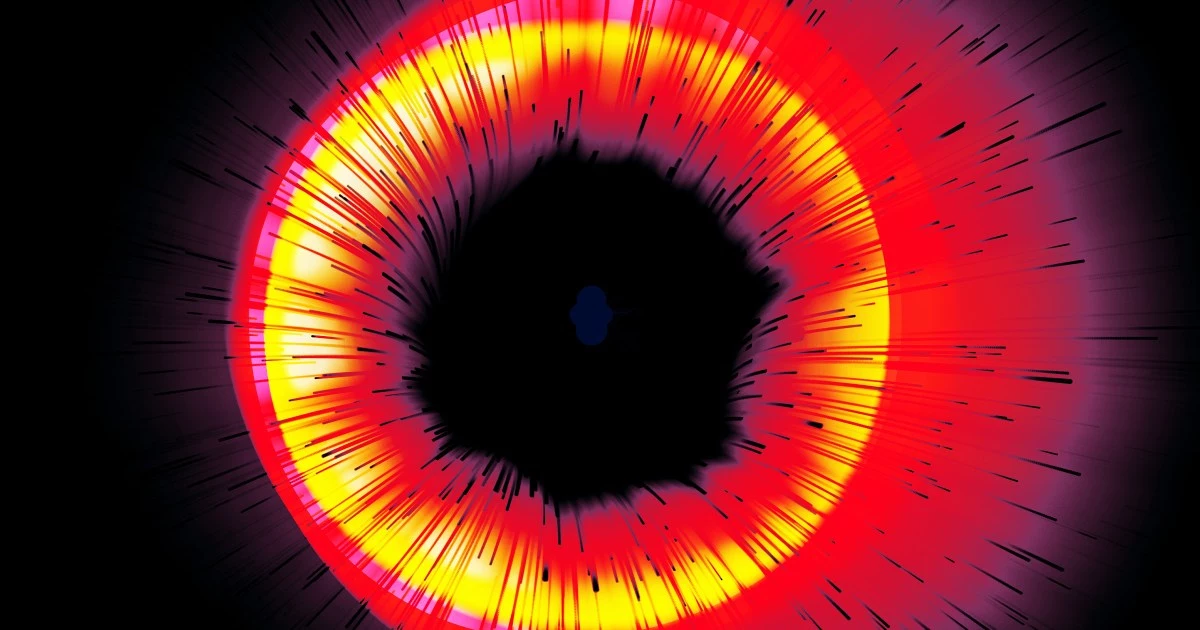

A Cosmic Outlier: GRB 250702B and the Inversion of Gamma-Ray Burst Physics
When NASA’s Fermi Gamma-ray Space Telescope recorded GRB 250702B, the astronomical community found itself staring at a cosmic anomaly that resists easy categorization. Lasting seven hours—an eternity in the fleeting world of gamma-ray bursts (GRBs)—this event unfolded in three distinct, high-energy peaks, billions of light-years from Earth. Its persistence and structure have forced theorists to invert their models, challenging the orthodoxy that GRBs are the death cries of collapsing stars. Instead, the most plausible scenario is a black hole spiraling into, and consuming, a dying stellar companion—a celestial cannibalism that upends the standard playbook.
Rethinking the Engines of Cataclysm: Theoretical and Observational Frontiers
GRB 250702B’s detection profile—three discrete bursts over a seven-hour span—defies the tidy taxonomies of classical GRBs. The “inside-out” model now gaining traction posits a stellar-mass black hole engulfed by an expanded, fuel-exhausted star. This interaction generates relativistic jets that, to our instruments, masquerade as a textbook GRB. Alternative explanations, such as core-collapse supernovae or tidal disruptions by intermediate-mass black holes, lack the explanatory power to account for the event’s duration and multi-peaked structure.
This paradigm shift is not merely academic; it exposes the limits of current computational and observational toolkits. Modeling such a multi-hour, relativistic event with nested magnetohydrodynamic variables is computationally prohibitive for today’s petascale clusters. The need for exascale—and, soon, quantum-accelerated—workflows is acute, with implications that ripple far beyond astrophysics. Sectors as diverse as drug discovery, climate modeling, and cryptography stand to benefit from the breakthroughs demanded by these cosmic puzzles.
Instrumentally, the Fermi telescope’s Large Area Telescope (LAT) and Gamma-ray Burst Monitor (GBM) proved indispensable, highlighting the value of persistent, wide-band, multi-detector architectures. The event’s sheer energy and duration strain the dynamic range and radiation tolerance of existing sensors, catalyzing R&D into next-generation scintillators and photon-counting ASICs. These innovations, while born in the crucible of astrophysical discovery, promise near-term benefits in medical imaging and nuclear safeguards—a testament to the dual-use nature of frontier science.
Strategic Ripples: Risk, Capital, and the New Space Economy
The reverberations of GRB 250702B extend well beyond the realm of pure science. For satellite operators and mission planners, a seven-hour, high-flux gamma event is a wake-up call. Threat models for satellite electronics, low Earth orbit constellations, and long-duration human missions must be recalibrated. Insurers and actuaries will need to revise coverage triggers and actuarial tables, likely inflating premiums and capital expenditures across the commercial space sector. Early adopters of real-time space-weather analytics and enhanced shielding materials—think boron nitride nanotubes or hydrogenated composites—will gain a measurable edge.
From an economic vantage, the event serves as a media-visible proof point for the scientific return on “deep-tech in space” investments. Venture and philanthropic capital are increasingly flowing into astrophysics, Earth observation, and on-orbit services, with GRB 250702B providing a compelling narrative for continued support. Yet, the supply chain for advanced detectors remains fraught: compound semiconductors and rare earths face geopolitical constraints, favoring firms with upstream control or diversified sourcing strategies.
National prestige is also at stake. Flagship astrophysics missions underpin soft power, talent attraction, and the vitality of STEM ecosystems. Expect intensified government procurement and grant activity as nations vie for leadership in next-generation observatories and multimessenger arrays.
The Road Ahead: Multimessenger Synergies and AI-Driven Discovery
If the black-hole-in-star hypothesis proves correct, the event should have left correlative neutrino and gravitational-wave signatures. This prospect is likely to accelerate the convergence of multimessenger observatories, fostering public-private consortia reminiscent of today’s climate observation markets. National labs and cloud hyperscalers are poised to insert GRB-class simulations into their “hero” workloads, de-risking investments in quantum annealing and neuromorphic chips. Enterprises across sectors should watch these roadmaps for commercial spillovers.
On the algorithmic front, GRB 250702B validates the promise of AI-enabled anomaly detection. Machine-learning pipelines that flagged this event’s low-probability light-curve signatures can be repurposed for cybersecurity, fraud analytics, and predictive maintenance—offering cross-domain monetization opportunities for technology vendors.
The cosmic drama of GRB 250702B is more than an astrophysical curiosity—it is a crucible for our observational infrastructure, computational ambition, and commercial risk models. Organizations that read the signal not just in photons, but in the strategic whitespace it illuminates, will find themselves ahead in the unfolding competition for technological and economic leadership.

 By
By


 By
By
 By
By

 By
By
 By
By