


- Why this story has so much intrigue
- The main people in this story
- A timeline of the key events
- The connection between Las Vegas and the California case
- The arrest of Ori Solomon and what he is accused of
- Reports of people becoming “deathly ill”
- Other properties and whether they were connected
- The question of labels: “HIV,” “malaria,” “TB,” “Ebola,” and what labels do and do not mean
- The role of the U.S. congressional report
- What is established as fact, and what remains allegation or uncertain
- The key questions a careful reader should consider
- Bottom Line
Why this story has so much intrigue
This story is drawing attention because it has the ingredients of a real mystery:
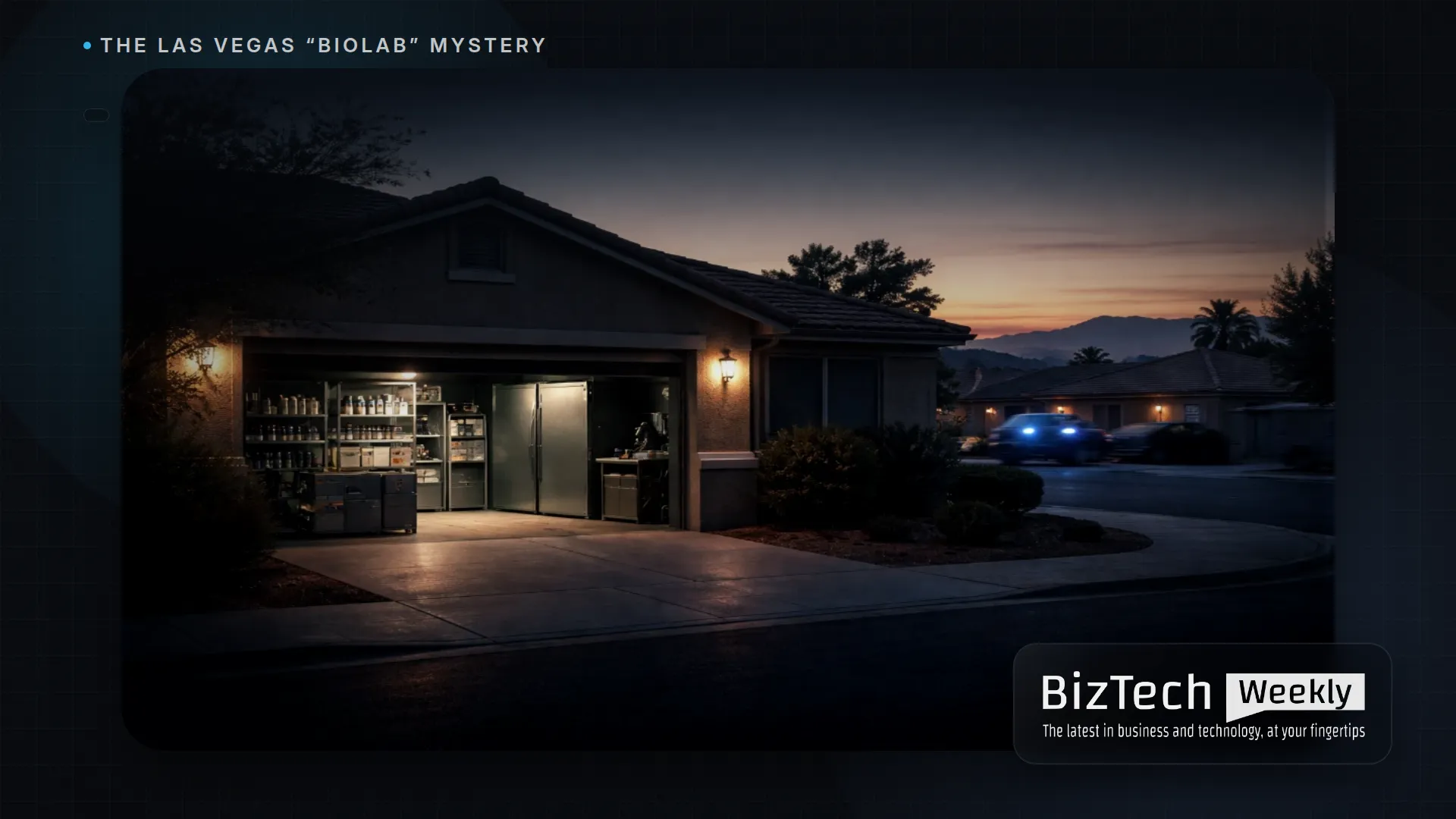
- Police say they found lab-style equipment and more than 1,000 samples in a Las Vegas home.
- The home is linked to a man already jailed over a similar lab discovery in California in 2023.
- Some containers in the earlier case were labeled with names of serious diseases like HIV, malaria, tuberculosis, and COVID-19—and even a refrigerator marked “Ebola,” according to one local official’s account.
- A person connected to the Las Vegas house, described as the property manager, was arrested on hazardous waste charges and later faced firearm-related charges, too.
- Officials say they don’t yet know what many of the substances are or what they were for.
- Some people reportedly became “deathly ill” after entering the Las Vegas garage, according to court documents cited by multiple outlets.
- At the same time, law enforcement has told the public there is no threat and that the home has been remediated.
That mix—serious-sounding materials, unclear purpose, international links, and incomplete answers—creates suspense. The key is to stay anchored in what can actually be shown.
The main people in this story
Jia Bei Zhu (also reported as Jesse Zhu, David He, Qiang He)
Across the reporting, one man appears at the center:
- He is reported to be 62 years old.
- He is described as a Chinese and Canadian citizen (in other places, as a Chinese national).
- He lived in British Columbia, Canada, for many years, and moved back and forth to the U.S. before leaving Canada.
- He is currently in U.S. federal custody and has been for about three years, according to his lawyer and news reports.
- He was arrested in 2023 after authorities investigated a facility in Fresno County / Reedley, California, described as an unauthorized or illegal biological lab.
- He has pleaded not guilty in the U.S. medical-device case.
- He is scheduled for trial in April 2026 in the federal case, according to multiple reports.
- Importantly: He is not charged with wrongdoing in the Las Vegas case, based on the reporting here.
Ori Solomon (also spelled “Salomon” in some coverage)
A second name appears in the Las Vegas part of the story:
- He is reported as 55 years old.
- Police and reporters describe him as the property manager connected to the Las Vegas home (and in some reports, more than one property).
- He is described as an Israeli citizen, and in some reports as having Israeli and French passports.
- He is described as being in the U.S. on a non-immigrant visa, which matters because it affects firearm laws.
- He was arrested after the Las Vegas raid and faces charges related to hazardous waste. He also faced federal firearm charges, according to local reporting.
Zhaoyan Wang
This person appears mainly in connection with the California case:
- She is described as Zhu’s wife in some reporting.
- She is also described as Universal Meditech’s manager.
- Court records cited in one report say she and a newborn child flew to China on a one-way ticket shortly after the Reedley search warrant was issued, though she declared she did not know about the search warrant.
A timeline of the key events
Part 1: The Canadian backstory (before the U.S. lab cases)
This story does not start in the United States. It starts years earlier in Canada.
- Jia Bei Zhu lived in British Columbia and became involved in a major business and court fight involving bull breeding technology.
- A company called XY LLC sued Zhu and related companies in B.C. court.
- The core issue: Zhu was found to have used a web of companies and actions to obtain or use confidential technology that helps separate male and female chromosomes in bull sperm—technology used to produce “sexed semen.”
- A B.C. court issued a judgment around $8.5 million against Zhu and related companies.
- After that, Zhu was found in civil contempt of court and was sentenced to six months. Reporting says his lawyer told a judge Zhu was afraid to set foot in British Columbia because he could be arrested.
- Zhu left B.C. in 2015. His last recorded border crossing was reported as flying into Los Angeles.
Later, the B.C. court issued a much larger ruling:
- Zhu faced damages totaling more than $270 million, described as among the largest ever in a B.C. courtroom.
- Court language about Zhu’s conduct was harsh, including phrases like “fraud of epic proportions” and “highly reprehensible conduct,” as quoted in later legal filings.
This matters today for two reasons:
- It helps explain why courts in the U.S. might view Zhu as a flight risk.
- It shows a pattern of complex, high-stakes legal conflict that continues across borders, including collection efforts in Hong Kong.
Part 2: The Reedley / Fresno County, California lab discovery (2023)
Now we shift to California.
How authorities say it was discovered
A U.S. congressional report is cited as describing an unusual discovery:
- A law enforcement officer noticed a green garden hose coming out of a hole drilled in the side of a warehouse.
- Inside, the officer found lab equipment, manufacturing devices, and medical-grade freezers.
- The report says there were thousands of vials:
- Many unlabeled
- Some labeled in Mandarin
- Some labeled in a code
- Some labeled in English
- The officer recognized some names, including HIV, even if other labels were unfamiliar.
What else was found (as reported)
Multiple reports describe the facility as containing:
- Test animals such as mice (one report says hundreds; another says about 1,000).
- Vials labeled with diseases such as HIV, tuberculosis, malaria, and COVID-19.
- Large amounts of biological material (one report says hundreds of gallons).
- A local official (Reedley City Manager Nicole Zieba) is quoted saying that even a refrigerator marked “ebola” was not tested by federal authorities.
A major disputed point: testing
The reporting repeatedly highlights that, despite alarm, many seized samples were never tested.
- The congressional report, and local officials, raised concerns about oversight and the lack of a monitoring system.
- The reporting quotes a conclusion that no one knows if there are other unknown labs because there is no monitoring system.
The federal charges tied to the California case
Authorities charged Zhu with offenses related to medical testing kits, not (at least in this reporting) with bioterrorism or knowingly handling pathogens:
- Selling hundreds of thousands of COVID-19 test kits without required FDA authorization (no pre-market approval, clearance, or emergency use authorization).
- Misbranding and distributing medical devices.
- In some reporting, additional claims include pregnancy and HIV tests, and making false statements to the FDA.
- Zhu disputes allegations and leadership roles; court records describe him as a consultant connected to Universal Meditech.
Zhu’s response and lawsuit
Zhu has fought back in court:
- He filed a civil suit seeking damages from officials.
- He claimed officials lied and dragged him “through the mud,” saying he was portrayed as operating an “illegal Chinese lab” and engaging in bioterrorism, even though he claimed those accusations lacked factual support.
- In one update, Fresno County officials said they were dropped from his lawsuit.
Part 3: The Las Vegas suspected lab discovery (late January–early February 2026)
Now we get to the event that brought the story back into headlines.
Where it happened
Police searched a home on Sugar Springs Drive in northeast Las Vegas. The house is described as a short-term rental in some reporting.
How the investigation started
Reports describe different initiating paths that point in the same direction:
- A “tip” that a biolab was located in the home.
- A code-violation call that escalated when authorities suspected illegal medical-type biological materials.
- A cleaner reporting lab equipment and medical waste.
According to one report citing a police arrest report, the FBI received a tip on January 9 from a cleaner.
What police say they found
Officials described a locked garage and a careful entry:
- Police used a tactical robot to enter/clear the garage.
- Hazmat precautions were used, including air sampling.
- Inside, investigators observed:
- Multiple refrigerators
- A freezer
- “Laboratory-type equipment”
- Numerous bottles and jugs with unknown liquids
- A centrifuge
- A biosafety hood and related items
- Liquids in gallon-size containers
- Vials and storage containers with liquids of different colors and compositions
Officials described it as complex and not yet identified.
How many samples
Multiple outlets report that over 1,000 samples were seized and sent for testing.
- Authorities said samples were sent to an FBI lab and to Maryland for analysis, including references to the National Bioforensic Analysis Center.
- Officials did not give a clear timeline for when testing would be done.
Public safety claims by authorities
Police told the public:
- There is no threat to the public.
- The home was remediated and there is no active danger in the neighborhood.
A key point: officials say they don’t know the purpose yet
At least one official statement is direct:
- “The truth is, we don’t know yet,” the sheriff said, when asked about the purpose.
- The FBI said this type of case requires measured steps that can’t be rushed.
The connection between Las Vegas and the California case
This is the heart of the intrigue: why do these two locations look similar, and how are they linked?
What officials say is the link
Police in Las Vegas stated that:
- The Las Vegas home is owned by someone already in federal custody related to the 2023 California lab case.
- The items in Las Vegas were consistent in appearance with those described in the California investigation.
What the reporting says about ownership
Several outlets report that:
- The owner of the Las Vegas property is Jia Bei Zhu, also known as David He, and other names.
- In at least one report, Zhu’s name is listed as registered agent for an LLC tied to the property.
- The house was reportedly purchased in 2022 by an LLC, according to one outlet.
What the reporting says about who lived there
Officials stated:
- Three people were renting rooms in the home and were removed safely.
- Authorities said those renters were not involved (at least at that time).
Zhu’s position on the Las Vegas case (through his lawyer)
Zhu’s attorney, Anthony Capozzi, was quoted saying:
- Zhu is not involved in any biolab being conducted in the Las Vegas home.
- What happened in that residence is unknown to them.
This is an important detail because it draws a line between ownership and operational control—something investigators will likely try to clarify.
The arrest of Ori Solomon and what he is accused of
Why he was arrested (as reported)
Police arrested Ori Solomon, described as the property manager.
He was booked on a charge of:
- Disposing and discharging hazardous waste, or
- Improper handling/disposal of hazardous materials (wording varies across outlets)
One report mentions improper storage and disposal of hydrochloric acid.
Firearms allegations
Local reporting adds a major extra layer:
- Solomon faced federal firearm charges because he is described as an Israeli citizen in the U.S. on a non-immigrant visa, which bars possession of firearms.
- Prosecutors said multiple guns were seized from his home.
- A detailed list of firearms appears in one outlet’s write-up, including handguns and rifles, and an Israeli-made rifle model is referenced.
- Some reporting says firearms were not seized during the first search because the first warrant did not cover weapons, and later warrants were used.
Release pending trial
Local reporting indicates:
- Solomon was released on his own recognizance with conditions:
- Surrender any passport
- Not leave the country
- Notify court before leaving Clark County
- Not possess firearms or other weapons
The exact mix of state vs federal proceedings is described differently across outlets, but the basic point is consistent: he is charged and is awaiting further court steps.
Reports of people becoming “deathly ill”
One of the most alarming details in the coverage is the repeated claim that people got seriously sick.
- Several reports cite court documents or an arrest report saying that after entering the garage, multiple people became “deathly ill” and could not get out of bed.
- The reporting describes at least two individuals, including a cleaner and another person who worked for Solomon.
- The reporting includes descriptions of a “hospital-like” smell that was not clean, but foul and stagnant, and mentions of dead crickets around the house.
What is not confirmed in these articles:
- Exactly what made people sick.
- Whether tests proved any specific cause.
- Whether the illness was chemical exposure, biological exposure, or something else.
At this stage, in the material provided, the illness is a reported claim grounded in cited documents, but not a confirmed causal finding tied to a known substance.
Other properties and whether they were connected
Authorities and local reporting mention at least one other location:
- Police said they investigated possible related locations and ruled most out.
- One report says FBI searched another property believed associated with Solomon but emphasized “zero connection” to the investigation.
- Another report (GV Wire) says two homes were raided and that materials were found in garages, with three renters across the two homes. Other outlets focus on one home.
This matters because it shows some uncertainty in early reporting: as investigations unfold, the “map” of relevant locations sometimes expands and then narrows.
The question of labels: “HIV,” “malaria,” “TB,” “Ebola,” and what labels do and do not mean
Across the articles, one of the scariest elements is the presence of disease names on labels. Here is how the reporting presents it:
- In California, vials were found with labels like HIV, malaria, TB, and more.
- Some were unlabeled; some in Mandarin; some in code; some in English.
- In Las Vegas, authorities did not publicly list disease labels in their main statements (in the materials provided here), but they said items were consistent with what was found in California and that samples were being tested.
- Some later reporting and international summaries claim that substances linked to hepatitis, COVID-19, HIV, and malaria were found in Las Vegas, but those appear to be secondary retellings rather than direct quotes from the core Las Vegas press conference in every case.
A crucial investigative point:
- A label alone does not prove what is inside a vial.
- That is why testing matters, and why officials keep saying they do not yet know.
The role of the U.S. congressional report
The reporting cites a congressional report from the House Select Committee on the Chinese Communist Party that described:
- The discovery in California.
- The concern that samples were not tested.
- The broader worry that the U.S. does not have a system to monitor labs that could be handling pathogens, meaning there could be unknown facilities.
This report shapes how the public reads the story, because it frames the California case as a warning about national oversight gaps.
What is established as fact, and what remains allegation or uncertain
Established (based on official statements and court filings as described)
- A Las Vegas home was searched by police and the FBI.
- Investigators found lab-style equipment and liquids/vials in refrigerators/freezers, mainly in a locked garage.
- More than 1,000 samples were collected and sent for testing.
- The home is linked by ownership to a person already in federal custody from a California case.
- Ori Solomon was arrested and charged with hazardous waste offenses.
- Solomon also faced firearm-related legal jeopardy tied to his immigration status.
- Authorities publicly stated there is no ongoing threat to the public and that the home was remediated.
- Authorities publicly stated they do not yet know what the substances are or what the purpose was.
Alleged / reported but not fully proven in the materials provided
- That the Las Vegas site was an “illegal biolab” in the sense of active biological research.
- That the materials definitely included particular pathogens (until test results are made public).
- That anyone’s illness was caused by exposure to these materials.
- That the Las Vegas and California sites were operationally connected beyond superficial similarity and shared ownership ties.
Clearly speculation or ideological framing (in some outlets)
- Claims about “false flags,” or broad geopolitical narratives, appear in one outlet’s commentary-heavy piece and are not presented as findings by authorities.
The key questions a careful reader should consider
This is the “gold standard” part: what you should watch for next, and what would actually answer the mystery.
1) What do the tests show?
The single most important unanswered question is simple:
- What are the substances?
Authorities have said they collected samples and sent them for testing. Until results come back, the story is mostly about possibilities rather than confirmed contents.
2) Were these materials dangerous, and if so, how dangerous?
Even if some samples are hazardous, there are different levels:
- Some hazards are serious but manageable.
- Others would be major public safety threats.
- Some might be ordinary lab reagents or mislabeled items.
This will depend on lab results and chain-of-custody documentation.
3) What was the purpose of the materials?
Possible purposes (not conclusions) could include:
- Legitimate research done illegally or without proper permits
- Medical testing development
- Counterfeit or unregulated medical device work
- Storage of materials connected to past operations
- Something else entirely
Right now, officials say they don’t know.
4) Who actually controlled the Las Vegas garage operation?
Ownership and control are different:
- Zhu is linked through property ownership and prior similar cases.
- Solomon is linked as property manager and was charged.
- Renters were said not to be involved.
A major open question is: Who put the equipment there, maintained it, and handled the materials?
5) Are the Las Vegas and California sites truly connected?
Authorities say the materials look similar and the owner link is real, but they have not publicly confirmed:
- Shared staff
- Shared supply chains
- Shared business operations
- Shared customers
The investigation may try to prove (or disprove) operational linkage.
6) Why did people get sick?
If people truly became “deathly ill,” investigators will want:
- Medical records (if available)
- Environmental sampling
- Testing for toxins, molds, fumes, and pathogens
- A timeline of exposure
Without that, the illness remains alarming but unclear.
7) Why was the California material allegedly not tested, and is Las Vegas being handled differently?
A repeated theme is that Reedley involved delays and limited testing, while Las Vegas appears to involve more extensive federal handling.
If true, that raises oversight questions:
- What changed?
- What did agencies learn?
- What are the rules now?
8) What is the legal endgame?
Zhu faces federal trial in April 2026 for the medical device case.
Solomon faces hazardous waste and firearm-related charges.
Investigators may add charges if evidence supports it.
Bottom Line
Two separate U.S. locations—one in California (2023) and one in Las Vegas (2026)—have been linked by authorities to the same property owner, Jia Bei Zhu, who is already jailed awaiting trial for alleged medical-device violations. In Las Vegas, investigators found lab-style equipment and more than 1,000 samples in a locked garage, and arrested the property manager, Ori Solomon, on hazardous waste and firearm-related allegations. Officials emphasize that the substances are still being tested and that they do not yet know the purpose or exact contents of what was found. Many of the most frightening details in the public conversation—especially disease labels and reports of severe illness—remain unresolved until official test results and court proceedings provide clearer proof.


 By
By

 By
By
 By
By
 By
By
 By
By
 By
By







