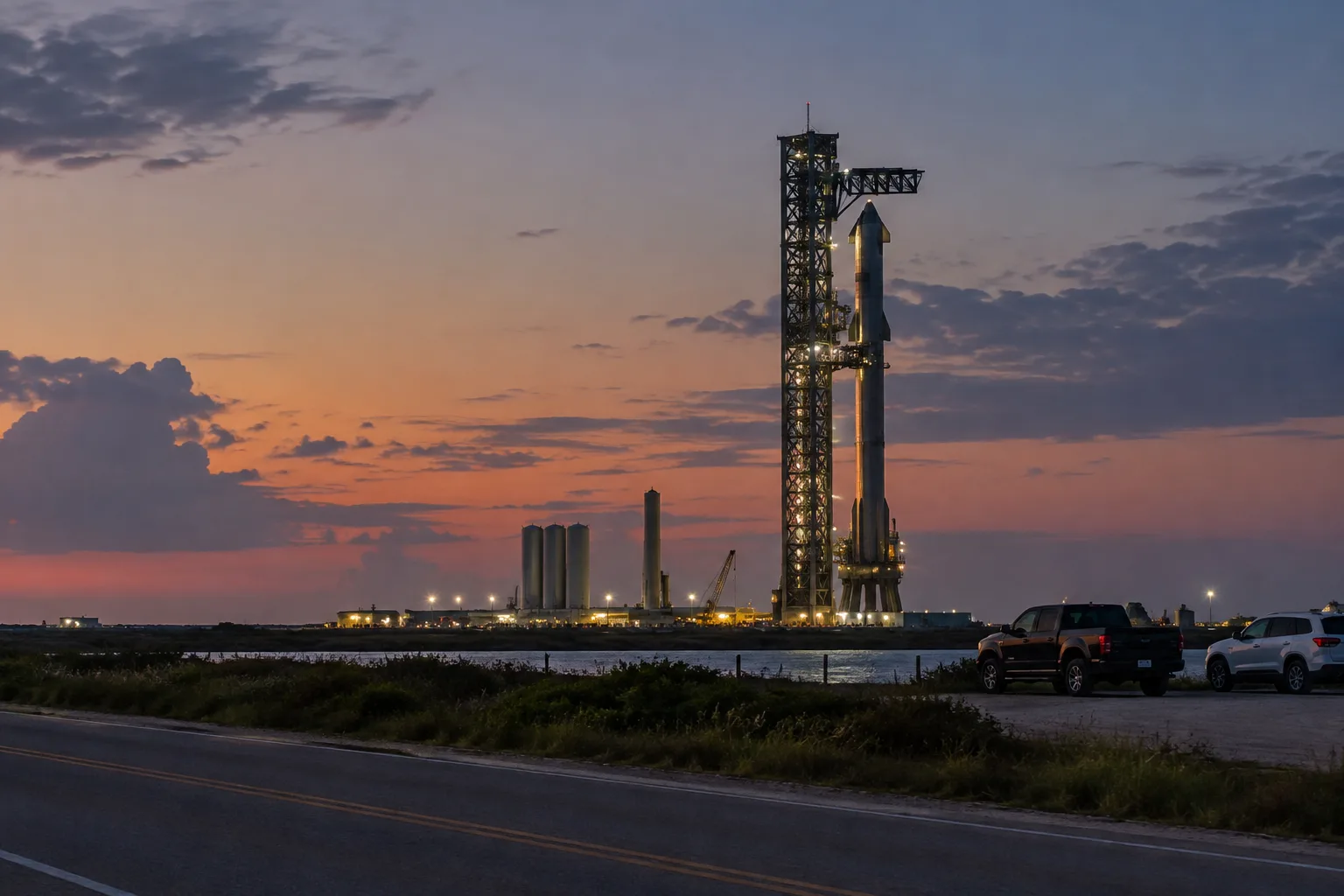

SpaceX’s Starship program cleared one of its biggest technical hurdles on Nov. 14: an upper-stage Starship returned from orbit and was caught by the launch tower’s mechanical arms at Starbase, Texas. Just as important, the same flight showed why the company’s larger business promise is still unfinished. The Super Heavy booster did not complete its own return after engines shut down too early; guidance determined the vehicle was out of position, and the booster diverted to the Gulf of Mexico and self-destructed.
For businesses, government customers and investors, the real question is not whether Flight 15 was dramatic. It is whether the mission materially de-risks a reusable system that is supposed to fly often, cheaply and on schedule. On the public record so far, the answer is mixed: Flight 15 meaningfully reduces uncertainty around orbital return of the upper stage, but it does not yet show the repeatable two-stage recovery, refurbishment and cadence that Starship’s economics require.
A milestone on only half of the recovery loop
According to SpaceX’s mission page, Flight 15 was planned as a more than 22-hour mission in an approximately 275-kilometer orbit, with deployment of 26 Starlink V3 satellites and an attempt to bring both stages back to the launch site for catch. SpaceX described the vehicle as 124 meters, or 407 feet, tall and framed the test as two firsts: a return-to-launch-site catch for a Super Heavy V3 booster and the first upper-stage catch at Starbase.
The upper stage delivered the harder half of that headline. As AP reported, Starship completed 14 Earth orbits at roughly 265 kilometers, stayed in flight for about 22 hours and released all 26 satellites before surviving reentry and being captured at the tower. SpaceX said the heat shield and other vital systems appeared to work well. That matters because the upper stage has to do far more than launch: it must endure orbital flight, reenter cleanly and return with enough precision to be recovered at the pad.
But the booster miss keeps the full system from crossing the line into credible routine reuse. Super Heavy is the stage that must launch every mission, absorb the highest flight rate and come back reliably if SpaceX wants airline-style cadence rather than occasional heavy-lift spectacles. Instead, Flight 15 ended with the booster diverted before its planned catch after the early engine shutdown and guidance problem. Whether that was an isolated fault or a broader integration issue is not yet public, and that distinction matters more than the visual success of the catch.
Why the business case is still incomplete
Starship’s strategic pitch has always been a chain of operational handoffs, not one triumphant landing. A launch provider has to separate safely, recover both stages, inspect them, refurbish them, assign them new payloads and launch again on dates customers can trust. Flight 15 advanced one of those handoffs in a big way. It did not demonstrate the whole chain.
That is why this result should not be read as proof that Starship has already solved launch economics. Public sources still do not provide an independent cost per flight, refurbishment cost, turnaround time or evidence that the caught upper stage can be prepared for another mission quickly. Even the commercial win on paper—deploying 26 Starlink V3 satellites—has limits as a business signal. Deployment shows payload capability; it does not by itself prove profitable service, predictable fleet operations or low cost per useful kilogram.
The denominator matters here. Flight 15 was the 15th full-scale Starship flight since 2023 and only the second to reach orbit. That is consistent with a program still pushing through major design checkpoints, not one that outside customers should treat as operational routine. Satellite operators, insurers and launch buyers will care less about a single successful catch than about whether SpaceX can repeat the sequence, document inspections and convert a test program into dependable manifest dates.
There is also a near-term infrastructure angle. AP said SpaceX expects to begin launching Starships from Florida’s Kennedy Space Center within the next few months. If that timetable holds, Starship’s reliability and recovery performance stop being just a Starbase story and become part of Florida site planning, supplier scheduling and regulatory workload. The booster anomaly leaves open whether any redesign, investigation or operational pause could affect that expansion.
What changes for NASA, Starlink and outside customers
NASA publicly welcomed Flight 15 for an obvious reason: it is paying billions of dollars for Starship to support Artemis lunar missions, and the agency is targeting a human lunar landing as soon as 2028. An upper-stage return from orbit is relevant progress for any architecture that depends on a large reusable spacecraft. It is harder to argue that Starship remains largely conceptual after an orbital mission that deployed satellites, survived reentry and returned to the tower.
Still, this flight does not settle the schedule question NASA actually cares about. Artemis needs mission assurance and planning confidence, not just a breakthrough headline. No public result yet shows that Flight 15 changes Starship’s contractual milestones, changes risk allocation for NASA, or guarantees support for a 2028 landing target. The gap between an impressive test and a dependable lunar transportation element is filled with exactly the things the public record still lacks: repeat recovery of both stages, detailed heat-shield inspection results, reflight evidence, predictable cadence and regulatory throughput.
The same practical scorecard applies to Starlink and to outside customers considering future Starship capacity. Can SpaceX recover both stages on the same mission? Can it show that the upper stage’s thermal protection works not once, but repeatedly enough to keep refurbishment manageable? Can it deploy payloads on schedule without tying service economics to a fragile test tempo? And can it do all of that often enough that launch dates, insurance terms and supplier commitments become easier—not harder—to manage?
Flight 15 gave SpaceX a milestone worthy of the attention it received. It also made the next questions more concrete. The upper-stage catch demonstrated that one major piece of the architecture can work. The booster loss showed that the full reuse loop still has to be proven where businesses and agencies feel it most: in repeatability.

 By

 By


 By

 By