


Synthetic Debates and the New Reality of Political Discourse
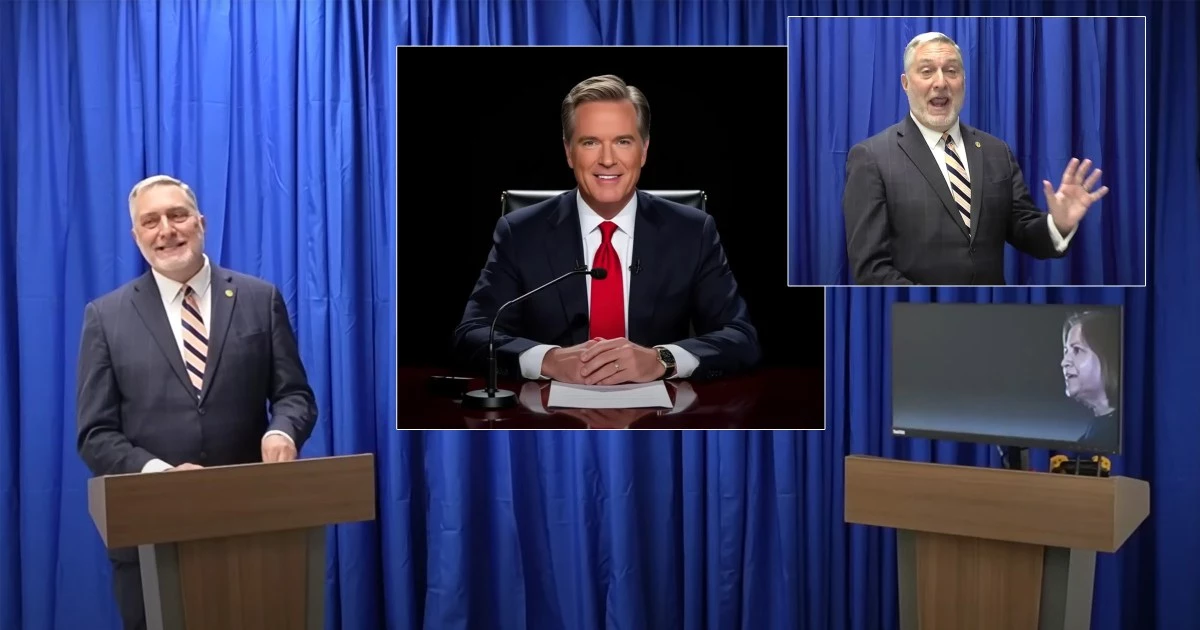
In an era where the line between reality and fabrication blurs with each algorithmic advance, the recent AI-generated “debate” in Virginia marks a watershed moment. John Reid, a Republican candidate for lieutenant governor, took to YouTube not to spar with his Democratic counterpart, Sen. Ghazala Hashmi, but with her digital simulacrum—a deepfake avatar, animated and voiced by generative AI. For forty minutes, Reid parried and rebutted algorithmically generated statements, while an AI moderator presided over the proceedings. Hashmi, having declined to participate in a live debate, was nonetheless present in uncanny digital form.
This spectacle is not an isolated oddity, but a harbinger. Across the globe, political actors are deploying generative AI to satirize, misrepresent, or outright discredit adversaries. Deepfake videos of former President Trump circulate alongside forged campaign clips targeting candidates from Ireland to Indonesia. The mechanics of democracy—debate, persuasion, trust—are being reengineered in real time, with synthetic media as both tool and weapon.
The Technological Arms Race: Deep Synthesis at Scale
What makes this moment especially fraught is the democratization of deep synthesis technology. Open-source diffusion models and large language model checkpoints have driven the marginal cost of creating a photorealistic, 60-frames-per-second digital persona toward zero. A mid-tier GPU cluster—available for less than $100 an hour at current spot rates—can now mass-produce hyper-realistic political dialogue in real time, indistinguishable from authentic footage to the untrained eye.
The technical leaps are staggering:
- Voice-cloning error rates have dropped below 2% in English, rendering synthetic speech nearly flawless.
- Lip-sync and facial animation are now photorealistic at 1080p, eliminating once-reliable heuristics for spotting fakes.
- Detection tools lag behind: Even state-of-the-art classifiers can only identify deepfakes with 60–70% accuracy, leaving ample room for malicious actors to operate undetected.
Cryptographic watermarking and metadata signatures exist, but their adoption is voluntary and their efficacy limited—watermarks can be stripped, and provenance chains broken. The asymmetry between creation and detection creates a probabilistic fog, in which misinformation can proliferate with impunity.
Economic Fallout and the Shifting Trust Premium
The implications extend far beyond the campaign trail. U.S. political advertising spend is projected to soar past $12 billion in 2024, up 31% year-over-year. Generative AI slashes creative production costs, shifting budgets toward micro-targeted distribution—a boon for programmatic ad platforms and data brokers, but a margin squeeze for traditional agencies and broadcasters.
The risks are not confined to politics:
- Brand impersonation becomes trivial: The same tools that can synthesize a senator’s speech can forge a CEO’s earnings call or a product recall announcement, exposing enterprises to catastrophic reputational harm.
- Cyber-insurance markets are recalibrating: Carriers are quietly modeling “synthetic defamation” riders, with premium increases of 8–12% forecast for media-exposed sectors by 2025.
- Institutional investors are reassessing the “trust discount”: Sectors that depend on remote identity verification—fintech, telehealth, edtech—face higher customer-acquisition costs and compliance overhead, with direct impacts on EBITDA multiples and market valuations.
Platforms such as YouTube, Meta, TikTok, and X are under intensifying scrutiny. The legal shield provided by Section 230 is politically fragile, and European-style duty-of-care standards, as seen in the Digital Services Act, may soon cross the Atlantic.
Strategic Imperatives: Building Digital Trust Before the Deluge
For C-suite leaders and policymakers, the Virginia deepfake debate is not merely a curiosity, but an early warning. The next synthetic event could target a company’s product recall, a CFO’s earnings call, or a customer-service chatbot—transforming deepfakes from political novelty to existential business risk. Strategic imperatives now include:
- Investing in real-time media verification: Embedding hash-chain provenance and advanced watermarking at the point of content capture, not just distribution.
- Piloting zero-knowledge proof credentialing: Creating immutable authenticity ledgers for executive communications.
- Treating synthetic media as an enterprise risk domain: Allocating board-level oversight and integrating synthetic threat modeling into crisis response.
- Building adversarial “red-team/blue-team” units: Combining communications, security, and data science to stress-test corporate channels before hostile actors do.
Regulatory momentum is building. U.S. Senate AI working groups are drafting labeling mandates for political ads, with enforcement likely after the 2024 cycle. The EU AI Act’s “high-risk” designation for synthetic political media will soon require ex-ante conformity assessments. China’s disclosure mandates for deep synthesis content offer a glimpse of state-driven control that Western regulators may partially emulate.
As the world enters an election super-cycle—spanning the U.S., India, the EU, and Indonesia—digital trust infrastructure will undergo its most severe stress test yet. The market will reward those who move swiftly: authenticity startups, specialist insurers, and cloud vendors with inference-optimized silicon stand to gain, while legacy agencies and unprepared brands risk obsolescence.
The lesson is clear: the age of synthetic media is not on the horizon—it is here. The challenge for leaders, both public and private, is to establish technological and governance guardrails before the next deepfake moves from viral curiosity to balance-sheet event. As this new reality unfolds, the imperative is not just to adapt, but to anticipate.

 By
By
 By
By

 By
By
 By
By
 By
By

 By
By







