

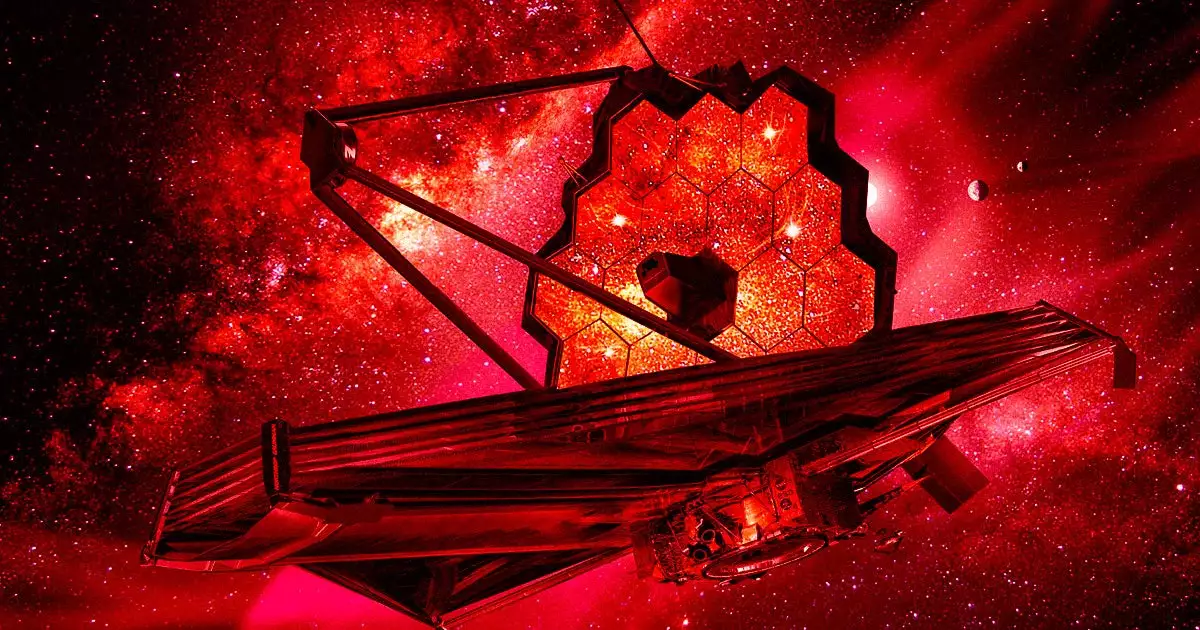

Unveiling the Cosmos: JWST’s “Little Red Dots” and the New Frontier of Astrophysical Discovery
The James Webb Space Telescope (JWST), in its brief tenure at the L2 point, has already delivered a revelation that reverberates far beyond the cloisters of astrophysics. The detection of ultra-compact, faint “little red dots”—tracing their origins to the universe’s first billion years—has cracked open a new chapter in our understanding of cosmic evolution. These enigmatic signals, subtle as whispers yet profound in implication, are forcing theorists and technologists alike to re-examine the scaffolding of early-universe models and the machinery required to probe them.
Dark-Matter Halos, Black-Hole Stars, and the Architecture of the Early Universe
At the heart of the debate lies a scientific fork: Are these red dots miniature galaxies forming in dark-matter halos with near-zero spin, or do they represent a previously unimagined class of “black-hole stars”—colossal black holes swaddled in dense, star-forming cocoons?
- Low-Spin Halo Hypothesis: The prevailing cosmological model, ΛCDM, has long predicted a bell curve of halo spin rates, with the slowest outliers expected but never observed—until now. These low-spin halos, by concentrating baryonic matter into extraordinarily compact volumes, may have supercharged the birth of stars and the rapid assembly of super-massive black holes. If confirmed, this would elegantly reconcile the “black hole–galaxy mass ratio” paradox that has vexed theorists for decades.
- Black-Hole Star Scenario: Alternatively, the “black-hole star” model posits a phase where a nascent black hole, still shrouded in the gas from which it formed, radiates in a manner that defies the boundaries between stellar and accretion physics. Such objects, if real, would not only rewrite the textbooks on high-energy astrophysics but also provide new targets for gravitational-wave and neutrino observatories.
Both scenarios stretch the limits of current theory, demanding not just new physics but new instruments and computational paradigms to validate them.
Technology’s Quiet Revolution: From Cryogenic Sensors to Exascale AI
JWST’s discoveries are not merely triumphs of observation; they are catalysts for a broader technological renaissance. The telescope’s mid-infrared acuity and adaptive optics are already outpacing initial projections, demonstrating the unforeseen return on investment for high-capital, long-cycle science missions. But the implications ripple much further:
- AI and Edge Computing: The deluge of faint-signal data from JWST is driving the development of edge-AI pipelines and exascale computing architectures. These advances, initially tailored for astrophysical data, are rapidly finding applications in Earth observation, medical imaging, and defense intelligence.
- Hydrodynamic Simulations: Accurately modeling low-spin halos or black-hole stars requires simulation resolutions an order of magnitude beyond the current state of the art. This is accelerating procurement for advanced GPU clusters and fueling the open-software movement around codes like AREPO and GIZMO—tools now coveted by both academic and commercial R&D labs.
- Sensor and Materials Innovation: The ultra-low-noise, cryogenic detectors that isolate these primordial signals are informing next-generation semiconductor roadmaps, with direct crossover potential in quantum sensing and superconducting logic.
Economic Ripples and Strategic Maneuvers in the Deep-Tech Ecosystem
The scientific intrigue of the “little red dots” is matched only by their economic and strategic aftershocks. Investor enthusiasm for deep-tech ventures—especially in optics, cryogenics, and launch services—has been palpably refreshed. Series B and C rounds are seeing renewed interest, particularly for firms specializing in mid-infrared instrumentation and advanced mirror technologies.
- Data Monetization: The unprecedented data yields from JWST are lending credibility to new commercialization models, where derivative analytics are sold to insurers, commodities traders, and climate scientists. This trend is likely to accelerate as subsequent missions promise even richer datasets.
- Talent and Supply Chain: The astrophysics-to-industry pipeline is set to intensify, with data scientists trained on cosmic signals migrating into finance, biotech, and AI. Meanwhile, looming shortages in cryogenic components (helium-3, indium phosphide) threaten to disrupt supply chains across quantum computing, medical imaging, and aerospace.
- Public-Private Dynamics: The political capital generated by JWST’s breakthroughs is strengthening the case for commercial co-funding of future observatories. Boards in adjacent industries must now articulate sharper R&D narratives to compete for federal and international funding.
Navigating the New Space Race: Strategic Imperatives for Leaders
For corporate strategists and policymakers, the message is clear: the era of JWST’s “little red dots” is not just about rewriting the cosmic origin story—it’s about recalibrating the engines of innovation and investment.
- Portfolio Realignment: Long-horizon investors should revisit allocations in sensing, photonics, and high-performance computing, sectors now validated by the demands of frontier science but primed for terrestrial disruption.
- Intellectual Property: The rush to develop new numerical methods and data-compression algorithms opens avenues for standard-essential patents and proprietary simulation frameworks, potentially locking in future ecosystem rents.
- Geo-Strategic Competition: As China’s Xuntian and Europe’s ELT prepare to join the hunt for early-universe signals, the cadence of U.S.-led launches and data analysis throughput becomes a matter not just of scientific prestige, but of soft-power dominance.
The “little red dots” of JWST are more than celestial curiosities—they are signals of a new alignment between science, technology, and economic strategy. Those who heed their message early, whether through partnership, investment, or talent acquisition, will find themselves not just observers, but architects of the next era in both cosmology and commerce.

 By
By
 By
By

 By
By
 By
By

 By
By
 By
By







