

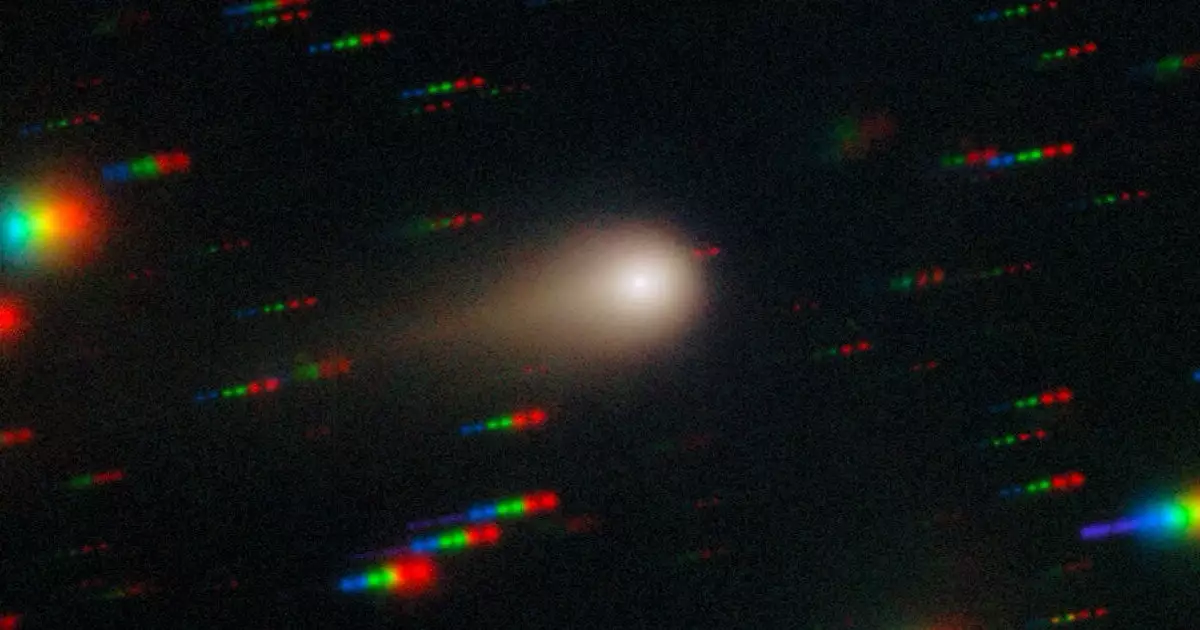

Interstellar Chemistry and the Universal Blueprint of Comets
The recent confirmation that 3I/ATLAS, only the third known interstellar comet, is laden with carbon-dioxide ice and dust signatures akin to those of Solar System comets, marks a pivotal moment in both astronomy and the broader business of space. This finding, achieved through a remarkable orchestration of four NASA spacecraft and the Gemini South observatory’s advanced optics, narrows the chemical divide between extrasolar visitors and our own cosmic backyard. The implication is profound: the processes that sculpt comets may be less parochial than once believed, hinting at a universal blueprint for icy bodies across the galaxy.
This revelation arrives not merely as an academic curiosity but as a harbinger of commercial and strategic opportunity. The ability to remotely dissect the composition of a fast-moving, interstellar object—hurtling toward its closest approach to the Sun—demonstrates the maturing synergy between cutting-edge instrumentation, federated data analytics, and multinational scientific collaboration. The event is a bellwether for sectors far beyond astronomy, from minerals prospecting in deep space to climate analytics and defense.
The Technological Renaissance in Remote Sensing
At the heart of this breakthrough lies a suite of technological advances that are rapidly redefining the boundaries of what is observable—and actionable—in the cosmos.
- Gemini’s GMOS Imager: By fusing multi-object spectroscopy with adaptive optics, the GMOS system delivers real-time chemical mapping at more than twice the previous signal-to-noise ratio. This leap in precision is not confined to astronomy; it is the template for the next generation of Earth-observation constellations and synthetic-aperture radar systems.
- NASA’s Multi-Band Array: The four-telescope array, leveraging heterogeneous sensor stacks across ultraviolet, infrared, and sub-millimeter bands, embodies the future of multi-modal surveillance. Such architectures are now being mirrored in cislunar traffic monitoring and commercial satellite imaging.
- Data-Fusion and AI Analytics: The campaign’s petabyte-scale telemetry, stitched together from disparate wavelengths, mirrors the federated data-management architectures now underpinning satellite start-ups. Real-time coma morphology classification, powered by machine learning, foreshadows the rise of autonomous observatories—a segment analysts expect to grow at over 20% CAGR through the decade.
These advances are not without their supply-chain complexities. CO₂-optimized spectrographs depend on cryogenic detectors and ultra-black coatings—components whose suppliers also serve defense ISR, semiconductor lithography, and quantum computing. As demand for these niche materials accelerates, the market tightens, amplifying the strategic value of upstream control.
Strategic and Economic Ripples: From Space Resources to Planetary Defense
The chemical kinship between 3I/ATLAS and Solar System comets breathes new life into the space resource thesis. If interstellar bodies routinely harbor water, volatiles, and organics in commercially viable concentrations, the probabilistic models that underpin asteroid mining ventures gain a crucial boost in confidence. For institutional investors, this reduces risk and sharpens the calculus for underwriting future missions.
Precision spectroscopy of high-velocity objects like 3I/ATLAS also enriches the planetary-defense playbook. The calibration data gleaned from this close pass will inform kinetic-impact and laser-ablation strategies, making the case for dual-use investments that straddle scientific and defense imperatives. The precedent of public-private cost sharing—exemplified by U.S. Space Force–NASA collaborations—may soon extend to these new frontiers.
On the geopolitical stage, the Gemini South observatory’s Chilean perch underscores the diplomatic heft of premier astronomical infrastructure. As nations vie for leadership in the space economy, such assets become levers for setting international standards on data sharing and intellectual property—especially as they pertain to celestial resource assays.
Industry Crosscurrents and the Road Ahead
The ramifications of this campaign ripple outward, touching industries as diverse as semiconductors, ESG analytics, and insurance:
- Semiconductor Cycles: Cryogenic detector demand feeds into the same ultra-pure silicon and compound-semiconductor supply chains that power AI accelerators, intensifying debates around capacity planning for the coming years.
- Climate Analytics: Algorithms honed for CO₂ detection in space are immediately transferable to terrestrial greenhouse-gas monitoring, a high-growth adjacency for Earth-observation firms navigating the ESG landscape.
- Risk and Insurance Markets: Improved compositional baselines for impactors could spawn new financial instruments—“space catastrophe bonds”—mirroring those that already exist for terrestrial natural disasters.
For decision-makers, the actionable imperatives are clear:
- Stress-test supply chains for specialty detector components.
- Track emerging players in autonomous observatory platforms and AI-driven data-fusion middleware.
- Engage early in the shaping of interstellar resource governance frameworks.
- Explore cross-licensing of gas-spectroscopy IP for both space and Earth-focused markets.
The saga of 3I/ATLAS is not merely a chapter in the annals of astronomy. It is a vivid tableau of converging scientific ingenuity, geopolitical maneuvering, and emergent commercial opportunity—a microcosm of the trillion-dollar space economy’s next act. Those with the acuity to interpret its signals today will shape the contours of tomorrow’s strategic high ground.

 By
By
 By
By


 By
By

 By
By
 By
By







