


Solar Fury and the Fragility of the Space-Enabled Economy
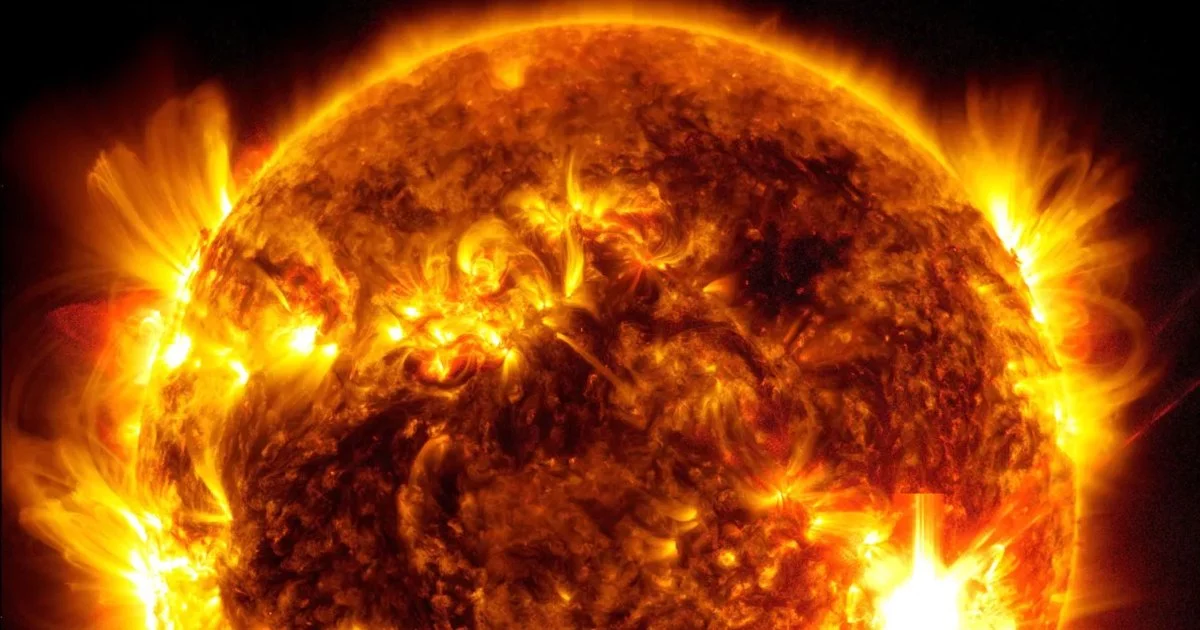
A rare and formidable geomagnetic storm—now upgraded by NOAA to G4 “severe” status, with the specter of G5 “extreme” looming—has swept the globe into a state of heightened alert. The event, the most potent since 2005, has already forced Blue Origin to delay the much-anticipated inaugural launch of its New Glenn heavy-lift rocket, stalling NASA’s ESCAPADE Mars mission on the pad. Yet the true significance of this solar tempest lies not in a single postponed launch, but in the stark exposure it reveals within the world’s increasingly satellite-dependent economic infrastructure.
Single Points of Failure in a Hyper-Connected World
The modern economy’s nervous system is orbital. Navigation, precision agriculture, global finance, and logistics all depend on the seamless functioning of satellite constellations. A 30-minute GNSS (Global Navigation Satellite System) outage can ripple through aviation, disrupt container-port operations, and unmoor algorithmic trading from its temporal anchors. The annual value of GNSS to the global economy is estimated at $300 billion; a single day’s disruption from a G5-class storm could erase billions in GDP.
The proliferation of mega-constellations—Starlink, Kuiper, OneWeb—has multiplied both capability and risk. Each new satellite is another node in a vast, fragile mesh. Insurers, keenly aware of this concentration, have begun modeling aggregate risk for “single-orbital-shell” events. Today’s geomagnetic storm will feed actuarial models and, inevitably, raise premiums for satellite operators and their downstream clients.
The storm’s impact is not confined to the heavens. On the ground, the May 2024 solar event offered a sobering preview: GPS-guided tractors in North America and Europe were rendered inoperable, disrupting planting schedules and exposing the food system’s dependence on orbital precision. Meanwhile, the energy grid—already strained by the integration of distributed resources—faces the threat of geomagnetically induced currents (GICs) that can shorten transformer lifespans or trigger catastrophic failures. With transformer replacement lead-times stretching beyond 18 months, the economic and security stakes are profound.
Technological Adaptation: From Silicon to the Stratosphere
The response to this new era of solar volatility is taking shape across multiple technological fronts:
- Satellite Resilience: The industry is pivoting toward radiation-hardened chipsets, fault-tolerant FPGAs, and autonomous safe-mode algorithms. Advances in silicon photonics and 3D-stacked memory promise higher error-correction thresholds, offering a bulwark against cosmic onslaught.
- Alternative Positioning, Navigation, and Timing (PNT): As reliance on GNSS grows perilous, demand surges for terrestrial eLORAN, low-frequency RF beacons, and quantum-clock mesh networks. Venture investment in “resilient PNT” startups is accelerating, reflecting a market newly attuned to orbital risk.
- Grid and Data Center Hardening: Utilities are re-examining the deployment of neutral-blocking devices and real-time GIC monitoring, while financial exchanges and cloud providers are adopting chip-scale atomic clocks to maintain regulatory compliance during satellite timing lapses.
The imperative extends to launch providers and payload owners. The Blue Origin delay is a case in point: space-weather is now a first-order variable in launch scheduling, procurement cycles, and contractual risk. Investors, too, must recalibrate their models, pricing in a “solar-maximum beta” for space infrastructure projects and rewarding designs that prioritize radiation shielding and autonomous recovery.
Strategic Realignment in an Era of Orbital Risk
This geomagnetic storm arrives at a moment of profound transformation. Western economies are re-industrializing, onshoring critical supply chains and elevating the importance of uninterrupted power and data. Climate-tech investment, increasingly tethered to earth-observation satellites, faces new questions about the resilience of orbital infrastructure. Meanwhile, the intensifying multipolar space race—between the U.S., China, and a host of private actors—renders launch cadence and mission prioritization more sensitive than ever to solar activity.
For executives and policymakers, the lesson is clear:
- Integrate real-time space-weather intelligence into launch and operational playbooks.
- Stagger constellation rollouts to distribute risk across orbital planes and time.
- Accelerate investment in both terrestrial and orbital hardening, from grid infrastructure to firmware-over-the-air (FOTA) architectures.
- Update insurance and financial models to reflect correlated risks between space and ground assets.
The current storm, with auroras visible as far south as Alabama, is both a spectacle and a warning—a vivid reminder that the digital fabric of civilization is stitched with threads spun in space. As the solar cycle peaks through 2025, those who treat space-weather resilience as a core design principle, not a footnote, will define the next chapter of the orbital age.

 By
By
 By
By


 By
By

 By
By
 By
By







