

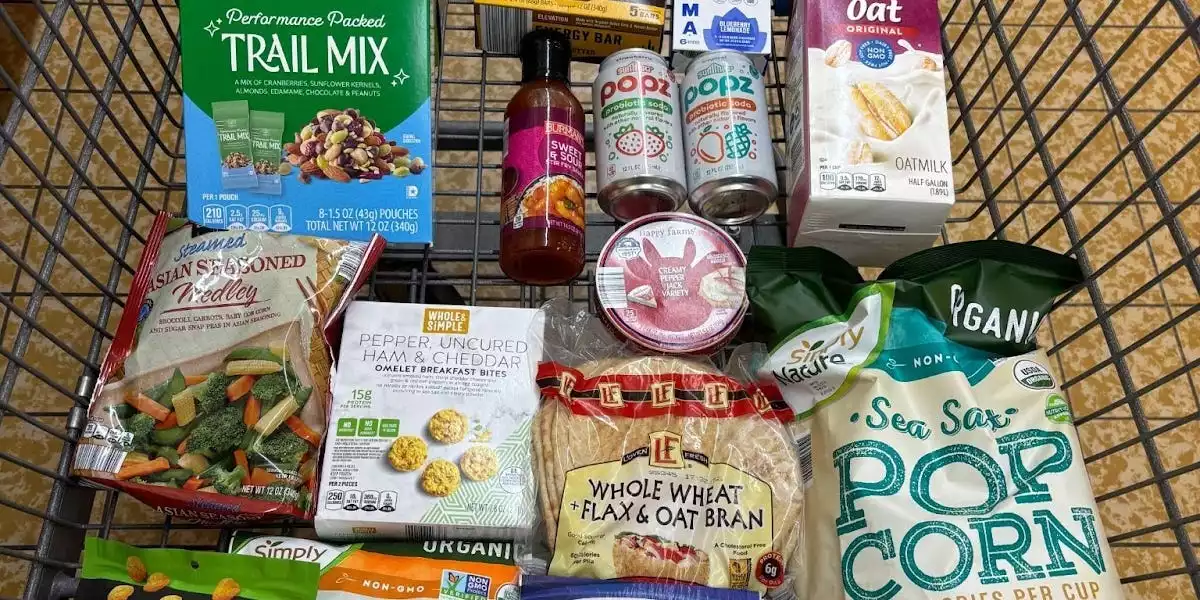

A home-office grocery basket that signals a broader retail reset
An empty-nester couple working from home may sound like a narrow consumer vignette, but their Aldi shopping routine reads like a field report on where grocery retail, private label strategy, and health-forward consumption are heading. The substitutions are telling: Elevation energy bars in place of Clif Bars, Whole & Simple egg bites instead of Starbucks-style versions, and Summit Popz prebiotic sodas replacing midtier national brands. Layer in Simply Nature coconut clusters, Southern Grove trail mix, Happy Farms cheese wedges, Season’s Choice frozen vegetable medleys, and Burman’s stir-fry sauces, and the pattern becomes clear: this is not “trading down” in the old sense—it is re-optimizing for value, convenience, and perceived wellness.
For business and technology leaders, the significance lies in how this basket compresses multiple macro forces into one repeatable behavior loop:
- Inflation and price sensitivity are accelerating private-label adoption.
- Work-from-home (WFH) routines are reshaping meal occasions into snackable, modular nutrition.
- Functional foods and clean-label expectations are moving from niche to baseline.
The result is a consumer who is less brand-loyal to legacy CPG names and more loyal to a retailer’s ability to deliver credible quality at a predictable price.
Private label moves from “cheap alternative” to engineered advantage
Aldi’s private-label portfolio illustrates how the category has evolved from a discount placeholder into a strategic differentiator. The key shift is psychological as much as economic: consumers increasingly treat private label as a first-choice brand architecture, not a compromise. When shoppers report both taste satisfaction and budget relief, the retailer wins twice—on loyalty and on margin control.
Several structural advantages underpin this shift:
- Price-value credibility at scale: Private-label products often land 30–50% below national-brand price points, while matching or exceeding perceived quality.
- Margin and pricing power: Proprietary brands reduce exposure to national-brand pricing strategies and promotional cycles, enabling tighter control over profitability.
- Category disruption where incumbents once dominated: Energy bars, trail mix, and “better-for-you” snacks were historically strongholds for established CPG players. Aldi’s ability to compete here signals a broader erosion of incumbent moats.
This is competitive disruption by design. A retailer with a disciplined private-label engine can effectively redefine category benchmarks—taste, ingredients, packaging cues, and functional claims—while keeping the consumer anchored to the store rather than the manufacturer.
For national brands, the implication is uncomfortable but clear: competing on brand equity alone becomes harder when the retailer can deliver a near-parity experience with better economics. That pressure often forces incumbents toward one of three paths: premiumization, value-tier creation, or co-development partnerships with retailers that increasingly behave like product companies.
WFH consumption patterns are rewriting the “daypart economy”
The home office has quietly dismantled the old rhythm of breakfast-lunch-dinner. In its place is a fragmented day of micro-meals, snack intervals, and convenience-driven nutrition decisions—all happening within arm’s reach of the kitchen. Products like egg bites, cheese wedges, trail mix, and functional sodas are not just items; they are tools for managing attention, energy, and time.
This is where the empty-nester detail matters. Empty nesters often combine:
- Stable income and predictable routines
- Higher health consciousness and label scrutiny
- Greater willingness to experiment if the perceived risk is low (which private label lowers through price)
They resemble younger cohorts in their appetite for functional benefits, but they bring different purchasing power and repeatability—making them an attractive segment for retailers optimizing lifetime value.
In this environment, the winning assortment is one that supports:
- On-demand protein and satiety (egg bites, cheese, trail mix)
- Convenient “health cues” (seed-based clusters, vegetable medleys)
- Better-for-you indulgence (prebiotic sodas that mimic the ritual of soda without the same positioning)
WFH doesn’t just change what people buy; it changes how frequently they decide what to eat. That increases the importance of products that are easy to grab, easy to justify, and easy to repeat.
Functional nutrition, supply-chain discipline, and the tech stack behind the shelf
The rise of prebiotic sodas and ingredient-forward snacks reflects a broader market reality: wellness is no longer confined to supplements and specialty aisles. It is becoming embedded in everyday grocery decisions, with consumers scanning for functional claims (gut health, sustained energy) and clean-label signals (simpler ingredient lists, transparent sourcing cues).
For retailers, this creates a high-upside opportunity—and a credibility challenge. Functional positioning works best when it is supported by:
- Clear nutrition transparency (labels that withstand scrutiny)
- Consistent product performance (taste, texture, repeat purchase)
- Operational reliability (availability, freshness, cold-chain integrity)
Aldi’s model—lean assortment, high-volume purchasing, and streamlined logistics—pairs naturally with this moment. A pared-down SKU strategy can outperform sprawling assortments when paired with high-velocity inventory management and strong supplier coordination. But it also raises the bar on execution: frozen vegetables, eggs, and dairy require dependable cold-chain management, especially during supply disruptions.
This is where technology becomes less optional and more foundational. The forward-looking playbook for retailers and CPG firms increasingly centers on:
- AI-driven demand forecasting to prevent stockouts in lean assortments
- IoT cold-chain monitoring to protect quality and reduce waste
- Traceability systems (including blockchain where appropriate) to support ESG reporting and sourcing claims
- Agile private-label R&D loops that can iterate formulations quickly as wellness trends evolve
What looks like a simple swap—from a Clif Bar to an Elevation bar, from a conventional soda to a prebiotic alternative—is, at scale, a signal that the grocery shelf is becoming a product innovation platform owned by the retailer. In a market defined by budget pressure, health expectations, and home-based routines, the companies that win will be those that can make value feel smart, wellness feel accessible, and availability feel effortless.

 By
By
 By
By
 By
By
 By
By

 By
By
 By
By








