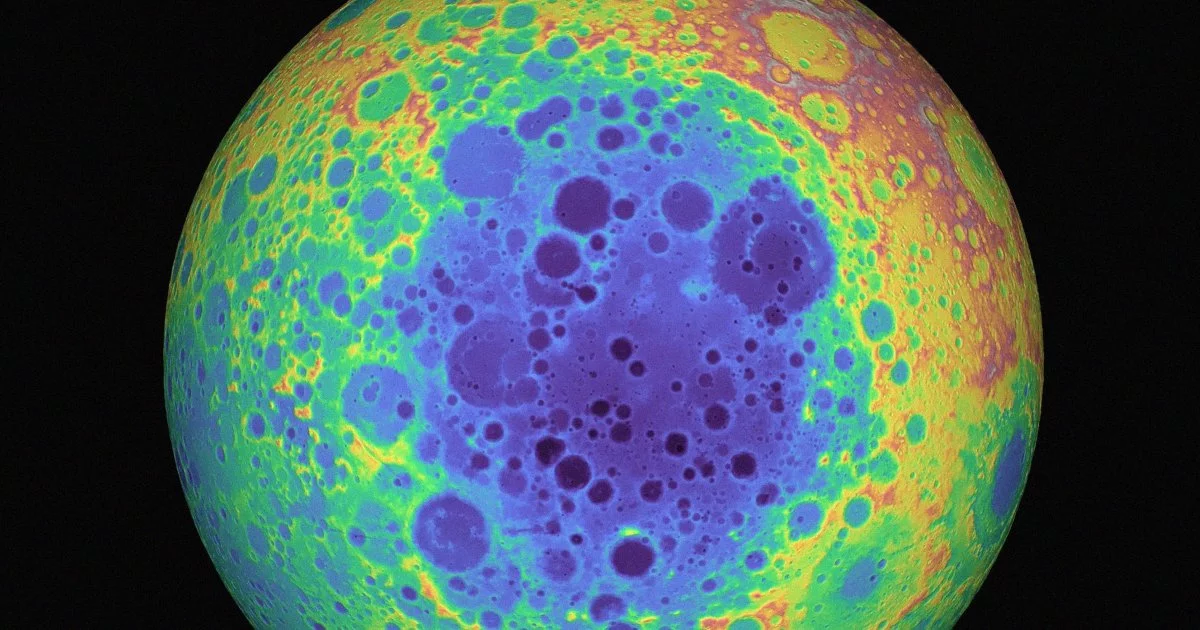

A New Lunar Narrative: Rethinking the South Pole–Aitken Basin’s Origins
The Moon, so often cast as a silent witness to Earth’s tumult, has once again upended our assumptions. A recent paper in *Nature* reframes the South Pole–Aitken (SPA) basin—the Moon’s largest and oldest impact scar—not as the aftermath of a direct, head-on collision, but as the result of a shallow, glancing blow some 4.3 billion years ago. This reinterpretation is not mere academic intrigue; it recalibrates our understanding of lunar evolution, reshapes Artemis-era mission planning, and ripples outward to touch the very foundations of planetary defense and resource strategy.
The Mechanics of a Tangential Catastrophe: Geology and Technology Intertwined
The SPA basin’s formation, now attributed to a side-swipe impact, offers a compelling explanation for the Moon’s enigmatic near-side/far-side dichotomy. Rather than a symmetrical “bull’s-eye,” the basin’s elongated, tear-drop profile signals a forceful, lateral redistribution of molten mantle—what researchers evocatively describe as a “toothpaste” effect. This mechanism thinned the Moon’s near-side crust and thickened the far side, accounting for the asymmetric distribution of KREEP (potassium, rare-earth elements, and phosphorus) and the basin’s distinctive mineralogy.
This insight is not only a triumph of geophysical modeling but a catalyst for technological innovation. The reimagined impact scenario demands a new generation of mission hardware:
- Sample-return systems must now target both lateral ejecta blankets and deep crustal exposures, requiring advanced drill-bit metallurgy and adaptable regolith handling.
- Subsurface radar and seismometer arrays are poised to become mission-critical, tasked with resolving complex KREEP–mantle boundaries at kilometer scales—capabilities with lucrative crossover potential in terrestrial mining and geothermal exploration.
- Impact modeling software—the backbone of both space agency planning and defense contractor simulations—faces a paradigm shift, as the SPA basin’s formation becomes a new template for classifying planetary basins and refining asteroid-deflection strategies.
Strategic Resources and Lunar Commerce: A New Gold Rush on the Rim
The economic implications are as profound as the scientific. KREEP-rich regions at the SPA boundary, newly validated as repositories of rare-earth elements, now feature prominently in the calculus of lunar resource extraction. With terrestrial supply chains for critical minerals—especially rare earths—dominated by a handful of geopolitical players, the Moon’s crust emerges as a notional strategic reserve.
For the burgeoning sector of in-situ resource utilization (ISRU), this is a clarion call. The same mission architectures designed to probe KREEP deposits can validate regolith-derived feedstocks for off-world manufacturing, from oxygen extraction to additive construction. Artemis contractors and their global partners are already redirecting millions in R&D toward:
- Geotechnical sensors and AI-based terrain mapping, essential for navigating the SPA’s heterogeneous boulder fields.
- Autonomous prospecting rovers capable of high-fidelity mineral analysis and sample collection.
- Insurance and risk assessment models that now must account for the increased landing hazards—and scientific rewards—of a glancing-impact landscape.
Geopolitics, Defense, and the Expanding Cislunar Economy
The SPA basin’s revised origin story reverberates far beyond lunar science. China’s Chang’e-6 mission, targeting the far-side SPA vicinity, now carries heightened strategic significance, as scientific primacy may soon confer negotiating leverage in the shaping of future lunar governance norms. For the United States and its Artemis Accords partners, the stakes are equally high: the ability to characterize, access, and ultimately utilize lunar critical minerals could redefine the contours of global supply chains.
Meanwhile, planetary defense receives an unexpected windfall. A deeper grasp of grazing-incidence impact physics sharpens our ability to model and mitigate Earth-threatening asteroids—a priority attracting bipartisan funding and NATO attention. The dual-use nature of the simulation platforms and hydrocodes refined for SPA analysis extends their market reach, from hypersonic vehicle design to subsea energy modeling.
Decision-Making at the Lunar Frontier: Seizing the Asymmetric Advantage
For executives and policymakers, the implications unfold across multiple time horizons:
- Near term (0–3 years): Artemis payloads must be re-baselined for modular coring and on-site mineral separation; venture investment in lunar geophysical services stands to benefit from the coming data surge.
- Mid term (3–7 years): Expect joint ventures between rare-earth refiners and aerospace primes; intellectual property in high-vacuum beneficiation and export-control clarity on lunar-derived materials will be decisive.
- Long term (7–15 years): Lunar mantle isotope signatures may unlock next-generation nuclear power and propulsion; regulatory debates on “impact-heritage” sites will demand robust ESG narratives from mining ventures.
The recasting of the SPA basin’s history is not simply a footnote in lunar science—it is a pivot point for space commerce, planetary defense, and the architecture of a cislunar economy. As new data streams from Artemis and allied missions, those who move swiftly to integrate this knowledge—whether through advanced simulation, resource prospecting, or dual-use technology—will define the contours of humanity’s next great frontier.

 By
By

 By
By

 By
By