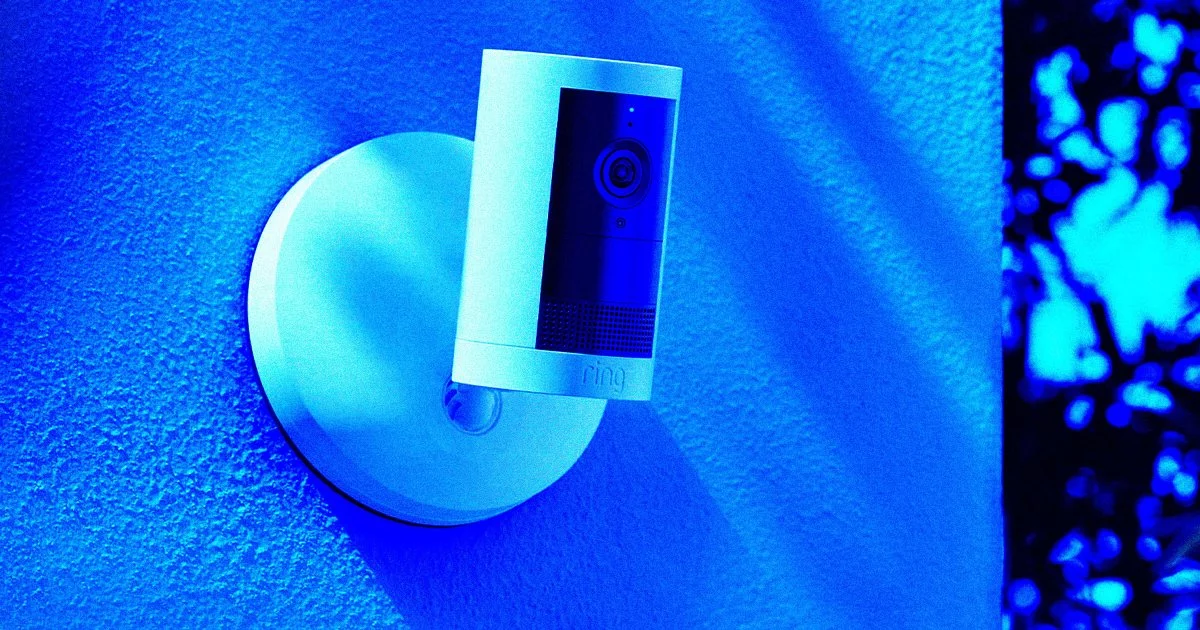

A bounty that reframes the smart-doorbell debate around data sovereignty
The Fulu Foundation—a nonprofit launched by repair-tech YouTuber Louis Rossman—has put a pointed challenge to the smart-home status quo: more than \$11,000 to any technologist who can retrofit Amazon Ring video doorbells to work without sending footage to Amazon-controlled servers. The bounty is not merely a technical puzzle; it is a public referendum on what “ownership” should mean in the era of cloud-tethered consumer electronics.
At its core, the challenge asks for a credible path to a Ring experience that is functionally comparable to stock behavior, while removing the structural dependencies that define Ring’s business model:
- No Amazon account requirement
- No cloud subscription requirement
- Local video storage on a PC or home server, via Wi‑Fi or direct connection
- Feature parity, implying reliable capture, playback, and day-to-day usability rather than a proof-of-concept demo
Fulu co-founder Kevin O’Reilly frames the effort as a response to an increasingly visible contradiction: devices marketed as “security” tools can leave households dependent on a tech giant’s evolving data policies, retention practices, and historical cooperation patterns with law enforcement. The timing is notable. Ring has faced recurring criticism over the years for how neighborhood surveillance can scale—sometimes socially, sometimes institutionally—into something broader than individual home protection. Even mainstream pop culture has begun to lampoon that tension, signaling that privacy concerns are no longer confined to niche forums.
For business and technology leaders, the bounty reads like a small headline with outsized implications: it spotlights a growing consumer expectation that hardware purchase should confer meaningful control over data flows, not just physical possession of the device.
The engineering challenge: local-first video without breaking the “Ring experience”
Retrofitting a Ring doorbell into a local-only, account-free device is not a trivial firmware tweak; it is a direct confrontation with how modern consumer IoT is architected. Ring devices are designed around cloud authentication, cloud storage, and cloud-mediated features. Delivering “feature parity” while removing those dependencies implies solving several hard problems at once:
- Authentication and provisioning: If the device expects Amazon identity services, a replacement onboarding and trust model is required.
- Video pipeline and storage: Local recording must be reliable, searchable, and resilient to network interruptions—without relying on Ring’s cloud as the system of record.
- Notifications and remote access: Users often expect mobile alerts and off-network viewing; a local-first design must decide whether to enable secure remote access (e.g., via VPN, self-hosted relay, or user-managed keys) without recreating the same centralized risk.
- Security posture: Any modification that enables local control must avoid turning a doorbell into an easily compromised endpoint—especially given the device’s role at the physical perimeter of a home.
This is why the bounty’s emphasis on firmware or software modifications matters. A successful approach could validate a broader industry direction: edge-first architectures where compute and storage live on-premises, with cloud services optional rather than mandatory. That model can reduce latency and cloud costs, but more importantly, it aligns with a privacy-first posture that is increasingly demanded by regulators and consumers alike.
It also raises a second-order question for device makers: will the next generation of consumer IoT embrace modular, auditable firmware—potentially even open reference implementations—or will vendors respond by hardening bootloaders, tightening cryptographic controls, and litigating the boundary between “security” and “user modification”?
Business model pressure: subscriptions, aftermarket ecosystems, and brand risk
Ring’s cloud subscription—commonly associated with the “Protect” tier—functions as a recurring revenue engine. A credible path to local-only Ring functionality threatens to decouple product utility from subscription lock-in, which is precisely why this bounty resonates beyond hobbyist circles.
Three economic dynamics stand out:
- Subscription revenue at risk: If a meaningful portion of users can preserve core features without cloud storage, the perceived value of the subscription shifts. Amazon could respond by re-bundling features, lowering prices, or emphasizing services that are harder to replicate locally (for example, advanced cloud analytics).
- Aftermarket growth: A successful retrofit would energize a broader market for DIY IoT, third-party firmware, self-hosted video management, and professional “privacy-preserving” installation services. Value migrates from closed ecosystems toward integrators and community-driven tooling.
- Reputational and liability exposure: Surveillance-adjacent controversies amplify scrutiny. Even absent wrongdoing, the perception that a device enables broad civilian surveillance can become a brand drag—particularly if users feel they lack meaningful consent controls, data minimization options, or offline modes.
For executives, the key insight is that trust is becoming a product feature with measurable revenue impact. In a market where consumers increasingly ask where footage is stored, who can access it, and how long it persists, “local-only mode” is not just a technical checkbox—it is a competitive differentiator.
What leaders should watch next: regulation, hybrid architectures, and community-driven leverage
The Fulu Foundation’s bounty is part of a wider pattern: “data liberation” is being operationalized through incentives, not just ideology. That approach borrows from security research culture—bounties, public challenges, reproducible results—but redirects it toward consumer autonomy.
Several forward-looking signals deserve attention:
- Regulatory gravity: Frameworks like GDPR and CCPA, alongside potential U.S. federal privacy proposals, continue to normalize expectations around data minimization, portability, and purpose limitation. Devices that cannot operate meaningfully without cloud dependence may face sharper compliance and disclosure burdens.
- Hybrid resilience as strategy: A cloud-optional architecture can be positioned not only as privacy-preserving but also as more resilient—continuing to function during outages, network disruptions, or deliberate disconnection.
- Community as a strategic force: When communities can prototype alternatives faster than OEM roadmaps, vendors face a choice: fight modification, or channel it. Structured, white-hat programs and controlled SDKs can convert adversarial energy into safer innovation while preserving a chain of trust.
The Ring bounty’s deeper message is that the smart-home market is entering a phase where ownership is measured by control over data lifecycle—where footage lives, who governs access, and whether the device remains useful when the cloud is removed. Companies that treat local-first capability as a premium add-on may find it becomes the baseline expectation, and those that treat it as a threat may discover that the market is already building around them.

 By
By
 By
By
 By
By
 By
By

 By
By
 By
By