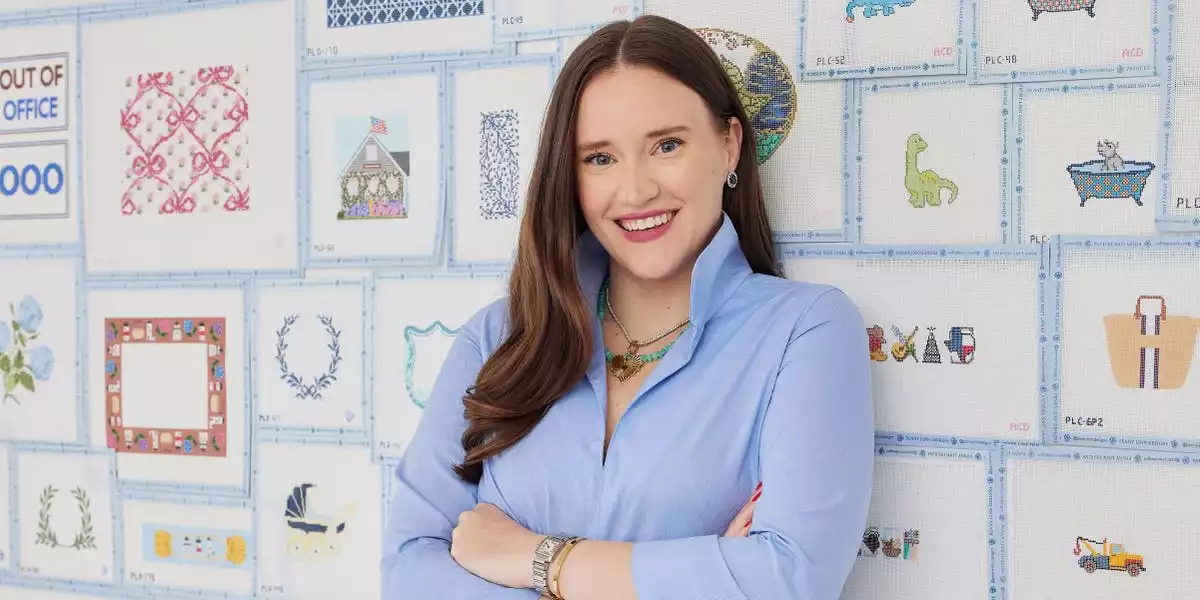

From rediscovered hobby to scaled DTC brand: what Penny Linn Designs signals about modern commerce
Krista LeRay’s trajectory with Penny Linn Designs captures a defining feature of today’s business landscape: the distance between a personal passion and a scalable enterprise has narrowed dramatically. What began as a revived interest in needlepoint—rooted in college-era exposure to preppy aesthetics and early stitching experience—became a direct-to-consumer craft company surpassing \$10 million in sales by 2022. That growth is notable not only for its speed, but for what it reveals about how niche categories can expand when paired with disciplined product strategy and digital distribution.
At the center of the story is a classic market gap: traditional needlepoint offerings often skewed toward legacy motifs, while a newer cohort of consumers wanted modern, culturally current designs. LeRay’s decision to hand-paint contemporary canvases wasn’t merely artistic differentiation; it was product positioning. By translating a recognizable lifestyle sensibility into a tangible craft format, Penny Linn effectively turned needlepoint into a brandable, giftable, and shareable consumer product—well-suited to the social internet.
Just as importantly, the company’s rise underscores how community demand can function as early-stage market research. Designs shared on a blog and social channels didn’t just attract attention; they created a feedback-rich environment where interest could be measured before scaling production. In an era where many consumer startups overbuild inventory or overextend product lines, Penny Linn’s early validation loop reads like a case study in restraint paired with responsiveness.
Community-led product development as an agile R&D engine
Penny Linn’s operating model illustrates a broader shift: digital-first product development is no longer exclusive to software. In physical goods—especially in niche, taste-driven categories—social platforms can act as a real-time signal layer for what to make, how to package it, and which customer segments to prioritize.
Several strategic mechanisms stand out:
- Agile, customer-led iteration: By using blog and social engagement to test concepts, the brand reduces the risk of producing designs that won’t convert. This is effectively R&D with demand proof, compressing the cycle from idea to launch.
- A disciplined feedback process: The “24-hour rule” for processing criticism is more than founder psychology; it’s operational hygiene. It creates space to separate noise from insight, enabling continuous improvement without reactive decision-making.
- Selective product roadmap: By emphasizing small, beginner-friendly canvases and kits, Penny Linn builds an accessible on-ramp. This lowers the barrier to entry, expands the addressable market, and supports repeat purchasing as skills grow.
This “narrow-and-deep” approach is particularly relevant for consumer brands navigating fragmented attention. Rather than chasing breadth, Penny Linn appears to be building depth of trust—a prerequisite for premium expansion later. The planned move into larger, more advanced projects aligns with a lifecycle strategy: acquire customers with approachable products, then increase lifetime value as customers mature.
The pandemic home economy, niche loyalty, and the mechanics of \$10M scale
Penny Linn’s acceleration during COVID-19 sits squarely within the pandemic-era “home economy,” when remote work and constrained social options drove demand for at-home leisure, mindfulness, and creative routines. Yet the company’s performance also highlights something more durable than a temporary spike: needlepoint and similar crafts can generate high customer lifetime value once consumers commit.
That loyalty dynamic resembles other enthusiast-driven markets—fitness, gaming, specialty coffee—where the first conversion is the hardest, and retention becomes the growth engine. For business leaders, the implication is clear: in the right niche, depth beats breadth, and community identity can be a stronger moat than price.
Equally instructive is the operational side of the \$10 million milestone. The result points to the maturity of the modern commerce stack:
- E-commerce platforms that support rapid storefront deployment, merchandising, and analytics
- Cloud-based order and inventory management that reduces administrative drag
- Outsourced logistics and 3PL partnerships that allow scaling without heavy capital expenditure
- Repeatable fulfillment workflows that protect customer experience as volume rises
In other words, Penny Linn’s growth is not just a creative success; it’s a demonstration of how infrastructure-as-a-service has made it possible for niche makers to operate with capabilities once reserved for larger retailers.
Where craft meets technology next: AR previews, AI patterns, and virtual stitch-alongs
The needlepoint category may appear analog, but the strategic frontier is increasingly hybrid. The next phase of competitive advantage in crafts is likely to come from digital augmentation—tools and experiences that make physical products easier to choose, easier to start, and more social to complete.
Potential vectors include:
- Augmented reality (AR) previews to visualize how a finished piece might look in a room, improving conversion and reducing buyer uncertainty
- AI-assisted pattern generation and personalization, enabling limited-run drops, custom motifs, or style-matched recommendations while preserving brand aesthetics
- Virtual stitch-along communities and live workshops, turning a product into an ongoing experience and strengthening retention
- Data-informed merchandising, using behavioral signals to refine kit difficulty, color palettes, and seasonal launches
For Penny Linn Designs, the strategic challenge will be balancing this opportunity with what made the brand work in the first place: quality control, coherent design language, and community trust. Scaling creative businesses often fail not from lack of demand, but from operational strain—especially when product complexity rises. LeRay’s emphasis on complementing creative strengths with accounting and legal expertise signals an awareness that professionalization is not optional at this stage; it is the cost of staying credible while expanding.
Penny Linn’s story ultimately reflects a broader truth about the passion economy: the winners are not simply the most talented makers, but the operators who can translate taste into systems—listening loops, focused product architecture, and scalable fulfillment—without losing the intimacy that made customers care in the first place.

 By
By
 By
By

 By
By
 By
By

 By
By
 By
By