
Project Zodiac and the new geography of hyperscale expansion in Indiana
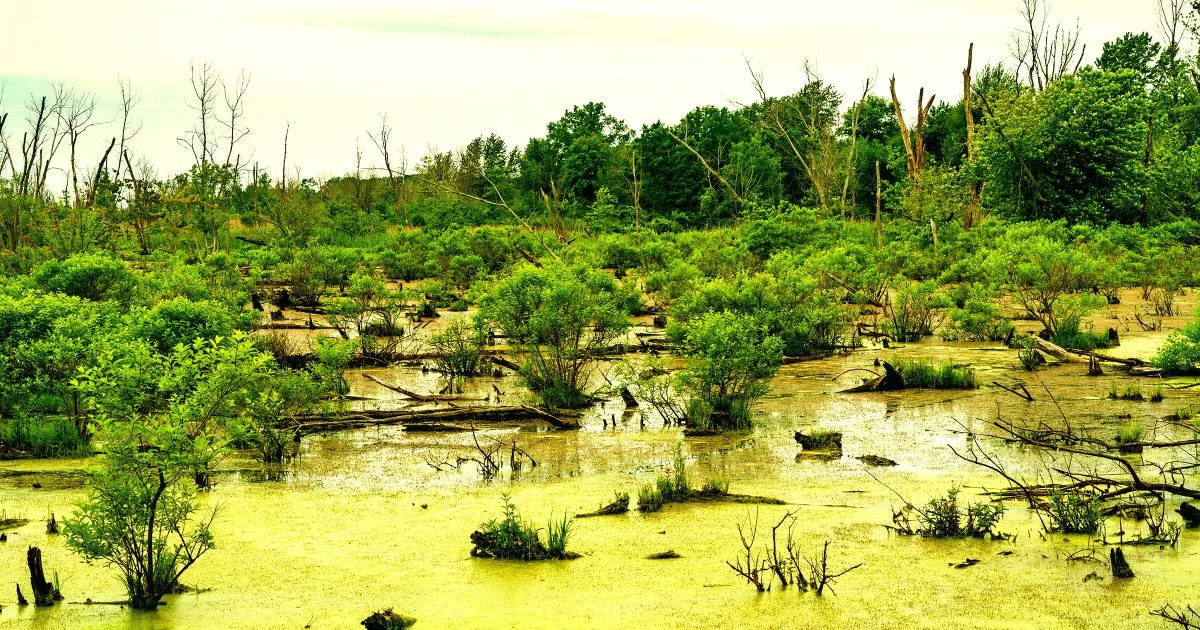
Google’s data center developer, Hatchworks LLC, is seeking approval from the Indiana Department of Environmental Management (IDEM) to purchase 4.26 acres of federally protected wetland near Fort Wayne—land slated to support Google’s roughly $2 billion “Project Zodiac” hyperscale data center campus. The proposal would convert about 2.13 acres—roughly half the wetland parcel—into three data center buildings and related wastewater and electrical infrastructure.
At face value, the application reads like a familiar chapter in America’s digital buildout: a fast-growing cloud and AI economy demanding new physical capacity, and a state competing for investment, jobs, and tax base. Yet the site itself complicates the narrative. While the land was historically agricultural, it now functions as a wetland system that provides flood mitigation, water filtration, and habitat value—services that are increasingly relevant as climate volatility and storm intensity rise across the Midwest.
Hatchworks argues that complete avoidance is “not feasible” due to design constraints, proposing minimization rather than elimination of impacts. A virtual public hearing is pending, and construction could begin as soon as mid-September, depending on regulatory conditions and community response. The timeline matters: in hyperscale development, permitting velocity can be as strategically important as power pricing.
Why AI-era data centers keep colliding with water, land, and permitting realities
The underlying driver is not mysterious. AI training and inference, cloud migration, and edge workloads are pushing hyperscale operators to expand capacity at a pace that strains traditional site-selection playbooks. What’s changing is the degree to which natural systems—especially wetlands and watersheds—have become both operational inputs and regulatory flashpoints.
Several forces converge here:
- Compute density is rising, and with it the complexity of thermal management. Even as the industry experiments with advanced cooling, many large facilities still rely on water-intensive approaches or water-adjacent infrastructure planning.
- Land is now digital infrastructure. The “best” parcels are no longer defined only by acreage and price, but by a multi-variable equation: grid interconnection, fiber routes, water availability, flood risk, and permitting timelines.
- Wetlands are strategic assets and liabilities at once. They reduce flood risk and stabilize hydrology—benefits that can protect long-lived assets like data centers—yet they also trigger stringent regulatory scrutiny when development requires fill or alteration.
This is the new tension: the same environmental features that can enhance resilience may also constrain construction footprints. When developers treat wetlands primarily as obstacles, they risk underestimating both the long-term operational value of natural infrastructure and the short-term friction of public process.
The economic upside meets the hidden balance sheet of ecosystem services
Indiana, like many states, competes aggressively for hyperscale investment. A $2 billion campus can signal durable economic momentum: construction activity, specialized contractor ecosystems, and potential long-term employment. But wetlands introduce a parallel ledger—one that rarely appears in headline job counts.
Wetlands provide ecosystem services with measurable economic value, including:
- Stormwater retention and flood attenuation, reducing downstream damage and municipal drainage burdens
- Pollutant filtration, supporting water quality and lowering treatment costs
- Carbon sequestration and soil stabilization, contributing to climate and erosion resilience
- Biodiversity and habitat support, which can affect regional ecological health and compliance risk over time
When a protected wetland is converted for industrial use, the trade-off is not simply “unused land” versus “productive land.” It is often a transfer of risk and cost—from private development balance sheets to public infrastructure and local ecosystems. That transfer becomes more consequential as extreme weather events intensify and as communities grow more sensitive to land-use decisions that may amplify flood exposure.
For hyperscalers, there is also a reputational and capital-market dimension. Data center operators increasingly operate under ESG scrutiny from:
- Institutional investors assessing climate and natural-capital risk
- Enterprise customers with sustainability procurement requirements
- Local stakeholders who can shape the “social license to operate” through hearings, media attention, and political pressure
In that context, the cost of delay is real—AI capacity is monetized on tight timelines—but so is the cost of appearing to externalize environmental impacts, particularly when alternatives or stronger mitigation pathways are perceived as available.
Regulation, precedent, and the strategic choices that will define the outcome
The IDEM process is more than a local permitting step; it is a test of how the region will govern the next wave of AI-era infrastructure. Under the Clean Water Act framework and related state rules, wetland impacts typically require avoidance where practicable, minimization, and compensatory mitigation—often through restoration, creation, or wetland banking.
The pivotal questions for regulators and the public hearing are likely to center on:
- Practicable alternatives: whether the campus design truly cannot shift to avoid protected wetland impacts
- Mitigation rigor: whether proposed offsets are on-site or off-site, like-for-like, and durable over time
- Cumulative precedent: whether approval signals that marginal wetlands in low-cost jurisdictions are acceptable targets for hyperscale expansion
For Hatchworks and Google, the strategic play is not merely to secure a permit, but to secure legitimacy. In today’s infrastructure politics, legitimacy is built through verifiable commitments—strong mitigation, transparent water management planning, and credible engagement with local stakeholders. Tools increasingly used in comparable projects include wetland banking, conservation easements, and funding partnerships with local environmental trusts, alongside engineering choices that reduce water intensity and improve watershed outcomes.
Project Zodiac sits at the intersection of two defining realities: the economy’s accelerating dependence on AI and cloud compute, and the growing recognition that natural systems are critical infrastructure. How Indiana, IDEM, and the project’s sponsors navigate this wetland decision will echo beyond Fort Wayne—shaping not only a campus footprint, but the rules of engagement for the next generation of hyperscale development.

 By
By

 By
By
 By
By



 By
By