
A hairline fracture with outsized meaning for low Earth orbit operations
The discovery of microscopic cracks—some fully penetrating—on the Shenzhou return capsule’s viewport while docked to China’s Tiangong space station is, on its face, a narrowly contained engineering anomaly. No crew was harmed, cabin pressure reportedly remained stable, and China’s space program executed a conservative operational decision: delay crew return, send an uncrewed replacement vehicle, and recover the damaged capsule without astronauts aboard. Yet the episode resonates far beyond a single porthole.
At orbital velocities, even tiny particles can behave like hypervelocity projectiles. A sub-centimeter fragment—whether micrometeoroid or orbital debris—can impart enough energy to initiate cracks that propagate under thermal cycling, vibration, and structural loads. The fact that the damage was detected by astronauts using a pen-shaped digital microscope, rather than by ground-based tracking or onboard automated diagnostics, underscores a central reality of today’s space economy: the most consequential threats are increasingly the hardest to see.
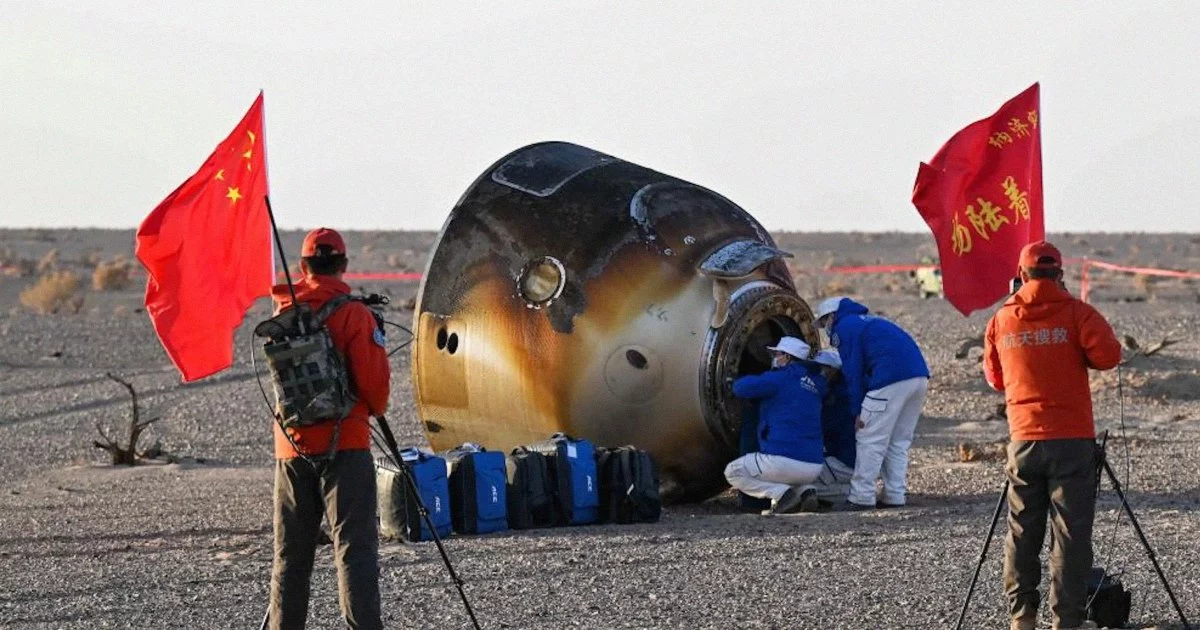
The capsule’s eventual uncrewed reentry and landing in Mongolia on January 19, described as “generally normal” despite an unexpected parachute-separation issue, closes the immediate operational loop. But the strategic loop remains open, because the incident is a crisp illustration of how orbital debris risk is shifting from theoretical to routine—and how that shift will shape budgets, insurance, regulation, and geopolitical signaling.
Engineering lessons from a cracked viewport: resilience worked, visibility lagged
From a technical standpoint, the event highlights both the strengths and blind spots of current human spaceflight design.
What worked as intended
- Multi-layer window architecture and redundancy appear to have prevented catastrophic depressurization despite through-cracks. This is a quiet validation of conservative design margins in crewed spacecraft.
- The rapid deployment of a specialized porthole repair kit signals operational maturity: Tiangong is not merely a destination, but an environment where in situ maintenance is becoming normalized.
What the incident exposes
- Viewport vulnerability remains a critical single-point concern. Windows are inherently difficult: they must be transparent, pressure-bearing, thermally stable, and resistant to impact—an unusually demanding combination.
- Detection and monitoring gaps for sub-centimeter threats are stark. Ground surveillance networks are improving, but objects below certain sizes remain effectively untrackable. When the first “sensor” is a human eye, the system is already late in the risk curve.
- The reliance on handheld inspection suggests a near-term opportunity for embedded diagnostics, such as:
– acoustic or strain sensors integrated into window frames
– optical health monitoring capable of detecting microfractures early
– automated inspection routines using internal cameras and machine vision
The broader implication is that spacecraft health monitoring is becoming as important as spacecraft shielding. In an increasingly congested low Earth orbit (LEO), resilience is not only about surviving impacts—it is about detecting damage early enough to preserve mission options.
The economics of contingency: when one extra launch rewrites the business case
Operational prudence in human spaceflight is non-negotiable, but prudence is expensive. The decision to dispatch an uncrewed replacement Shenzhou and postpone crew departure likely carries hundreds of millions of dollars in direct and indirect costs once vehicle production, launch services, mission operations, recovery, and schedule disruption are accounted for.
That cost profile matters because Tiangong is increasingly intertwined with a broader ecosystem of activity—scientific utilization, technology demonstrations, and potential commercial partnerships. When human presence is delayed or mission timelines slip, downstream impacts can include:
- microgravity experiment interruptions and lost research windows
- deferred payload operations and re-planning costs
- reduced cadence confidence for partners and suppliers
- higher contingency reserves in future program budgets
For investors and policymakers watching the commercialization of LEO, the incident reinforces a basic financial truth: debris risk is not just a safety externality; it is a schedule and revenue risk. As mega-constellations proliferate and orbital traffic rises, the probability distribution of “rare” events shifts. The market response typically follows: higher insurance premiums, stricter underwriting requirements, and greater emphasis on demonstrable mitigation capabilities.
This is also where a new category of opportunity becomes clearer. The presence of a dedicated repair toolkit hints at an emerging service layer: on-orbit inspection, maintenance, and repair. A credible servicing ecosystem—inspection drones, modular repair packages, rapid logistics—could become as structurally important to LEO as ground support is to aviation.
Governance, attribution, and strategic signaling in a crowded orbital commons
The incident arrives at a moment when LEO governance is struggling to keep pace with deployment velocity. Under the Outer Space Treaty and the Liability Convention, the provenance of debris can be legally significant, but attribution is technically difficult—especially for small fragments. As constellations scale into the tens of thousands of satellites, disputes over responsibility for damaging debris could become more frequent and more contentious.
Several policy and strategic dynamics are likely to intensify:
- Regulatory tightening around post-mission disposal, collision-avoidance maneuvering, and design-for-demise standards—raising compliance costs for operators.
- Insurance innovation, with premiums increasingly tied to measurable behaviors: tracking quality, maneuver capability, end-of-life disposal reliability, and participation in debris-mitigation programs.
- Geopolitical interpretation of collision-like events. Even when accidental, damage scenarios can be read through a dual-use lens, especially amid concerns about anti-satellite capabilities and co-orbital systems.
Notably, the decision to publicize the incident and the contingency response can be interpreted as a form of credibility signaling—demonstrating operational discipline and transparency that may support China’s positioning in future international initiatives, including lunar ambitions. At the same time, the very visibility of vulnerability reinforces why major powers increasingly treat orbital resilience as a strategic asset.
The cracked Shenzhou viewport is, ultimately, a small defect that illuminates a large trajectory: LEO is transitioning from an open frontier to a managed infrastructure domain, where inspection, repair, attribution, and governance will determine not only who operates safely—but who operates at all.

 By
By
 By
By
 By
By
 By
By


 By
By