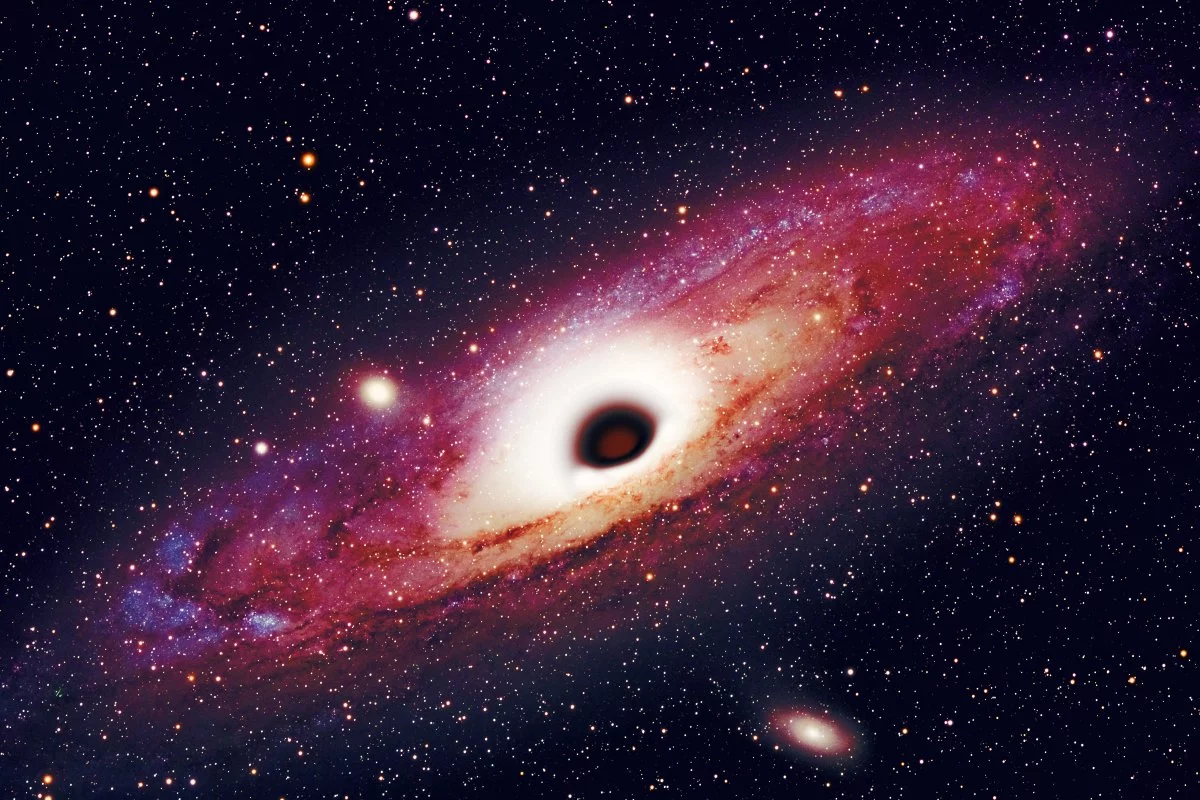

Rethinking the Heart of the Milky Way: Dark Matter’s Shadow Over Sagittarius A*
For decades, the gravitational anchor at the center of our galaxy has been an article of faith: a supermassive black hole, Sagittarius A*, weighing in at four million times the mass of our Sun. Its existence seemed sealed by the orbits of the so-called S-stars, the velocity curves of galactic matter, and—most viscerally—the shadow imaged by the Event Horizon Telescope (EHT). Yet a provocative new study in the *Monthly Notices of the Royal Astronomical Society* dares to redraw this cosmic portrait: what if, instead, the Milky Way’s core is a dense, fermionic dark-matter sphere masquerading as a black hole?
This hypothesis, which reproduces both the observed star dynamics and the EHT’s shadow, does more than challenge astrophysical orthodoxy. It reframes the very machinery of galactic centers, the distribution of dark matter, and the technological frontiers required to distinguish between them.
—
Instrumentation at the Edge: Telescopes, Data, and the Quantum Frontier
The search for the true nature of Sagittarius A* is inseparable from the tools we wield. The EHT’s global network—synchronizing millimeter-wave observatories from Hawaii to the South Pole—epitomizes the power of distributed sensor architectures. Its success is not just a triumph of optics, but of data: petascale model-fitting, machine-learning deconvolution, and federated analytics. These same architectures, honed for the galactic center, are now bleeding into commercial domains:
- Risk and anomaly detection in finance and healthcare, leveraging EHT-style distributed inference.
- Synthetic-aperture radar and 6G beamforming, where interferometric signal processing migrates from astronomy to Earth observation and autonomous vehicles.
- Edge-to-cloud data fusion, with federated governance and privacy-preserving analytics, echoing the EHT’s global data choreography.
The next wave—heralded by the Square Kilometre Array, ESO’s Extremely Large Telescope, and NASA’s Nancy Grace Roman Space Telescope—will escalate both the resolution and the data deluge. Discriminating between a black hole and a fermionic core may hinge on subtle lensing or polarization signatures, demanding exabyte-scale infrastructures and real-time, AI-driven pipelines.
—
Dark Matter’s Technological Ripple: Detectors, Commodities, and Quantum Algorithms
Should the dark-matter-core hypothesis gain traction, the implications will radiate far beyond astrophysics. Fermionic dark matter, with its sub-MeV mass range, necessitates a new generation of detectors: cryogenic sensor arrays, superconducting electronics, and quantum-enhanced photonics. These technologies are not mere scientific curiosities—they are the seeds of new supply chains and commercial ecosystems:
- Specialty semiconductor vendors stand to gain as demand for ultra-low-noise amplifiers and low-temperature electronics surges.
- Cryogenic materials and rare isotopes, already geopolitically sensitive, may become the lithium or helium-3 of the 2030s.
- Quantum-classical simulation toolkits, initially developed for galactic modeling, are finding dual use in battery design, pharmaceutical discovery, and materials science.
The computational demands—integrating fermionic particle physics with N-body galactic dynamics—are accelerating investment in heterogeneous architectures (CPU-GPU-FPGA blends) and quantum simulation stacks. Here, the cross-pollination of algorithmic intellectual property is not just plausible but inevitable.
—
Strategic Stakes: Talent, Policy, and the New Space Race
The contest for cosmic insight is shaping up as a crucible for both talent and geopolitical leverage. Astrophysics and high-energy physics are now “code-first” disciplines, producing professionals fluent in distributed computation, statistical inference, and anomaly detection—skills in high demand across AI-driven industries. For organizations struggling to recruit top-tier data scientists, this talent pool is a largely untapped reservoir.
Meanwhile, sovereign access to next-generation telescopes is emerging as a subtle but potent soft-power asset. The nations underwriting these instruments secure not only scientific prestige but privileged access to early-stage data—fuel for both fundamental discovery and dual-use AI ecosystems. As dark-matter research tightens the bond between fundamental physics and national security, corporates in aerospace, quantum tech, and advanced materials must monitor evolving export-control regimes and supply-chain vulnerabilities.
Forward-looking decision-makers would do well to:
- Track the commissioning of new observatories and the emergence of unique dark-matter signatures.
- Benchmark data-fusion and federated analytics against the EHT’s model, as these become essential for edge-intensive IoT and autonomous systems.
- Plan for quantum-ready HPC workloads, especially in molecule-level R&D and predictive analytics.
- Engage policy teams on supply-chain sovereignty for critical cryogenic and superconducting materials.
—
Whether Sagittarius A* is a black hole or a fermionic shadow, the journey to uncover its true nature is already reshaping the landscape of instrumentation, computation, and cross-disciplinary talent. Enterprises that treat “Big Science” as a living test-bed—rather than distant academia—are poised to capture first-mover advantages in data infrastructure, quantum algorithms, and high-performance sensors. In this new era, the boundary between cosmic discovery and economic power grows ever more porous, and the universe itself becomes a proving ground for the technologies that will define the decades ahead.

 By
By


 By
By
 By
By


 By
By