
The Storage Dilemma at the Heart of Nintendo’s Next-Gen Console
As Nintendo prepares to launch the much-anticipated Switch 2, the conversation around its hardware is dominated not by graphics or processing power, but by a more prosaic—yet pivotal—element: storage. The new console’s 256 GB of internal flash memory, while a leap from its predecessor, is already being eyed with skepticism in a gaming era where a single AAA title can devour over 50 GB. The industry’s response, and the consumer’s recourse, is a fascinating study in platform economics, supply chain dynamics, and the subtle art of shifting costs downstream.
microSD Express: A Technological Pivot with Strategic Implications
The arrival of microSD Express marks a watershed moment in removable storage. By leveraging PCIe/NVMe 1.3, these cards promise theoretical speeds of up to 985 MB/s—nearly an order of magnitude above the aging UHS-I standard. Yet, the real-world impact hinges on Nintendo’s willingness to fully enable these speeds at the hardware level. Without a matching controller lane, early adopters may find their high-speed cards throttled, a scenario that would echo past frustrations with underutilized tech.
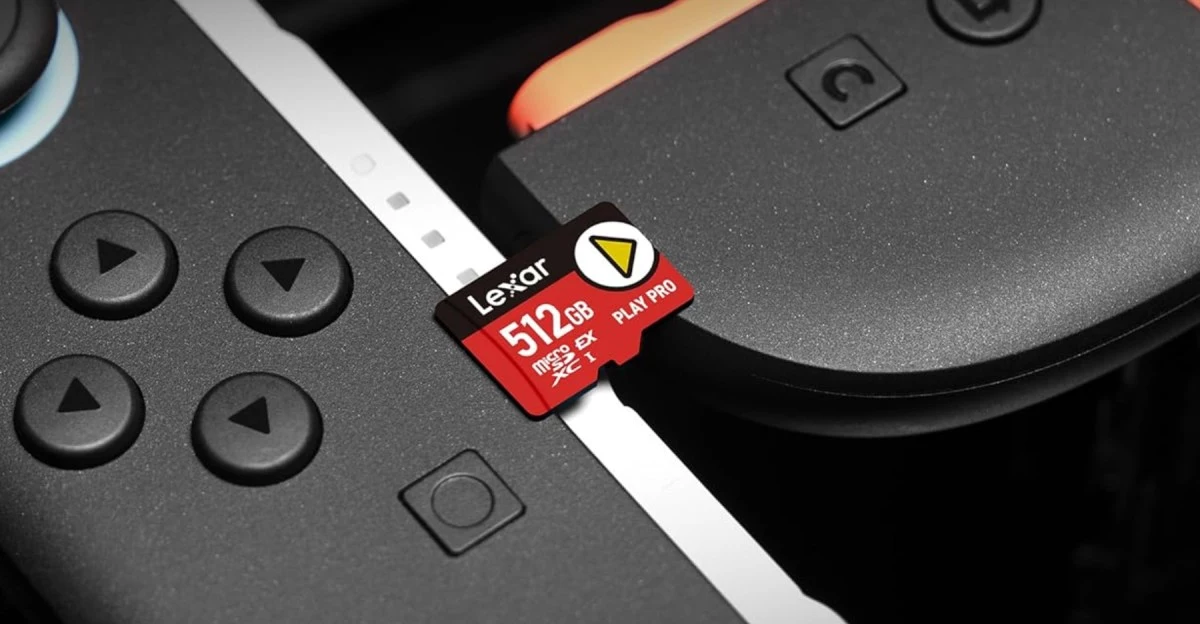
Meanwhile, the economics of NAND flash are tilting in favor of consumers—at least, temporarily. Spot prices have plunged nearly 40% year-over-year, the result of oversupply in 3D-QLC memory and a tepid smartphone market. Retailers, sensing an opportunity, are moving aggressively: Lexar’s 1 TB microSD Express card, once a luxury, now sits at $158 on Amazon, a 28% drop. This discount window, however, is likely fleeting. As memory producers eye summer capacity cuts, the current glut could evaporate just as the Switch 2 ignites a fresh wave of demand.
Nintendo’s embrace of the SD Association’s open standard, rather than a proprietary format reminiscent of Sony’s PS Vita, is a calculated move. It reduces bill-of-materials costs and externalizes the burden of capacity upgrades to the user, sidestepping the risk of inventory overhang and price volatility in the flash market.
Game-Key Cartridges and the New Economics of Digital Distribution
Publishers are also recalibrating their strategies. The emergence of “Game-Key” cartridges—physical tokens that authenticate purchases but require hefty digital downloads—signals a shift toward a hybrid model. This approach slashes manufacturing and logistics costs but pushes the storage challenge squarely onto players. The result is a diminished resale market and a tightening of platform lock-in, much like the digital-first paradigm that has defined PC gaming for years.
For consumers, the calculus is clear: invest in high-capacity, high-speed removable storage, or face the friction of constant file management. At $158 for a 1 TB card—translating to roughly 15 cents per gigabyte—the cost is markedly lower than what Nintendo would incur by increasing internal storage, a delta that would inevitably be passed on at retail. Instead, memory vendors and retailers are poised to capture this ancillary revenue, while Nintendo preserves its family-friendly price point and hardware margins.
Retailers, too, are jockeying for position. Amazon’s aggressive pricing undercuts even Walmart’s private-label Onn cards, highlighting the e-commerce giant’s willingness to subsidize high-velocity accessories to maintain its grip on the early-adopter gaming crowd. Persistent out-of-stocks for house brands underscore the fragility of supply chains and the high stakes of allocation in a volatile memory market.
The Broader Platform Play: Modular Expansion and Ecosystem Leverage
Nintendo’s storage strategy is emblematic of a broader industry trend: the shift from integrated, fixed-capacity devices to modular, user-financed expansion. This approach offers several advantages:
- Price Stability: By offloading storage costs, Nintendo can maintain its target MSRP despite inflation and currency headwinds.
- Inventory Agility: Exposure to flash price swings is minimized, reducing risk for both Nintendo and its partners.
- Lifecycle Flexibility: Faster removable media enable performance scaling over time, extending hardware relevance without costly mid-cycle refreshes.
For memory vendors, the Switch 2 represents a long-awaited mass-market anchor for microSD Express, with potential attach rates in the tens of millions. This could catalyze economies of scale that ripple across adjacent sectors, from drones to industrial IoT.
Publishers, meanwhile, are likely to accelerate their move away from physical media, experimenting with tiered download structures and rethinking retail distribution budgets. Retailers will increasingly use memory pricing as a lever to drive traffic around major game launches, investing in predictive algorithms to optimize inventory.
The coming months will test the resilience of this ecosystem. Should Switch 2 demand surge as NAND production tightens, the current price trough may give way to a new cycle of scarcity. Strategic alignment—between console makers, memory suppliers, and content publishers—will determine who captures value in this evolving storage chain, and who is left subsidizing the next wave of digital entertainment.

 By
By
 By
By
 By
By
 By
By
 By
By


 By
By