


A parakeet, a reef, and the new face of consumer-grade engineering
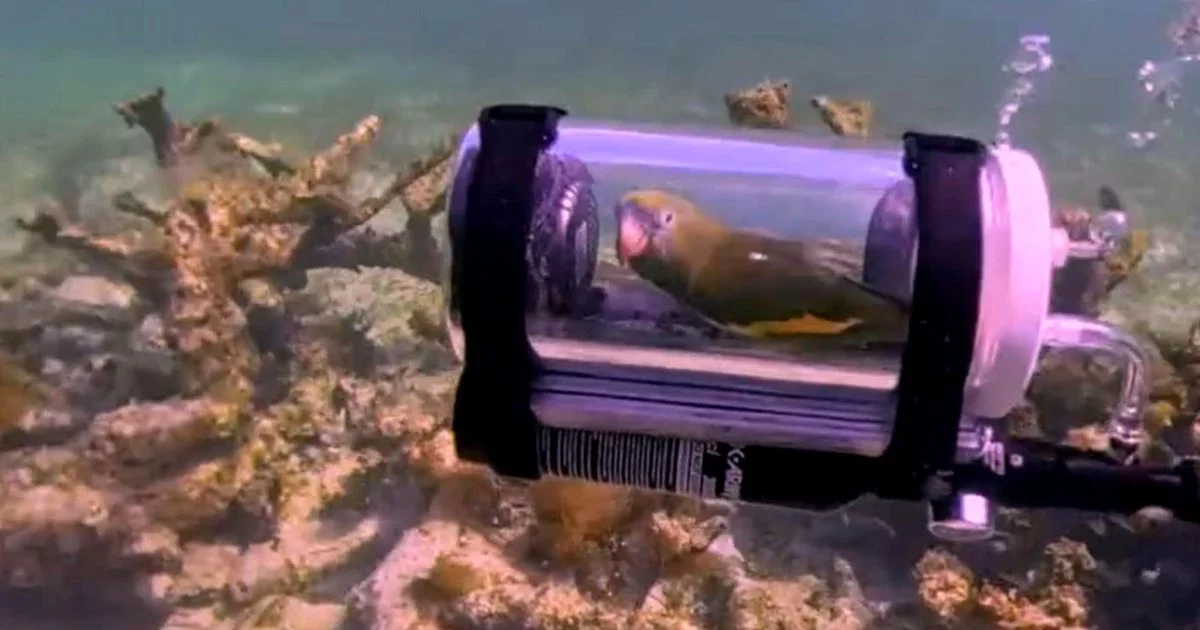
A six-year-old parakeet named Bebe descending roughly three feet beneath a Bahamian reef inside a homemade mini-submarine—quickly dubbed the “Bebosphere”—might read like internet-era whimsy. Yet the episode is also a crisp signal of where maker culture, pet technology, and the experience economy are converging in plain sight.
Built from off-the-shelf components—including a paintball air tank, an oxygen sensor, and ballast weights—the device reflects a broader shift: sophisticated, life-adjacent systems are no longer confined to industrial labs or regulated medical supply chains. They are increasingly assembled by enthusiasts with access to commodity hardware, online tutorials, and a willingness to prototype in public.
The viral video that followed did what modern distribution systems do best: it compressed a niche engineering build, an unusual animal scenario, and a visually striking environment into a shareable narrative. Public reaction predictably split between delight and discomfort—an emotional polarity that often accelerates reach. But beyond the spectacle, the Bebosphere offers a revealing case study in DIY life-support design, pet humanization, and the economics of high-novelty content.
Key technical and cultural ingredients behind the moment include:
- Rapid prototyping at “pet scale” using readily available parts rather than bespoke manufacturing
- Lightweight monitoring (even a basic oxygen meter) that hints at broader pet-health telemetry trends
- A story format optimized for virality: a familiar companion animal placed into an unfamiliar environment with apparent calm
Pet-scale life support and the rise of “micro-telemetry” design patterns
From a technology perspective, the Bebosphere is less about underwater tourism and more about the normalization of small, modular environmental control systems. The architecture—air supply, sensor feedback, and ballast—resembles a simplified life-support loop. That matters because it mirrors a wider pattern in consumer tech: miniaturization plus instrumentation.
Even modest sensing capability changes the nature of a product category. An oxygen sensor is not merely a safety feature; it is a gateway to data-driven pet experiences, where owners increasingly expect visibility into conditions and risk. This is the same arc seen in human wearables: early devices tracked a few metrics, then evolved into platforms that shaped behavior, purchasing, and services.
In practical market terms, this points toward a growing opportunity for:
- Pet wearables and environmental sensors that support richer biometric and situational monitoring
- Cloud dashboards and analytics tailored to companion animals (respiration proxies, stress indicators, temperature exposure)
- Accessory ecosystems where hardware is only the entry point and recurring value comes from software, services, and content
At the same time, the Bebosphere underscores a less comfortable reality: as prototyping becomes easier, the line between “inventive” and “insufficiently validated” can blur. Consumer-grade components can be repurposed brilliantly, but they can also create false confidence if the system’s limits are not rigorously tested. That tension—between democratized engineering and the need for safety discipline—is likely to intensify as DIY builds move from novelty to repeatable product concepts.
The business of pet humanization meets the mechanics of viral monetization
Economically, this story lands squarely in the premiumization of pet care. The global pet market—already measured in the hundreds of billions of dollars—has been expanding beyond food and veterinary services into what might be called “experience spend.” The logic is straightforward: as pets are treated more like family members, spending shifts toward enrichment, travel, custom gear, and shareable moments.
Bebe’s earlier skydiving exploits in a transparent chest-mounted capsule reinforce the same theme: the pet is framed not as a dependent, but as a co-participant in the owner’s lifestyle. That framing is commercially potent because it supports new categories that sit between recreation, wellness, and media.
For brands and platforms, viral animal content is not just entertainment; it is an acquisition funnel and a licensing asset. The monetization pathways are familiar, but the differentiator is the novelty premium—the ability to offer something viewers have not seen before. In that sense, the Bebosphere functions like a prototype not only of a device, but of a repeatable content format.
Business implications likely to attract attention across pet tech and consumer media include:
- Sponsored integrations for adventure gear, pet safety products, travel brands, and creator tools
- Merchandising and licensing of footage, formats, and branded “extreme pet experience” concepts
- Partnership models between pet hardware makers and established safety-equipment domains (dive tech, aerospace materials, protective enclosures)
The strategic question for companies is whether this becomes a durable segment—certified, productized, and scaled—or remains an episodic novelty driven by individual creators.
Welfare, consent, and the coming demand for credible guardrails
The most consequential dimension may be behavioral and ethical. Public skepticism—voiced in mainstream commentary questioning whether animals can “consent” to such activities—signals a reputational risk that will grow as experiential pet products proliferate. The market may reward spectacle in the short term, but it tends to punish ambiguity when safety and welfare are involved.
This creates an opening for standards, certifications, and transparent protocols. If “extreme pet experiences” evolve into a real commercial category, credibility will hinge on demonstrating that animal welfare is not an afterthought. That likely means:
- Third-party welfare guidance grounded in animal behavior expertise
- Clear operating limits (duration, depth/pressure, temperature, stress signals) communicated in plain language
- Design-for-fail principles: redundancy, emergency egress, and conservative safety margins
Regulators may eventually take interest as DIY life-support concepts move into semi-commercial distribution. Even before formal rules emerge, consumer trust will increasingly be shaped by whether creators and companies can show their work: testing methods, safety assumptions, and humane decision-making.
Bebe’s reef dive is easy to dismiss as a quirky viral moment. Yet it also captures a sharper reality: consumer hardware is becoming powerful enough to build micro-environments, pet owners are spending more on shared experiences, and platforms are primed to amplify anything that fuses engineering with emotion. The next wave of pet tech may be less about bowls and leashes—and more about instrumentation, storytelling, and the hard requirement that innovation earns its legitimacy through safety and welfare rigor.
 By
By
 By
By
 By
By
 By
By

 By
By
 By
By







