

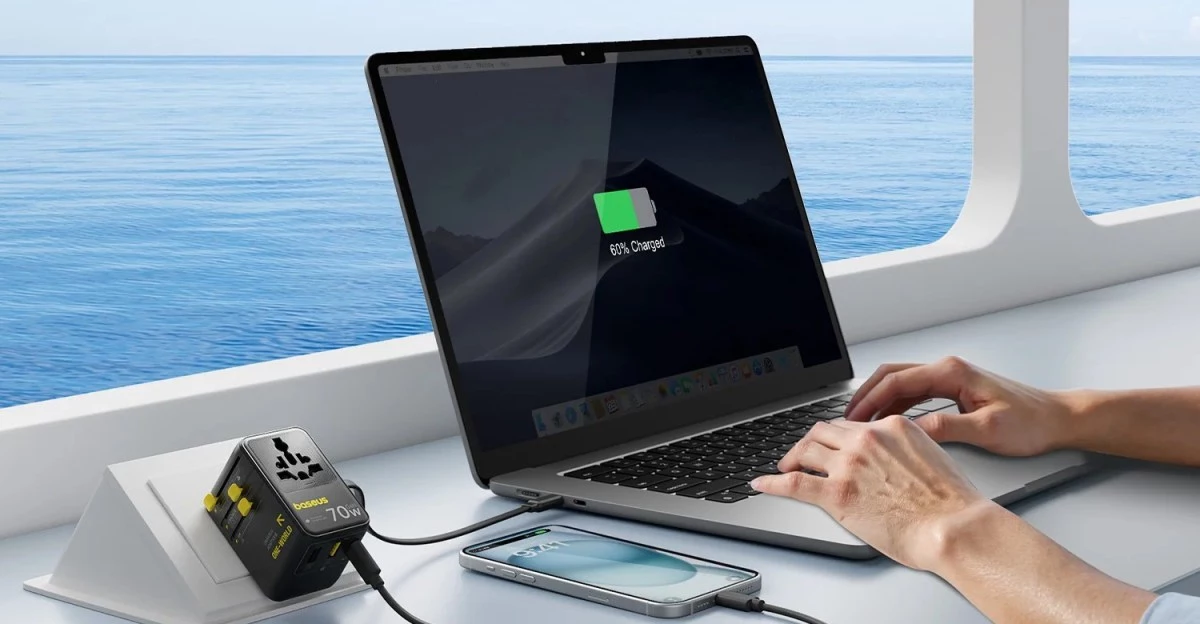

A compact travel adapter becomes a lens on modern power, mobility, and platform economics
Baseus’ EnerCore CG11 universal travel adapter arrives as a deceptively small product with outsized relevance to business travel, consumer electronics, and the increasingly standardized world of USB power. Positioned as a palm-sized, all-in-one charger for 200+ countries, the device integrates four retractable plug types (A, C, G, I) and consolidates charging into a single cube weighing roughly 0.5 lb—a form factor designed to replace the familiar tangle of region-specific adapters and separate wall chargers.
What makes the CG11 particularly newsworthy is not only its feature set, but its market posture: a lowest-ever price of $24.95 (down from $69.99) via Amazon promotion. In a category where differentiation is difficult and brand loyalty is fragile, the CG11’s launch moment underscores how travel accessories have become a battleground defined by power density, convenience engineering, and algorithm-driven e-commerce competition.
Key specifications shaping buyer expectations include:
- USB-C + USB-A outputs up to 60 W each, plus an additional 5 W USB-A port
- A built-in retractable USB-C cable (27 inches) delivering up to 70 W
- A design positioned as cruise-ship safe, but notably without built-in surge protection
That last detail—surge protection—may prove pivotal in how the product is perceived across different traveler segments and geographies.
Power density and the march toward USB-PD as the universal interface
The CG11’s ability to deliver 60–70 W in a compact cube points to the broader maturation of modern power electronics. While Baseus’ materials may not explicitly foreground component choices, this level of wattage in a small enclosure strongly suggests the use of high-efficiency architectures such as GaN (gallium nitride) or comparable advanced switching designs. The business implication is straightforward: as GaN-class efficiency becomes mainstream, high-wattage travel charging is shifting from “premium niche” to “expected baseline.”
Equally important is what the port configuration signals about standards consolidation. The CG11’s design leans into USB Power Delivery (USB-PD) as the de facto global charging language—one cable family increasingly expected to serve phones, tablets, handheld consoles, headphones, and even many laptops. For frequent travelers and digital nomads, the value proposition is less about novelty and more about reducing failure points: fewer bricks, fewer cables, fewer compatibility surprises.
The retractable cable is a subtle but meaningful user-experience move. Travel charging pain points are rarely about raw wattage alone; they’re about wear, tangling, and forgotten accessories. An integrated cable turns the adapter into a more “single-piece” tool—an approach that mirrors broader consumer demand for self-contained, ready-to-use mobility hardware.
Looking ahead, the product also hints at where the category could go next. As USB standards evolve, the market will likely pressure brands toward:
- Higher ceilings (100 W+) to reliably support laptops and multi-device loads
- Better alignment with USB4/Thunderbolt ecosystems, not for data in an adapter, but for the expectation of “one cable does everything”
- More robust safety and monitoring features as wattage rises and travelers plug into increasingly variable infrastructure
Price as strategy: Amazon dynamics, margin compression, and the safety trade-off
The CG11’s steep discount—roughly 65% off—is best read as a strategic maneuver rather than a simple promotion. In the Amazon travel accessory arena, winning visibility often depends on a tight loop of price competitiveness, review velocity, fulfillment performance, and Buy Box dynamics. Aggressive pricing can function as customer acquisition, review generation, and ranking acceleration all at once—particularly in a category where many products appear interchangeable at a glance.
This is the modern accessory market in microcosm: low margins, high velocity, and platform-mediated competition. Brands that can scale manufacturing efficiently and manage returns can treat pricing as a lever to buy attention—then attempt to retain customers through perceived quality, reliability, and ecosystem trust.
Yet the CG11 also illustrates a classic cost-versus-risk decision. The omission of surge protection reduces bill-of-materials cost and complexity, but it introduces a reputational vulnerability—especially for travelers moving through regions with unstable grid conditions or voltage irregularities. For individual consumers, the risk may be tolerable if they prioritize portability and price. For institutional buyers—such as enterprise travel programs, managed mobility providers, or hospitality partners—the absence of surge protection can become a procurement barrier, because it shifts risk onto the organization and the traveler’s device stack.
In practical terms, the CG11’s positioning may bifurcate demand:
- Value-driven consumers attracted by high wattage and deep discounting
- Risk-sensitive buyers who may prefer slightly bulkier solutions with surge protection and stronger safety signaling
Where travel tech, hospitality, and sustainability narratives intersect
The CG11’s most interesting implications may sit outside retail shelves. As business travel rebounds and “work from anywhere” becomes operational reality, charging reliability is no longer a convenience—it’s a productivity dependency. That creates whitespace for partnerships that turn a commodity adapter into a service touchpoint.
Potential channel and ecosystem plays include:
- Hotels, airlines, lounges, and loyalty programs offering co-branded adapters as premium amenities
- Coworking networks and remote-work memberships bundling standardized charging kits to reduce friction for mobile professionals
- Corporate travel departments standardizing approved accessories—provided safety features meet policy thresholds
There is also a credible sustainability angle. Consolidating multiple adapters into one device can reduce packaging, redundant chargers, and e-waste, aligning with ESG messaging that resonates with both consumers and corporate procurement. The next competitive frontier may be less about raw wattage and more about lifecycle credibility—such as take-back programs, refurbishment pathways, or modular replaceable components that extend product life.
At the same time, the broader macro backdrop remains relevant. Supply-chain normalization has improved availability, but geopolitical risk, tariffs, and component constraints still shape cost structures. Brands that diversify manufacturing footprints or dual-source critical components may be better positioned to sustain aggressive pricing without compromising quality.
The Baseus EnerCore CG11 ultimately captures a moment when USB-PD standardization, GaN-enabled miniaturization, and Amazon-driven pricing tactics converge—while reminding the market that safety features like surge protection are not mere checkboxes, but trust signals that can determine whether a travel essential becomes a mainstream staple or a situational bargain.

 By
By
 By
By

 By
By
 By
By










