


A palm-sized answer to the modern traveler’s power problem
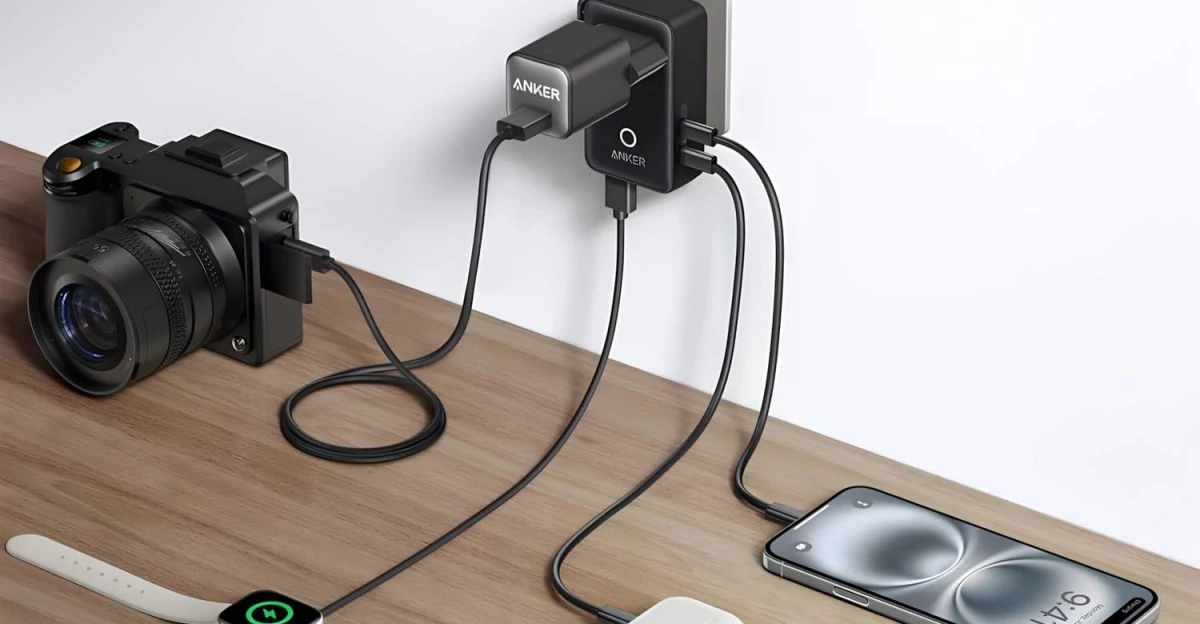
Anker’s Nano Travel Adapter arrives at a moment when international mobility is no longer a niche behavior reserved for frequent flyers—it is a baseline expectation for hybrid workers, digital nomads, and globally distributed teams. The product’s proposition is straightforward but timely: consolidate the messy reality of international plugs and multi-device charging into a 3.8-ounce, pocketable hub that can power up to five devices at once.
From a usability standpoint, the design targets a real friction point in travel: the growing number of devices that must be charged simultaneously—phone, laptop, earbuds, smartwatch, and sometimes a second phone or hotspot—often in hotel rooms or airports where outlets are scarce or inconveniently placed. By combining:
- Four prong configurations for broad international compatibility
- Two USB-C ports (up to 20W each)
- Two USB-A ports
- One AC socket
…the Nano positions itself less as a simple “plug adapter” and more as a compact travel power hub. That distinction matters, because the market has shifted from single-purpose adapters toward integrated charging stations that reduce carry weight and simplify packing.
One operational caveat is central to consumer safety and satisfaction: the Nano does not convert voltage. For travelers moving between 110–120V and 220–240V regions, that means the adapter is only as safe as the device plugged into it. Most modern electronics (laptop chargers, phone chargers) are dual-voltage, but high-heat appliances—hair tools, some grooming devices—can still be risky without a proper converter. In practice, this is a deliberate trade-off: Anker prioritizes portability, cost, and certification simplicity over full “universal conversion.”
Engineering signals: integration today, GaN-driven evolution tomorrow
Technologically, the Nano reflects the broader consumer electronics arc toward miniaturization and functional convergence. Packing five outputs into a sub-smartphone footprint requires careful internal layout, thermal management, and power-control logic—especially when multiple ports are used concurrently.
The inclusion of 20W USB-C Power Delivery is a meaningful baseline. It is sufficient for fast-charging most smartphones and accessories, and it supports a travel scenario where users top up multiple devices rather than fully power a high-draw laptop. While the materials provided do not explicitly confirm the use of gallium nitride (GaN), the market direction is clear: GaN and other high-efficiency architectures are increasingly the enabling layer behind smaller chargers with higher wattage and better thermals.
What the Nano’s configuration suggests—intentionally or not—is a product calibrated for mainstream travel charging, not the power-user segment. The next competitive frontier is likely to center on:
- Higher USB-C wattage tiers (30W, 45W, 65W and beyond) to support ultrabooks and tablets more reliably
- Smarter power allocation across ports to prevent throttling surprises when multiple devices are connected
- Potential modular designs that let users swap prong systems or add regional sleeves without increasing bulk
The “voltage conversion gap” remains the most notable engineering omission—and also a strategic opening. True conversion adds weight, heat, and cost, but it also unlocks a premium category for travelers who want one device that handles everything safely. That white space is available either to Anker in a future product tier or to competitors specializing in universal converters.
Pricing, promotions, and the rebound of travel-tech demand
At $19.99 (down from $25.99) across Amazon, Best Buy, and Anker’s own channel, the Nano is positioned at an impulse-friendly price point—particularly for travelers who realize they need an adapter shortly before departure. This is not just discounting; it is a signal of how the accessories market competes at scale, where brand trust, distribution reach, and manufacturing efficiency can sustain aggressive promotions without necessarily eroding profitability.
Several market dynamics converge here:
- Tourism and business travel rebound: As cross-border movement normalizes, the “forgotten essentials” category—adapters, cables, compact chargers—regains volume.
- Hybrid work persistence: Travel is increasingly blended with work, raising the importance of multi-device charging reliability.
- Supply chain stabilization: More predictable component pricing and logistics make it easier to hold aggressive retail pricing while maintaining margins.
Anker’s omnichannel distribution strategy is also telling. Selling through major marketplaces and big-box retail maximizes reach, while direct sales preserve the ability to collect first-party customer data, test bundles, and build retention through ecosystem accessories. In a mature category, that data advantage can matter as much as the product itself—especially when cross-selling power banks, cables, and higher-wattage chargers.
Strategic implications: ecosystem gravity, standards pressure, and the next wave of travel power
The Nano Travel Adapter fits neatly into Anker’s broader identity: a brand building an “everything-powered” portfolio where individual products reinforce each other. The ecosystem effect is subtle but real—users who already own Anker cables or power banks are more likely to trust an Anker travel adapter, and that trust compounds with every successful trip.
At the same time, the product highlights where the category is headed. The next generation of travel power solutions is likely to be shaped by three forces:
- Rising expectations for universal compatibility: Travelers increasingly want one device that works everywhere, safely, without caveats.
- Regulatory and standards evolution: The EU’s push toward USB-C standardization and broader safety certification requirements could reshape design priorities and port configurations over time.
- Sustainability pressure: Compact accessories are often treated as disposable; brands that introduce recycled materials, repairability, and take-back programs may gain an edge with both consumers and corporate travel buyers.
For now, Anker’s Nano Travel Adapter reads as a pragmatic product for a pragmatic era: lightweight, multi-port, and priced to move. Its success will likely hinge on whether travelers value convenient consolidation over “true universal” capability—and whether Anker chooses to climb the ladder into higher-wattage, smarter, and potentially voltage-converting designs as the travel-tech market continues to professionalize.

 By
By
 By
By
 By
By
 By
By
 By
By

 By
By
 By
By







