

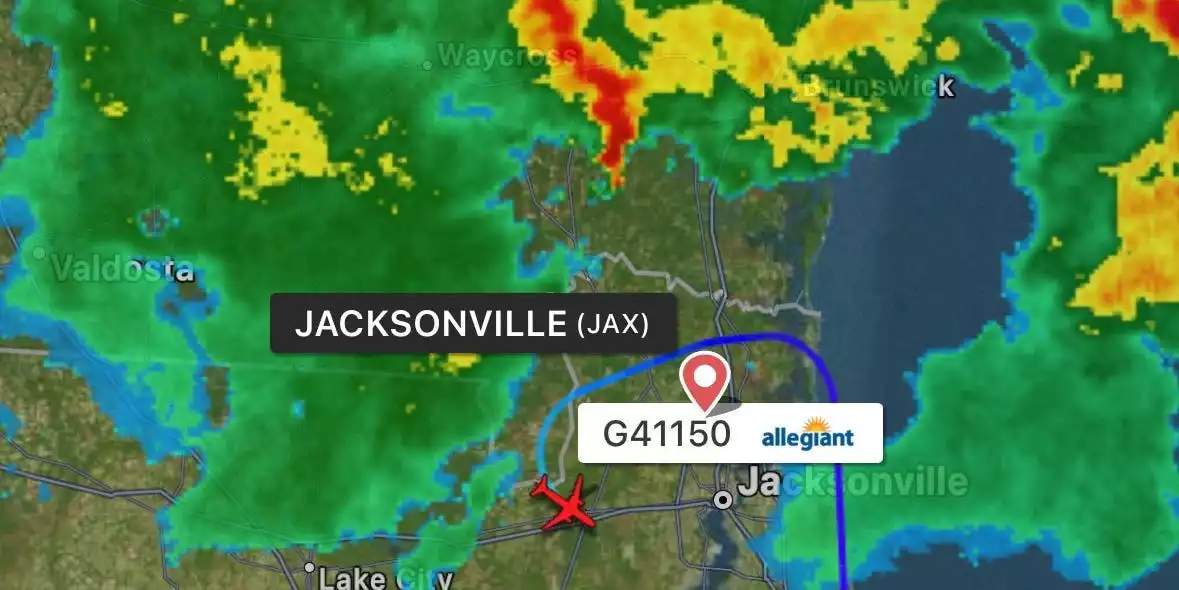

Storms in the Flight Path: Weather Disruptions as a Defining Challenge for Modern Aviation
When Allegiant Air Flight 1150, an aging Airbus A320 packed with 179 passengers, veered off its intended Melbourne–Pittsburgh course to land safely in Jacksonville, the event was more than a routine weather diversion. It was a microcosm of a swelling crisis: the collision of climate volatility, operational technology, and the unforgiving economics of ultra-low-cost carriers. As the southeastern skies dumped torrents of rain and radar screens flickered with storm cells, this flight’s emergency declaration became a data point in a broader narrative—one where the future of air travel is being rewritten by atmospheric unpredictability.
The Technology Paradox: Avionics Brilliance Meets Data Bottlenecks
Modern airliners are technological marvels, bristling with Doppler radar, predictive wind-shear sensors, and lightning-hardened flight controls. On Allegiant 1150, these systems performed flawlessly, allowing pilots to anticipate and evade the worst of the weather. Yet, the cockpit’s tactical awareness is still hemmed in by a stubborn constraint: the speed and fidelity of real-time weather data.
- Bandwidth Bottlenecks: Many narrow-body fleets, including those favored by budget carriers, rely on satellite data links that rarely exceed 200 kbps. This throttles the flow of up-to-the-minute meteorological intelligence, leaving flight crews to make high-stakes decisions with partial information.
- AI and Edge Analytics: The industry is on the cusp of a transformation. Machine learning models, trained on oceans of atmospheric and radar data, are beginning to forecast turbulence with unprecedented accuracy—sometimes predicting rough air minutes in advance. Embedding these “edge” analytics directly onto avionics servers promises a leap in real-time situational awareness, especially as the FAA’s System-Wide Information Management (SWIM) architecture edges closer to broad deployment.
The promise is clear: fewer diversions, smarter fuel use, and a new layer of digital resilience. But the gap between technical potential and operational reality remains stark, especially for carriers with legacy fleets and razor-thin margins.
The Economic Weather Front: Costs, Claims, and Capital
The financial calculus of a weather diversion is brutal in its simplicity. Each unplanned landing can cost an airline between $25,000 and $75,000—factoring in fuel, crew overtime, and passenger compensation. For ultra-low-cost carriers, whose business models hinge on relentless aircraft utilization and minimal slack, these disruptions can ripple through schedules for days.
- Insurance Pressures: The insurance market is feeling the strain, with turbulence-related claims up 40% year-over-year. Premiums for hull and liability coverage are climbing in tandem, further squeezing operational budgets.
- Investor Scrutiny: Climate-linked volatility is now a fixture in ESG risk models and credit ratings. Moody’s, for instance, has begun to explicitly score “weather-sensitivity” in its assessments, making the cost of capital more sensitive to operational resilience. For airlines that rely on ancillary revenue—the lifeblood of ULCCs—frequent diversions threaten not just immediate profits but also long-term customer satisfaction and brand equity.
Strategic Horizons: Building Climate-Resilient Flight Networks
The industry’s response is coalescing around a new competitive frontier: climate resilience. The Intergovernmental Panel on Climate Change projects a doubling or tripling of convective storm days across the U.S. Southeast by mid-century. Airlines that weave high-resolution climate analytics into their route planning, crew base placement, and fleet strategy will not only protect their on-time performance but also carve out a distinctive market position.
Key vectors of adaptation include:
- Operational Integration: Embedding turbulence-prediction APIs into Electronic Flight Bag workflows, and staffing operations centers with meteorologists and data scientists—a model that has already halved weather-related cancellations for some legacy carriers.
- Strategic Investment: Early participation in FAA SWIM data-sharing initiatives and upgrading fleet connectivity to enable real-time weather ingestion. The return on investment multiplies when these upgrades dovetail with passenger Wi-Fi monetization strategies.
- Portfolio Resilience: Stress-testing route networks against severe weather scenarios, repositioning assets, and favoring newer aircraft with extended range and routing flexibility.
As weather-driven diversions add measurable CO₂ overhead, eliminating avoidable reroutes becomes a critical lever in meeting Scope 1 emission targets—complementing sustainable aviation fuel strategies and next-generation aircraft orders.
The Allegiant 1150 diversion is not an outlier but a harbinger. In this era, weather volatility is no longer an episodic nuisance; it is a structural force reshaping the economics, technology, and strategic calculus of commercial aviation. Those who harness advanced meteorological intelligence and climate-adaptive design will not just weather the storm—they will define the new normal in the skies.

 By
By


 By
By


 By
By
 By
By







