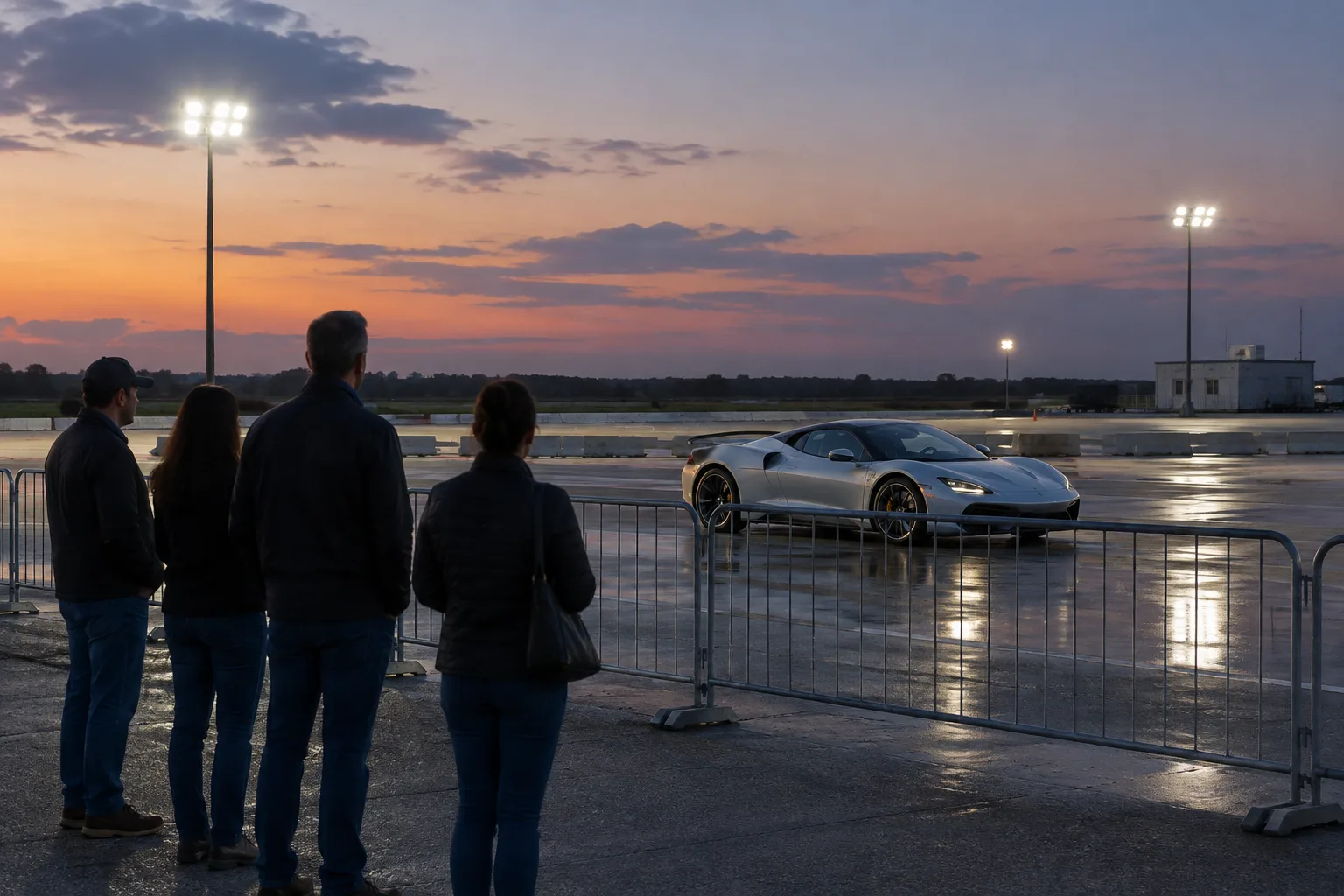

Tesla’s Oct. 15 Roadster reveal was engineered to do more than restart a long-delayed car program. At a SpaceX test site in Texas, Tesla showed a redesigned second-generation Roadster using a suction system to drive upside down on a ramp and cold-gas thrusters to rotate in the air and hop over other vehicles, according to Reuters. Tesla said consumer production would begin in 2028.
That makes this less a launch than a test of credibility. The question buyers, investors, insurers, and competitors need answered is not whether Tesla can stage an eye-catching engineering demonstration. It plainly can. The question is whether that demonstration can be turned into a certifiable, manufacturable, serviceable halo car that customers will actually receive.
What Tesla actually showed
The reveal presented the Roadster as three related products rather than one simple trim ladder: a Performance version, a Thrust version with acceleration thrusters, and an invite-only Rocket version with what Tesla described as a full flight system. That structure matters because the business and regulatory path for each version could be very different.
What has been demonstrated is real enough to take seriously. Tesla and SpaceX engineers publicly collaborated on a vehicle with active aerodynamics, fan-based suction, and cold-gas thrusters. This was not just a rendering or a concept reel. But it was demonstrated in a controlled facility, not in a public-road operating environment, and that difference is the center of the story.
The performance claims also need to be kept in their proper lanes. Tesla’s official Roadster page advertises a fully electric four-seat sports car with a 1.9-second 0-to-60 time, top speed above 250 mph, 620 miles of range, active aerodynamic elements, cold-gas thrusters, and a multifunction fan system. At the event, reporting reflected a more limited set of numbers: Tesla’s vehicle-engineering chief said the car could exceed 230 mph and travel more than 300 miles on a charge, while Tesla said zero to 60 mph would take less than one second.
Those figures should not be blended into a single neat spec sheet. They point to an unresolved production picture. Pressure vessels, fans, thrusters, cooling, safety hardware, and passenger load all affect weight, packaging, and range. Until Tesla publishes production specifications by variant, the Roadster’s headline numbers are better read as directional ambition than as a settled buyer’s guide.
The business today is deposits, not deliveries
The immediate commercial move is a reservation campaign. After the event, Tesla’s reservation page showed a $50,000 deposit for the Performance version and a $250,000 deposit for the Thrust version. Tesla did not announce a final price at the reveal, and the website says reservations do not guarantee delivery.
That fine print matters more here than it would for a routine refresh of a mass-market car. This is a program with a long memory. Musk first showed the second-generation Roadster in 2017 and originally indicated deliveries could begin in 2020. The new target is 2028. That does not prove Tesla will miss the date again, but it changes the burden of proof. A decade between concept reveal and planned production is not normal for an automotive product intended to feel imminent.
It also changes who the likely customer is. The Roadster looks positioned as an expensive, low-volume halo car rather than a revenue engine. Reuters noted that its financial importance is likely to be small relative to Tesla’s core business, while analysts cited by Reuters split between viewing it as an engineering flex with limited commercial value and as a legitimate halo product. Both readings fit the available facts: the demonstration was technically impressive, but Tesla has not yet shown the manufacturing evidence that would make the business case broader than brand theater.
That brand role is still meaningful. Tesla’s first Roadster helped establish the company’s EV-performance identity in 2008. In 2026, Tesla is increasingly directing strategic attention toward self-driving technology and robotics, including the Cybercab, with third-quarter results due on Oct. 21. In that context, a dramatic manually driven Roadster can serve as a bridge between Tesla’s sports-car heritage and its AI-and-robotics narrative. The bridge only holds if the product reaches customers in a form that is recognizable from the reveal.
Where the real risk now sits
The gap between a spectacular test-site demonstration and a commercially credible car program is operational, not cinematic.
For the road-going version, buyers still need to know whether the suction system is part of the standard road-legal package, what its maintenance demands look like, and how it affects range, tire wear, and reliability. For the thruster-equipped variants, the harder questions multiply: how compressed-gas tanks are packaged, what crash standards apply, how refill and inspection procedures work, who services the system, what insurers will do with it, and whether any public-road use is allowed at all.
AP reported that road approval, state rules, price, delivery timing, and the legal status of the flight-like features remain unresolved, and that the demonstrated vehicle was not safety-optimized. That points toward an outcome in which the three Roadsters may end up being materially different products: a road-oriented performance car, a track-oriented thrust model, and a tightly limited or invite-only demonstrator.
That would not make the reveal a failure. It would make it more honest to classify the Roadster as a specialty product family with escalating restrictions and costs. But Tesla has not yet published the evidence buyers would normally want before treating deposits as a step toward delivery: final pricing, a binding production schedule, detailed refund terms, range testing that accounts for the full hardware stack, a certification path for the suction and thruster systems, or clarity on production capacity.
For now, the Roadster is best understood as a live engineering demonstration attached to a reservation funnel. The next stage is much less glamorous: production design, crash and pressure-vessel safety work, testing, certification, insurance, service procedures, and proof that Tesla can build what it showed on something closer to schedule. If that evidence arrives, the Roadster could become a defensible halo car with genuine brand value. If it does not, the reveal will stand mostly as a reminder that in the car business, spectacle is the easy part and delivery is the product.

 By
By
 By
By
 By
By
 By
By

 By
By
 By
By