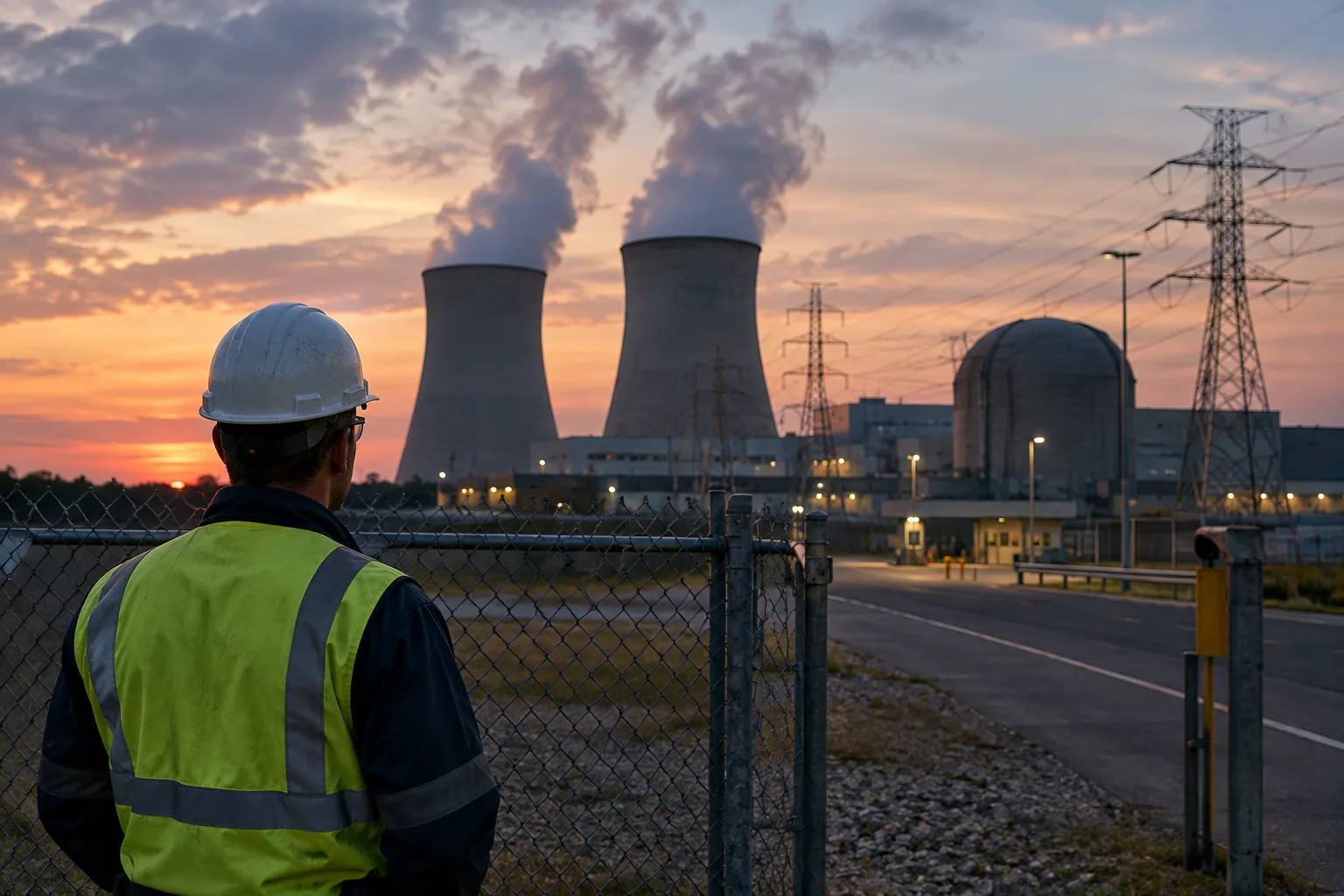

The U.S. is trying to bring three shuttered nuclear plants back into service, with as much as $4.4 billion in federal lending tied to projects in Michigan, Pennsylvania, and Iowa. Together, the plants could return about 2.25 gigawatts of generation to the grid—roughly enough to power two million homes and businesses under the comparison used by The Associated Press. What makes this more than a utility story is who needs the power: the restart plans are increasingly linked to data-center demand from the AI and cloud buildout.
That shifts the practical question for business readers. This is not simply whether nuclear energy is low-carbon or whether old plants can be revived. It is whether hyperscaler contracts and federal loans can turn retired reactors into a repeatable source of firm power faster than building new plants—or whether they mainly move schedule, safety, and cost risk around before the projects have proved they can run again.
Why old reactors are back in the power conversation
The attraction is easy to see. A previously operating nuclear site already has a grid connection, a known location, and in some cases a remaining operating license or a path to one. For utilities, plant owners, and large power buyers, that can look faster than starting a major new reactor project from scratch. For hyperscalers planning AI and cloud campuses, the appeal is steady electricity that does not depend on weather.
That logic is now showing up in the financing structure. At Duane Arnold in Iowa, the Department of Energy says a Title 17 loan of up to $1.9 billion closed in September 2026 for NextEra Energy’s restart effort. NextEra and Google are collaborating on a plan to return the 615-megawatt plant to service by early 2029. At the Crane Clean Energy Center—the former Three Mile Island Unit 1 facility in Pennsylvania—Microsoft has agreed to buy power from the planned restart. And at Palisades in Michigan, a $1.5 billion restart loan approved in 2024 continued under the Trump administration.
For the DOE, these are part of a broader nuclear push, outlined in its nuclear energy fact sheet. For the tech sector, they point to a different reality: energy procurement is becoming a competitive input for AI infrastructure, not just a back-office utility matter.
Three projects, three different levels of readiness
The three plants are often grouped together because the federal support is large and the combined capacity is meaningful. But they are not at the same stage.
Palisades is the most advanced—and also a reminder that “advanced” is not the same as finished. The 800-megawatt plant operated from 1971 until 2022. Holtec bought it after its prior owner exited the wholesale market. Its operating license lasted until 2031, giving it a clearer legal foundation than a project starting from zero. But AP reported that the plant’s fuel-loading process was paused after a fuel assembly tilted, prompting a Holtec investigation. That does not prove the restart will fail, but it does show how quickly an “existing” plant can run into engineering and schedule friction. Palisades’ power-purchase agreements require service by March 2027.
Crane sits in the middle: a high-profile site, a committed corporate customer, and DOE support for an 835-megawatt restart, but still a project that must convert planning and contract momentum into operating output. The site matters symbolically because of its location at Three Mile Island, though the current project is the former Unit 1 facility, distinct from the 1979 accident at Unit 2. The business case may be stronger with Microsoft attached, yet the existence of a buyer does not eliminate refurbishment or regulatory risk.
Duane Arnold may be the clearest test of whether the model can scale beyond a uniquely favorable asset. The plant stopped operating in 2020 and was once expected to save customers money by closing. It can supply power equivalent to nearly 500,000 homes, according to the DOE’s project page, but it still needs Nuclear Regulatory Commission licensing approvals before it can return to service. The NRC says the site must restore its licensing basis, return components to a safe operating condition, and complete inspections and upgrades. In other words, the federal loan and the Google relationship help fund the effort; they do not shorten the list of work the plant must clear.
The key business issue is not demand. It is risk allocation.
There is little mystery about why these restarts are being attempted now. U.S. electricity demand is rising, and large data centers want dependable power in large blocks. Nuclear plants can, in principle, provide firm low-carbon capacity that fits that need better than intermittent supply alone.
The harder question is who pays when the theory meets project reality.
Federal loans reduce financing pressure, but they do not answer the all-in cost of each restart. Public materials do not yet offer one comparable figure covering refurbishment, licensing work, fuel, workforce, transmission needs, contingency, and outage planning across all three plants. They also do not fully show how much of each plant’s output is spoken for by data centers versus the broader grid, or how contracts divide delay risk, outage risk, and price exposure.
That matters to several groups at once. For hyperscalers, the operational question is whether a plant can meet a campus load date and what happens if it cannot. For utilities and industrial customers, the concern is whether scarce firm power is effectively reserved for the biggest buyer. For ratepayers and regulators, the issue is whether public support and utility arrangements protect other customers from stranded costs if a project underperforms. For investors and suppliers, it is whether these are one-off rescues of unusually viable plants or the start of a financeable restart playbook.
The counterarguments are real. Older plants may need substantial safety work, especially as extreme-weather risks intensify. Duane Arnold shut after a 2020 derecho. Palisades has already hit a fuel-loading problem. Earlier economic losses at Palisades, Crane, and Duane Arnold are a reminder that these were not thriving merchant assets when they closed.
Still, the case for trying is not trivial. A restarted plant, if it clears licensing and refurbishment, could add large, steady generation faster than a new large reactor and without waiting for an entirely new site to be developed. That is why data-center operators are paying attention.
What will make these projects important beyond their own megawatts is not the loans or the headlines. It will be whether owners can show a workable sequence of approvals, repairs, staffing, fuel supply, and contract performance without pushing hidden costs onto the public. If that happens, AI infrastructure may help finance a new class of nuclear restart. If it does not, these three plants will look less like a template and more like a politically useful exception.
 By
By
 By
By
 By
By


 By
By

 By
By

 By
By